Author: Pawan Panwar

  • Ethical Hacker vs Penetration Tester: What’s the Difference?

    Ethical Hacker vs Penetration Tester: What’s the Difference?

    Ethical Hacker vs Penetration Tester: What’s the Difference?

    Do you know the difference between an Ethical Hacker vs Penetration Tester? If not, then you will be able to know about that here. We will talk about how different they are from each other and how you could choose if you want to become an ethical hacker or a dignified pentester.

    In the end, we will tell you how you can start your career as one of them or both with the help of a reputed training institute. What are we waiting for? Let’s get straight to the topic!

    Who Is an Ethical Hacker? Definition and Role Explained

    Learn about Who Is an Ethical Hacker Definition and Role Explained

    A cybersecurity expert who legally and morally looks for weaknesses in computer networks, applications, and systems is known as an ethical hacker. With the owner’s express consent, they employ the same instruments and methods as malevolent hackers to find and address security vulnerabilities.

    Improving an organization’s security posture and averting real cyberattacks is its ultimate objective. Let’s talk about “Ethical Hacker vs Penetration Tester” more deeply!

    What Does a Penetration Tester Do? Key Responsibilities?

    Penetration testers do the following tasks:

    1. Plans and Scopes Engagements: Before any testing is done, the customer is consulted to establish the goals, parameters, and guidelines of the engagement.
    2. Conducts Reconnaissance: Uses active scanning, open-source intelligence (OSINT), and other techniques to learn more about the target system or network to find any potential vulnerabilities.
    3. Identifies Vulnerabilities: Finds security flaws in systems, networks, apps, and cloud environments using both automated technologies and manual methods.
    4. Exploits Vulnerabilities: Attempts to imitate real-world assaults by ethically taking advantage of vulnerabilities found to show their impact and obtain unauthorized access.
    5. Performs Post-Exploitation: After gaining access, they evaluate the possible harm, search for methods to increase privileges, and investigate further compromises.
    6. Document Findings: In a concise, comprehensive report, all vulnerabilities found are documented, along with the impact, proof of concept, and techniques utilized to exploit them.
    7. Provides Recommendations: Provides the client with useful and doable suggestions on how to fix the found security vulnerabilities and enhance their overall security posture.
    8. Presents Findings to Stakeholders: Informs the client organization’s technical and non-technical audiences of the technical results and their business consequences.

    Core Differences Between Ethical Hackers and Penetration Testers

    S.No. Topics Factors What?
    1. Ethical Hackers Broader Scope Beyond testing, ethical hacking encompasses a wide range of security-related tasks, such as vulnerability analysis, security research, and security awareness training.
    Penetration Testers Specific Engagement A highly targeted, time-bound activity with a well-defined scope is penetration testing (e.g., testing a specific online application or a segment of the network).
    2. Ethical Hackers Continuous & Proactive To continuously identify and address vulnerabilities throughout an organization’s whole digital footprint, it frequently entails proactive, continuous security operations.
    Penetration Testers Methodical & Goal-Oriented Focuses on identifying exploitable vulnerabilities by using a systematic approach that includes reconnaissance, scanning, exploitation, post-exploitation, and reporting.
    3. Ethical Hackers Mindset/ Philosophy Represents a way of thinking about using hacking abilities for good, frequently looking for innovative ways to breach security to better understand and fortify it.
    Penetration Testers Simulates Real Attacks Their main purpose is to mimic actual cyberattacks to find exploitable vulnerabilities in a controlled and lawful way.
    4. Ethical Hackers May Include Policy/ Training May assist in creating security policies, teaching security awareness, and guiding general security posture.
    Penetration Testers Deliverable-Driven Leads to the main deliverable, a written report that describes vulnerabilities, their effects, and repair suggestions.
    5. Ethical Hackers Less Formalized Targets Although they always function lawfully, their “targets” may be more abstract (such as “secure our next product feature”) as opposed to a single test’s stated, constrained scope of systems.
    Penetration Testers Tactical Focus More concerned with the technological implementation of system intrusion and the detection of urgent security flaws.

    Types of Tests Conducted by Each Role

    The following are the types of tests conducted by each role:

    1. Ethical Hackers:

    1. Red Teaming: These are thorough, objective-based exercises that evaluate an organization’s detection and response skills by simulating real-world attacks with little to no prior knowledge.
    2. Security Research & Tool Development: Frequently entails investigating novel vulnerabilities, building unique exploits, and producing instruments to support security evaluations.

    2. Penetration Testers:

    1. Web Application Penetration Testing: Focused online application testing to identify security flaws such as SQL injection, XSS, and compromised authentication.
    2. Network Penetration Testing (Internal & External): Evaluates the security of servers, firewalls, routers, and other network equipment from both the inside and the outside.

    Which Role Is Right for You? Choosing Based on Your Goals?

    Your professional goals will determine whether you choose to become an ethical hacker or a penetration tester. If you want a broad, ongoing role that focuses on overall security improvement, including research and proactive protection, ethical hacking may be the way to go.

    Penetration testing might be more appropriate for you if you want organized, project-based work that focuses on locating and taking advantage of particular technical flaws within predetermined parameters to offer workable fixes.

    summer training program in cyber security at craw Security

    Goals and Objectives: Offensive Security Roles Compared

    The following are the goals and objectives related to both parties:

    Ethical Hackers:

    1. Overall Security Posture Improvement: Their main objective is to improve an organization’s overall security posture by consistently detecting and addressing vulnerabilities of all kinds, ranging from human error to technical defects.
    2. Proactive Threat Simulation & Education: To assist firms in better understanding their vulnerabilities, training employees, and enhancing their detection and response skills, they proactively simulate a variety of real-world threats.

    Penetration Testers:

    1. Identify Exploitable Vulnerabilities in Scope: Finding specific, exploitable vulnerabilities within a well-defined scope (such as a certain application or network segment) and demonstrating their impact is their primary goal.
    2. Provide Actionable Remediation Reports: To help the customer comprehend the risks and carry out efficient remediation measures to address the found security vulnerabilities, they strive to provide thorough, actionable findings.

    Tools Used: Ethical Hacker vs. Penetration Tester

    S.No. Topics Tools What?
    1. Ethical Hackers Kali Linux/ Parrot OS These are whole operating systems that come pre-installed with a wide range of security and hacking tools, offering a complete environment for different kinds of ethical hacking jobs.
    Penetration Testers Metasploit Framework A crucial tool for penetration testers, it provides a large collection of payloads, modules, and exploits to mimic actual assaults and obtain access.
    2. Ethical Hackers OSINT Tools (e.g., Maltego, Shodan) Used for open-source intelligence collection, which often has a wider reach than a pen test’s designated system and gathers information about targets from publicly accessible sources.
    Penetration Testers Burp Suite Professional/ OWASP ZAP Crucial for online application penetration testing, it enables the examination, alteration, and interception of HTTP traffic to identify vulnerabilities such as SQL injection and XSS.
    3. Ethical Hackers Vulnerability Scanners (e.g., Nessus, OpenVAS) Used to perform comprehensive network and system vulnerability assessments, finding any flaws that might not be immediately exploitable but yet pose a security risk.
    Penetration Testers Nmap (Network Mapper) Essential for first access, widely used for network reconnaissance, port scanning, service identification, and network topology mapping.
    4. Ethical Hackers Social Engineering Toolkits (e.g., SET – Social-Engineer Toolkit) Used frequently as part of larger ethical hacking operations to mimic social engineering attacks that target human vulnerabilities, such as phishing.
    Penetration Testers SQLMap A specialized tool that automatically finds and takes advantage of SQL injection vulnerabilities in web applications to access databases.
    5. Ethical Hackers Forensics Tools (e.g., Wireshark, Autopsy) Although they are also utilized in network analysis pen testing, ethical hackers may employ these more generally for incident response comprehension and digital forensics.
    Penetration Testers John the Ripper/ Hashcat With the goal of cracking credentials and elevating access, password-cracking tools are used to test the strength of hashes that have been found.

    Salary Comparison: Ethical Hacker vs. Pen Tester in 2025

    Salary Comparison Ethical Hacker vs. Pen Tester in 2025

    In India, ethical hackers can anticipate earning between ₹30,000 and ₹1,00,000 per month by 2025. The typical yearly compensation for a penetration tester in India is about ₹6,00,000, or roughly ₹50,000 per month.

    Career Opportunities and Job Titles: How They Differ

    S.No. Topics Job Profiles What?
    1. Ethical Hackers Security Analyst Ethical hacking abilities are used in this wide-ranging position to monitor systems, identify threats, conduct vulnerability assessments, and assist with the implementation of security procedures.
    Penetration Testers Penetration Tester (Junior/ Mid/ Senior) Planning, carrying out, and reporting on simulated cyberattacks against certain systems, networks, or applications is the primary responsibility of the core job.
    2. Ethical Hackers Security Engineer Creates, constructs, and manages safe networks and systems. Understanding ethical hacking is essential to protecting systems against actual attacks.
    Penetration Testers Web Application Penetration Tester Focuses on identifying and taking advantage of weaknesses in web apps, APIs, and related infrastructure.
    3. Ethical Hackers Security Consultant Gives companies advice on their overall security posture by carrying out evaluations and suggesting fixes based on a thorough knowledge of ethical hacking techniques.
    Penetration Testers Mobile Application Penetration Tester Focuses on evaluating the security of backend components and mobile applications (iOS, Android).
    4. Ethical Hackers Vulnerability Analyst/ Vulnerability Management Specialist Focuses on finding, evaluating, and ranking vulnerabilities in all of an organization’s assets, frequently with the aid of ethical hacking tools and techniques.
    Penetration Testers Network Penetration Tester Focuses on detecting vulnerabilities in switches, routers, firewalls, and other network equipment.
    5. Ethical Hackers Red Team Engineer A very specialized position that tests an organization’s detection and response capabilities by simulating complex, multi-layered attacks (sometimes with little prior information about the target’s defenses), exhibiting a real “adversary mindset.”
    Penetration Testers Cloud Penetration Tester Focuses on evaluating cloud environment security (AWS, Azure, GCP), including cloud-native application defects, IAM vulnerabilities, and misconfigurations.

    Conclusion

    Now that we have talked about “Ethical Hacker vs Penetration Tester,” you should know about how you can learn such skills professionally. For that, you can get in contact with Craw Security, offering a dedicated training & certification program, “Ethical Hacking Training Course with AI in Delhi,” to IT Aspirants.

    During the training sessions, students will be able to try their skills on live machines via the virtual labs introduced on the premises of Craw Security. With that, online sessions will facilitate students’ remote learning.

    After the completion of the Ethical Hacking Training Course with AI in Delhi offered by Craw Security, students will receive a dedicated certificate validating their honed knowledge & skills during the sessions. What are you waiting for? Contact, Now!

    Frequently Asked Questions

    About Ethical Hacker vs Penetration Tester: What’s the Difference?

    1. What is the main difference between an ethical hacker and a penetration tester?

    A penetration tester does a more focused, time-bound evaluation to find vulnerabilities within a specified scope, whereas an ethical hacker is a general phrase for someone who utilizes hacking techniques to improve security.

    2. Do ethical hackers and penetration testers use the same tools?

    Yes, a number of the same tools, including Nmap, Metasploit, Burp Suite, Wireshark, and other tools for cracking passwords and scanning for vulnerabilities, are frequently used by both ethical hackers and penetration testers.

    3. Is penetration testing a part of ethical hacking?

    Yes, penetration testing is seen as a particular, targeted aspect of ethical hacking.

    4. Which role is better for beginners in cybersecurity?

    Positions that provide basic knowledge and practical experience, such as Security Operations Center (SOC) Analyst or cybersecurity-focused IT Support, are typically better entry points for newcomers to the field than direct penetration testing or ethical hacking.

    Despite the existence of “junior penetration tester” positions, employers frequently favor applicants with some prior security or IT expertise.

    5. What certifications are required for ethical hackers and pen testers?

    The following are some of the certifications required for ethical hackers and pentesters:

    1. Certified Ethical Hacker (CEH) by EC-Council,
    2. CompTIA Security+,
    3. Offensive Security Certified Professional (OSCP) by Offensive Security, and
    4. CompTIA PenTest+.

    6. Who earns more: ethical hackers or penetration testers?

    Because of the specialized, highly technical, and concentrated nature of their work, penetration testers typically make a little more than ethical hackers, although they frequently have identical skill sets and overlapping areas.

    7. Are ethical hackers always employed by companies?

    No, ethical hackers are not always hired by businesses; they can also work for government organizations, as independent consultants, or as freelancers for bug bounty programs.

    8. Can one person be both an ethical hacker and a penetration tester?

    Given that penetration testing is a fundamental technique employed in the larger field of ethical hacking, it is completely possible for one individual to be both an ethical hacker and a penetration tester.

    9. How do job responsibilities differ between the two roles?

    With a wider focus on overall corporate security, an ethical hacker finds and fixes vulnerabilities in a variety of systems, frequently offers suggestions for long-term security, and trains teams.

    The focus of a penetration tester, on the other hand, is more limited and time-bound. They simulate particular cyberattacks on designated systems or applications to identify exploitable vulnerabilities and provide comprehensive reports on those particular findings.

    10. Which career path has more demand in 2025?

    The following are some of the career paths that are more in demand in 2025:

    1. Overall Cybersecurity Demand,
    2. Specialization in Penetration Testing,
    3. Regulatory Compliance,
    4. Emerging Technologies, and
    5. Focus on Proactive Defense.

  • Best Cloud Hacking Techniques Used by Ethical Hackers

    Best Cloud Hacking Techniques Used by Ethical Hackers

    Best Cloud Hacking Techniques Used by Ethical Hackers

    Do you know why cloud security is necessary? If not, then you are at the right place. Here, we will talk about the Best Cloud Hacking Techniques Used by Ethical Hackers to protect cloud platforms from online threats that could cause monetary loss and data breaches.

    In the end, we will introduce you to a dedicated training institute offering a dedicated training & certification program related to cloud security skills. What are we waiting for? Let’s get straight to the topic!

    What Is Cloud Hacking?

    Information about What Is Cloud Hacking?

    Unauthorized access and exploitation of cloud-based systems, apps, and data is known as “cloud hacking.” It entails compromising cloud resources by taking advantage of flaws in the infrastructure, incorrect setups, lax access rules, or human mistakes.

    Cloud hackers may aim to disrupt services or launch more attacks, or they may steal data and profit. Let’s take a look at some of the Best Cloud Hacking Techniques Used by Ethical Hackers!

    A Quick Overview for Ethical Hackers

    “White hat” or ethical hackers employ their technical expertise to proactively find and address security flaws in networks, apps, and systems. In contrast to malevolent hackers, they work with express authorization and follow a rigorous code of ethics to bolster an organization’s defenses.

    Through stages including reconnaissance, scanning, getting access, retaining access, and reporting, they simulate actual attacks to offer practical suggestions for enhancing cybersecurity posture.

    Benefits of Cloud Security for Organizations

    S.No. Benefits How?
    1. Enhanced Data Protection To protect sensitive data, cloud security provides strong protections, including encryption, access limits, and data loss prevention.
    2. Cost-Effectiveness It lessens the need for significant up-front expenditures on software and infrastructure, frequently transferring security costs to an ongoing expense model.
    3. Scalability and Flexibility To adapt to shifting business requirements and safeguard dynamic cloud environments, cloud security solutions may be readily scaled up or down.
    4. Disaster Recovery and Business Continuity Strong disaster recovery procedures are built into cloud platforms by default, guaranteeing that business operations can promptly resume following an incident.
    5. Centralized Security Management A single platform for controlling security configurations, policies, and monitoring throughout a whole cloud architecture is offered by cloud security products.
    6. Advanced Threat Detection and Response To counter new attacks, cloud providers give advanced AI-driven threat intelligence, anomaly detection, and automated response capabilities.
    7. Regulatory Compliance Cloud security solutions frequently include integrated features and certifications that assist businesses in fulfilling a range of national and international regulatory obligations.
    8. Real-time Security Updates and Expertise Cloud providers relieve enterprises of this burden by offering specialized security expertise and regularly updating their security procedures.

    Why Cloud Environments Are a Prime Target for Hackers?

    Infor about Why Cloud Environments Are a Prime Target for Hackers

    Cloud environments are a prime target for hackers for the following reasons:

    1. Vast Amounts of Sensitive Data: Large amounts of valuable data are consolidated in cloud settings, which makes them appealing targets for data theft.
    2. Misconfigurations and Human Error: Easily exploitable security flaws are frequently caused by improperly configured cloud services or human error during setup.
    3. Shared Responsibility Model Complexities: Vulnerabilities may go unnoticed if the customer and cloud provider don’t understand how security duties are divided.
    4. Insecure APIs: Application Programming Interface (API) flaws or misuse can give attackers direct access points.
    5. Credential Theft and Weak Access Management: Hackers can pose as authorized users and obtain unauthorized access thanks to compromised user credentials and insufficient access controls.
    6. Increased Attack Surface: Because cloud services are open and networked, there are more possible points of entry for attackers.
    7. Lack of Visibility: It could be difficult for businesses to have a thorough understanding of their cloud infrastructure and identify questionable activity.
    8. Advanced Persistent Threats (APTs): Cloud vulnerabilities can be used by skilled and persistent attackers for long-term, covert data exfiltration and penetration.

    Reconnaissance in the Cloud: How Ethical Hackers Gather Intel

    S.No. Factors How?
    1. Open-Source Intelligence (OSINT) To obtain early hints about an organization’s cloud footprint, ethical hackers use publicly accessible data from news stories, company websites, social media, and public repositories (such as GitHub).
    2. DNS Enumeration To find subdomains, related IP addresses, and maybe cloud service providers or particular cloud resources, they query DNS records.
    3. Passive Scanning/ Shodan Searches Without speaking to the target directly, tools like Shodan are used to passively look for cloud instances that are accessible over the internet, improperly configured services, and open ports.
    4. Cloud Service-Specific Enumeration They list buckets, virtual machines, functions, and other available resources using tools and methods designed for certain cloud providers (such as AWS, Azure, and GCP).
    5. Metadata and Configuration Analysis To uncover sensitive data, user passwords, or cloud environment misconfigurations, ethical hackers search for exposed metadata, configuration files, and public resource policies.

    Misconfigured Cloud Storage Buckets: A Goldmine for Hackers

    Learn about Misconfigured Cloud Storage Buckets

    Because misconfigured cloud storage buckets, like Google Cloud Storage or Amazon S3 buckets, frequently expose private information to the public internet, they are, in fact, a top target for hackers.

    This frequently happens as a result of human error, where access controls are configured too loosely or default permissions are not adequately guarded. Using straightforward search terms or automated tools, hackers can then quickly find these publicly available buckets, which could result in data breaches, data tampering, or even the removal of important data.

    Credential Harvesting and Privilege Escalation in Cloud Platforms

    Credential Harvesting and Privilege Escalation in Cloud Platforms

    In cloud platforms, credential harvesting is the practice of hackers using a variety of dishonest techniques, such as phishing campaigns, malware, or taking advantage of setup errors, to obtain user login information (passwords, access keys, etc.).

    Privilege escalation is the process by which attackers use flaws or configurations in the cloud environment to achieve higher levels of access and control after obtaining initial, frequently low-level credentials.

    This involves going from a basic user to an administrator or root user, thereby granting them “keys to the kingdom.” This enables them to alter vital resources, obtain private information, or send even more nefarious payloads.

    Exploiting IAM (Identity and Access Management) Weaknesses

    Taking advantage of holes in cloud systems’ authentication and authorization processes for users and resources is known as exploiting IAM (Identity and Access Management) vulnerabilities.

    This frequently entails taking advantage of configuration errors that allow more access than intended, compromising weak credentials, or abusing overly permissive rules. Privilege escalation, illegal access to private information and systems, and eventually a complete penetration of the cloud environment are all possible outcomes of successful exploitation.

    summer training program in cyber security at craw Security

    Abusing Serverless Functions and APIs for Unauthorized Access

    Abusing serverless functions and APIs for illegal access entails taking advantage of flaws in their implementation or design. Attackers may use insecure API endpoints to get around authentication and access private information, alter input to cause unwanted code execution (injection), or take advantage of roles that are too permissive for functions to obtain more rights.

    Data breaches, resource depletion (costing the victim money), or even total control over certain cloud infrastructure components might result from this.

    Cross-Site Scripting (XSS) and Injection Attacks in Cloud Web Apps

    Info about Cross-Site Scripting (XSS) and Injection Attacks in Cloud Web Apps

    In cloud web applications, Cross-Site Scripting (XSS) is the practice of inserting malicious client-side scripts into user-viewed legitimate web pages. These scripts have the potential to compromise user trust and data by stealing session cookies, defacing websites, or rerouting users to malicious websites.

    More generally, injection attacks happen when a hacker inserts malicious code or commands into data inputs (such as SQL queries or OS commands). This can result in system manipulation, unauthorized data access, or even complete database and cloud resource penetration.

    How to Defend Against These Cloud Hacking Techniques?

    S.No. Factors Why?
    1. Strong Identity and Access Management (IAM) Use multi-factor authentication (MFA), the least privilege principle, and periodically check the rights of service accounts and users.
    2. Secure Configurations and Continuous Monitoring Use automated tools to find misconfigurations, audit configurations often, and follow cloud security best practices for all services.
    3. Data Encryption Securely handle encryption keys and use robust encryption techniques to encrypt data both in transit and at rest.
    4. Input Validation and Secure Coding Practices Create applications that adhere to secure coding standards and have strong input validation to thwart injection attempts.
    5. Network Segmentation To reduce an attack’s blast radius, isolate cloud resources and apps using virtual private clouds (VPCs), subnets, and security groups.
    6. Regular Vulnerability Management and Patching Apply fixes and upgrades as soon as possible after conducting a continuous scan for vulnerabilities in infrastructure and apps.
    7. Comprehensive Logging and Monitoring Use security information and event management (SIEM) solutions to keep an eye out for questionable activity in real time, and enable thorough logging across all cloud services.
    8. Robust Incident Response Plan To promptly identify, contain, eliminate, and recover from security issues, create and test a clear incident response plan on a regular basis.

    Top Tools Ethical Hackers Use for Cloud Penetration Testing

    Best Ethical Hacking Training i

    The following are some of the tools ethical hackers use for cloud penetration testing:

    • Pacu: An open-source exploitation framework that simulates several types of attacks and is especially made for offensive security testing against AWS cloud systems.
    • ScoutSuite: AWS, Azure, and GCP environments are scanned for security threats and misconfigurations by this multi-cloud security auditing tool, which produces thorough findings without changing any resources.
    • Prowler: An all-inclusive open-source tool for AWS security testing that assists in locating weaknesses in S3 buckets, security groups, and IAM roles, among other AWS configurations.
    • Nmap (Network Mapper): A traditional and flexible open-source program for port scanning, network discovery, and locating cloud-based system services.
    • Burp Suite Professional: A well-known commercial web application security testing tool that is essential for finding flaws in cloud-hosted web apps and APIs, like SQL injection and XSS.
    • OWASP ZAP (Zed Attack Proxy): A popular free and open-source substitute for Burp Suite that checks web apps, especially cloud-based ones, for common security flaws.
    • Metasploit Framework: An effective open-source exploitation tool for testing existing vulnerabilities and creating unique attacks that may be modified for cloud environments.
    • CloudSploit: AWS setups are continuously monitored for errors and compliance threats using an automated security scanner.
    • Azucar: A tool made especially for auditing Azure setups that gathers pertinent information about the platform automatically to find security flaws.
    • PowerZure: An Azure environment observation and testing tool that runs on PowerShell and helps identify setup errors and possible attack points.

    Job Profiles Related to Cloud Security?

    S.No. Job Profiles What?
    1. Cloud Security Engineer Ensures compliance and defends against threats by designing, implementing, and maintaining security measures for cloud infrastructures (AWS, Azure, and GCP).
    2. Cloud Security Architect Integrates security into the overall cloud design by creating high-level security frameworks and policies for cloud infrastructure.
    3. Cloud Security Analyst Keeps an eye out for security risks in cloud settings, handles incidents, evaluates vulnerabilities, and puts security policies in place.
    4. DevSecOps Engineer (with Cloud Focus) Automates security controls in CI/ CD pipelines and incorporates security policies into cloud-native settings at every stage of the software development lifecycle.
    5. Cloud Security Consultant Helps companies create and deploy secure cloud solutions, performs security assessments, and counsels organizations on best practices for cloud security.
    6. Cloud Identity and Access Management (IAM) Specialist Ensures appropriate authentication and authorization by concentrating on controlling user identities and access controls within cloud systems.
    7. Cloud Security Operations (SecOps) Engineer Focuses on managing security tools in cloud settings, monitoring, and incident response, among other operational facets of cloud security.
    8. Cloud Security Auditor/ Compliance Manager Makes sure cloud environments follow legal requirements (such as GDPR, HIPAA, ISO 27001, and SOC 2) and carries out audits to confirm adherence.
    9. Cloud Penetration Tester Carries out mock assaults on cloud apps and infrastructure to find flaws and vulnerabilities before bad actors can take advantage of them.
    10. Chief Information Security Officer (CISO) – with Cloud Expertise A senior leadership position in charge of an organization’s overall cybersecurity strategy, with a focus on risk management and cloud asset security.

    Conclusion

    Now that we have talked about how amazing the Best Cloud Hacking Techniques Used by Ethical Hackers are, you might want to learn more about them. For that, you can get in contact with Craw Security, offering the AWS Security Training and Certification Course with AI in Delhi to IT Aspirants.

    During the training sessions, students will be able to get hands-on experience under the guidance of professional cloud security experts on the premises of Craw Security. With that, online sessions offered by Craw Security will facilitate the students’ remote learning.

    After completing the AWS Security Training and Certification Course with AI in Delhi offered by Craw Security, students will be able to get a certificate validating their honed knowledge & skills during the sessions. What are you waiting for? Contact, Now!

    Frequently Asked Questions

    About Best Cloud Hacking Techniques Used by Ethical Hackers

    1. What is cloud hacking in ethical hacking?

    Cloud hacking, as used in ethical hacking, is the approved imitation of attacks on cloud-based systems and apps to find flaws and vulnerabilities before malevolent actors can take advantage of them.

    2. Why is cloud security important for ethical hackers to test?

    Cloud security is important for ethical hackers to test for the following reasons:

    1. Shared Responsibility Model,
    2. Complex & Dynamic Environments,
    3. Vast Attack Surface,
    4. Misconfigurations are Common, and
    5. Compliance & Trust.

    3. What are the most common cloud vulnerabilities?

    The following are some of the most common cloud vulnerabilities:

    1. Cloud Misconfigurations,
    2. Insecure APIs,
    3. Poor Identity & Access Management (IAM),
    4. Lack of Visibility, and
    5. Insider Threats.

    4. Which cloud platforms are most often targeted by hackers?

    Although all of the major cloud platforms—AWS, Azure, and GCP—are targets, new reports show that, despite differences in client distribution across platforms, AWS settings are disproportionately more likely to experience security incidents than other cloud environments.

    5. How do ethical hackers identify misconfigured cloud storage buckets?

    Google Dorking for publicly accessible assets, manual checks, automated scanning tools (such as Prowler and ScoutSuite), and examining HTTP responses for bucket references are some of the methods used by ethical hackers to find improperly set up cloud storage buckets.

    6. Can ethical hackers legally test cloud infrastructure?

    Legally, ethical hackers are permitted to test cloud infrastructure, but only with the owner of the cloud service’s express written consent and within the predetermined parameters.

    7. What tools do ethical hackers use for cloud penetration testing?

    The following are some of the tools that ethical hackers use for cloud penetration testing:

    1. Pacu,
    2. ScoutSuite,
    3. Prowler,
    4. Nmap, and
    5. Burp Suite Professional.

    8. 9. How do hackers exploit IAM roles in the cloud?

    To obtain illegal access and elevate privileges within the cloud environment, hackers take advantage of IAM roles by using incorrect settings, excessively liberal policies, or stolen credentials.

    What are the risks of serverless architecture in cloud hacking?

    The following are some of the risks of serverless architecture in cloud hacking:

    1. Increased Attack Surface,
    2. Over-privileged Functions,
    3. Insecure Event Data Injection,
    4. Lack of Centralized Visibility & Logging, and
    5. Supply Chain Vulnerabilities (Third-Party Dependencies).

    10. How can organizations protect themselves from cloud hacking attacks?

    By putting in place rigorous IAM policies, safeguarding configurations, encrypting data, routinely checking for threats, and keeping a strong incident response strategy, organizations can defend themselves against cloud hacking assaults.

  • Top 10 AI Tools for Ethical Hackers In 2026

    Top 10 AI Tools for Ethical Hackers In 2026

    Top 10 AI Tools for Ethical Hackers

    Do you know that there are a lot of AI-implemented amazing technologies that can help organizations to secure their data against online threats? Here we will talk about the Top 10 AI Tools for Ethical Hackers in 2026 that can help IT practitioners understand how AI can enhance the quality of organizational security measures.

    In the end, we will introduce you to a reputed training institute offering a dedicated training & certification program related to ethical hacking with AI skills. What are we waiting for? Let’s get straight to the topic!

    What is AI in Ethical Hacking?

    Learn about What is AI in Ethical Hacking?

    The use of artificial intelligence and machine learning methods to improve and automate different phases of vulnerability assessment and penetration testing is known as “AI” in ethical hacking.

    This enables ethical hackers to analyze large datasets and spot intricate patterns that could indicate risks, enabling them to do security audits more quickly, accurately, and scalably. Human ethical hackers are still essential for strategic thinking, creativity, and moral judgment, even while AI speeds up chores like reconnaissance and vulnerability scanning.

    Let’s talk about the Top 10 AI Tools for Ethical Hackers, which can be beneficial for the protection of confidential data against online threats.

    How Do AI Tools Improve Penetration Testing Efficiency?

    Learn about How Do AI Tools Improve Penetration Testing Efficiency?

    In the following ways, AI Tools improve penetration testing efficiency:

    1. Automated Reconnaissance: Compared to human techniques, artificial intelligence (AI) can quickly collect enormous volumes of data about a target, discovering open ports, services, and possible entry sites.
    2. Faster Vulnerability Detection: Machine learning algorithms can more rapidly identify known and even new vulnerabilities by scanning code, settings, and network data.
    3. Improved Accuracy & Reduced False Positives: AI-powered solutions can reduce the amount of time spent on false alarms by analyzing intricate data patterns to differentiate between benign anomalies and real threats.
    4. Scalability: Penetration testers can now effectively evaluate more systems, apps, and networks at once thanks to AI, greatly expanding their testing efforts.
    5. Advanced Threat Simulation: AI can mimic complex assault scenarios and adjust to target reactions, which improves testers’ comprehension of intricate attack vectors.
    6. Prioritization of Risks: AI can assist in prioritizing vulnerabilities found based on their potential effect and exploitability by evaluating a variety of criteria, directing testers to concentrate on the most important ones.
    7. Automated Exploit Generation (Assisted): Certain artificial intelligence (AI) technologies can speed up the verification process by helping to create proof-of-concept exploits for vulnerabilities that have been found.
    8. Continuous Monitoring and Adaptive Testing: AI can provide continuous security assurance by continuously monitoring changes in the target environment and modifying testing methodologies in real-time.

    Top 10 AI Tools for Ethical Hackers in 2026

    S.No. Tools What?
    1. Automated Vulnerability Scanners (with Advanced AI) AI is being used more and more by tools like Qualys VMDR, Invicti, and Tenable Nessus to improve their scanning capabilities for quicker and more precise vulnerability discovery.
    2. AI-Powered Reconnaissance and OSINT Tools AI will be used by platforms such as Recon-ng and specific AI-driven OSINT systems to automate the collection of data from public sources, offering more in-depth insights for target profiling.
    3. Autonomous Penetration Testing Platforms Emerging solutions that provide automated penetration testing that can investigate and exploit vulnerabilities with little human involvement include Ridge Security’s RidgeBot and Horizon3.ai’s NodeZero.
    4. AI-Enhanced SOAR (Security Orchestration, Automation, and Response) Platforms AI is being incorporated into SOAR platforms such as Palo Alto Networks Cortex XSOAR and Splunk SOAR to automate incident response, plan security processes, and more intelligently prioritize threats.
    5. AI-Driven Code Analysis and Fuzzing Tools AI is being used by tools like SonarQube with AI add-ons, Codacy, and Snyk’s DeepCode AI to find vulnerabilities in source code and during fuzzing, identifying security problems earlier in the development cycle.
    6. AI for Social Engineering and Phishing Simulation According to data from firms like Hoxhunt, AI agents are more proficient at developing complex and customized phishing campaigns for security awareness training.
    7. AI-Assisted Exploit Development Frameworks The period from disclosure to weaponization is being significantly shortened by using generative AI to speed up the process of converting recently found vulnerabilities into functional exploits.
    8. Cloud Security Posture Management (CSPM) with AI AI is being used by CSPM solutions such as Palo Alto Networks Prisma Cloud and Wiz to continually scan cloud systems for potential attack routes, compliance violations, and misconfigurations.
    9. AI for Threat Intelligence and Adversary Simulation By evaluating enormous volumes of data, AI is improving threat intelligence platforms by predicting attacker behavior, simulating advanced opponent tactics, and identifying new threats.
    10. Generative AI for Report Generation and Documentation Generative AI will greatly assist ethical hackers by automating the production of thorough penetration test reports, executive summaries, and vulnerability documentation, even though it is not a direct hacking tool.

    Limitations of Using AI in Hacking

    Learn about Limitations of Using AI in Hacking

    The following are the limitations of using AI in hacking:

    1. Lack of True Creativity and Intuition: Human hackers are better at solving creative problems and coming up with new attack vectors than AI.
    2. Dependency on Training Data Quality: The caliber, volume, and applicability of the data that AI technologies were trained on have a significant impact on how effective they are.
    3. Inability to Handle Ambiguity and Nuance: Complex security scenarios frequently involve ambiguous or context-dependent information, which AI frequently fails to interpret.
    4. Ethical and Legal Constraints (for ethical hacking): Concerns around culpability and the moral limits of automated penetration testing may arise due to AI’s independent nature.
    5. Cost of Development and Implementation: It takes a lot of money and processing power to create, train, and implement sophisticated AI hacking tools.
    6. Explainability and Trust Issues (Black Box): It can be challenging to comprehend the reasoning behind an AI’s decisions, which creates a “black box” issue and undermines trust.
    7. Evasion by Counter-AI Measures: In an arms race to identify and stop AI hacking tools, defenders are likewise designing AI-driven protections.
    8. Limited Physical Interaction: By its very nature, AI is unable to communicate with the physical world, which is occasionally required for social engineering or other advanced assault techniques.

    Ethical Considerations of Using AI in Hacking

    S.No. Factors Why?
    1. Potential for Misuse and Malicious Use Malicious actors may use the same technologies that assist ethical hackers as weapons, resulting in more complex and destructive cyberattacks.
    2. Autonomous Decision-Making and Accountability It becomes difficult to determine who is responsible if an AI makes actions during a penetration test that result in unintended harm on its own.
    3. Bias and Fairness in Vulnerability Detection AI models may disproportionately detect flaws in some systems or overlook others if they are trained on biased data, creating an uneven security posture.
    4. Escalation of the Cyber Arms Race The growing sophistication of cyberthreats and responses may result from the expanding usage of AI in both offense and defense, increasing the volatility of the cyber environment.
    5. Impact on Privacy Because AI can handle large volumes of data quickly, it may unintentionally reveal private information while conducting vulnerability scanning or reconnaissance.
    6. Erosion of Human Oversight and Control Hacking that relies too much on self-governing AI systems may result in unexpected dangers since it diminishes human comprehension and control over intricate processes.
    7. Unintended Consequences and Collateral Damage If AI-driven penetration tests are not properly managed and observed, they may unintentionally interrupt or harm systems.
    8. Ethical Boundaries of “Ethical Hacking” The definition of an “ethical” test is becoming more hazy due to the growing autonomy of AI in ethical hacking, particularly when it comes to the degree of intrusiveness and disruptive potential.

    Criteria for Selecting AI Tools for Ethical Hacking

    Info about Criteria for Selecting AI Tools for Ethical Hacking

    The following is the criteria for selecting AI tools for ethical hacking:

    1. Accuracy and Reliability of Detection: With a low rate of false positives, the tool should reliably and consistently detect real vulnerabilities, reducing wasted effort and guaranteeing that important problems are not missed.
    2. Scope and Depth of Capabilities: Examine the tool’s ability to probe deeply for intricate or hidden vulnerabilities as well as whether it supports the specific evaluation types required (such as web application, network, cloud, and code analysis).
    3. Integration and Compatibility: To guarantee efficient operation and data flow, the AI tool should be smoothly integrated with current ethical hacking workflows, frameworks (such as Metasploit and Nmap), and reporting systems.
    4. Explainability and Actionability of Insights: The results of the AI shouldn’t be a “black box”; instead, they should offer concise, intelligible justifications for vulnerabilities found as well as practical remedial suggestions.
    5. Ethical Considerations and Control Mechanisms: Give preference to technologies that provide strong control over their automation and decision-making procedures, guaranteeing that the ethical parameters of the penetration test are upheld and avoiding misuse or unintentional harm.

    Learn about Six-Months Diploma in Artificial Intelligence (AI) and Machine Learning (ML) in Delhi at Craw Security

    Future Trends in AI and Cybersecurity for Ethical Hackers

    S.No. Trends What?
    1. Autonomous Pentesting Complete, autonomous security evaluations are being carried out by AI systems.
    2. Generative AI for Exploits AI is developing new attack payloads and exploits.
    3. AI-Driven Reconnaissance Super-efficient information collection using advanced AI (OSINT).
    4. Adaptive Attack Simulations During testing, AI red teams dynamically modify their tactics.
    5. AI-Enhanced Threat Intel AI prediction for spotting new online dangers.
    6. AI vs. AI Defense Automated cyberwarfare pits defensive AI against offensive AI.
    7. Human-AI Teaming AI is being used by ethical hackers as a potent co-pilot.
    8. Deepfake/ Voice Cloning Attacks Artificial intelligence is producing incredibly lifelike social engineering stuff.
    9. Quantum-Resistant Testing New instruments to test against potential dangers from quantum decryption.
    10. Automated Compliance Audits AI regularly verifies that systems comply with regulations.

    Conclusion

    Now that we have talked about the Top 10 AI Tools for Ethical Hackers, you might want to learn about ethical hacking professionally. For that, you can get in contact with Craw Security, offering the Ethical Hacking Course with AI in Delhi to IT Aspirants.

    During the training sessions, you will get a closer look at how ethical hackers perform ethical hacking tasks with the help of the latest hacking tools available in the IT Industry. With that, students will get the chance to learn remotely via online sessions.

    After the completion of the Ethical Hacking Course in Delhi offered by Craw Security, students will get a dedicated certificate validating their honed knowledge & skills during the sessions. What are you waiting for? Contact, Now!

    Frequently Asked Questions

    About Top 10 AI Tools for Ethical Hackers

    1. What are the best AI tools for ethical hacking in 2026?

    The following are the best AI tools for ethical hacking in 2026:

    1. Darktrace & IBM QRadar,
    2. Pentera, Acunetix & Burp Suite with AI add-ons,
    3. Maltego & Recon-NG,
    4. OpenAI Codex & XploitGPT, and
    5. Cortex XSOAR & Microsoft Security Copilot.

    2. How do AI tools help ethical hackers improve cybersecurity?

    By automating tedious processes, improving threat detection, speeding up vulnerability identification, and increasing penetration testing efficiency, artificial intelligence (AI) solutions enable ethical hackers and, in turn, fortify cybersecurity defenses.

    3. Are AI-based penetration testing tools more effective than traditional ones?

    Though human experience is still essential for complicated analysis and strategic decision-making, AI-based penetration testing solutions typically offer considerable advantages in speed, scalability, and the capacity to uncover a wider range of vulnerabilities more quickly than traditional manual techniques.

    4. Is it legal to use AI tools for ethical hacking purposes?

    As long as the system owner gives clear, written consent and all actions follow applicable laws and accepted ethical standards, using AI technologies for ethical hacking is acceptable.

    5. What skills do I need to use AI tools for ethical hacking?

    Strong foundational cybersecurity knowledge (networking, operating systems, web technologies), programming abilities (particularly Python), comprehension of machine learning/ AI concepts, and the ability to critically analyze AI outputs and plan attacks are all necessary for using AI tools for ethical hacking.

    6. Can beginners use AI tools for penetration testing?

    Even though some AI-powered penetration testing tools promise to make the process easier and provide user-friendly interfaces, novices still need a basic understanding of cybersecurity principles and conventional hacking techniques to properly interpret results, steer clear of false positives, and carry out insightful penetration tests.

    7. Are AI-powered cybersecurity tools safe and reliable?

    Although AI-powered cybersecurity solutions improve overall security posture, speed up response times, and improve threat detection, they are not infallible and can introduce new risks like data bias or adversarial assaults if not properly managed.

    8. How do AI tools detect vulnerabilities in networks or systems?

    By examining enormous volumes of data (network traffic, logs, code, and user behaviour) for irregularities and patterns that point to security flaws or active threats, artificial intelligence (AI) systems find vulnerabilities. These tools frequently learn and adapt over time to find new attack avenues.

    9. What are the limitations of using AI in ethical hacking?

    The “black box” problem of explainability, the inability to grasp the context, the difficulty of adjusting to new threats without retraining, the potential biases from training data, and the absence of human creativity and intuition are some of the limits of AI in ethical hacking, despite its capability.

    10. Do companies require ethical hackers to use AI tools in 2026?

    By 2026, businesses want ethical hackers to be adept with AI tools to stay ahead of changing threats and increase the effectiveness of cybersecurity evaluations.

  • Top 15 Browser Extensions For Hackers In 2026

    Top 15 Browser Extensions For Hackers In 2026

    Top 15 Browser Extensions For Hackers

    Do you know how hackers can use browser extensions to steal your data under your nose? If not, then it’s time to get on that. Here, we will talk about the Top 15 Browser Extensions for Hackers that can determine the future of the cyberworld.

    At the end, we will talk about a renowned educational institution offering a dedicated training & certification program for hacking skills to IT professionals. What are we waiting for? Let’s get straight to the topic!

    What is Ethical Hacking?

    Information about What is ethical hacking?

    Authorized attempts to breach computer systems, apps, or data to find security flaws are known as ethical hacking. A “white-hat” hacker mimics actual cyberattacks to assist corporations in strengthening their defenses in a proactive and lawful manner.

    Finding vulnerabilities before bad actors can take advantage of them is the aim. Let’s talk about the Top Browser Extensions For Hackers in 2026!

    Uses of Browser Extensions For Hackers

    S.No. Uses What?
    1. Reconnaissance & Information Gathering (OSINT) Extensions such as Wappalyzer, BuiltWith, and Shodan provide useful information for target profiling by rapidly identifying technologies used on websites and finding open ports, services, and related IP addresses.
    2. Vulnerability Identification (Passive) By automatically identifying known vulnerable components or out-of-date JavaScript libraries on a webpage, tools such as Retire.js highlight possible low-hanging fruit for exploitation.
    3. Web Application Parameter Manipulation Hackers can quickly examine, alter, and insert payloads (such as SQL injection or XSS) into HTTP requests and responses with extensions like HackBar and Tamper Data, testing server-side logic and input validation.
    4. Cookie and Session Management Testing To test session hijacking, authentication bypasses, and unsafe cookie processing, tools such as Cookie Editor make it possible to examine, edit, and create cookies.
    5. Proxy Configuration & Interception Quick switching between proxy servers is made possible by extensions like FoxyProxy, which send traffic through intercepting proxies (such as Burp Suite or ZAP) for in-depth analysis and manipulation.
    6. User-Agent & Header Spoofing By imitating multiple browsers, devices, or operating systems, hackers can use User-Agent Switcher extensions to see how web apps modify their content and security responses for different users.
    7. Email and Contact Information Discovery Email addresses linked to a domain can be found with the aid of extensions like Hunter.io or Clearbit Connect, which are essential for social engineering reconnaissance and comprehending the internal workings of a company.
    8. Automated Payload Generation To speed up testing, certain sophisticated extensions (such as HackTools or particular XSS automation tools) may create and inject standard payloads for a variety of vulnerabilities straight into web forms or URLs.
    9. Visual and DOM Inspection Developer tools integrated into browsers (and occasionally improved by extensions) are essential for examining the Document Object Model (DOM), CSS, and network requests, which aid in understanding page structure and possible client-side vulnerabilities, even if they are not just for hacking.
    10. Enhanced OSINT Correlation By enabling rapid cross-referencing of data (IPs, domains) across several OSINT databases, extensions such as Mitaka offer a more thorough picture of a target’s digital footprint.

    Top 15 Browser Extensions For Hackers in 2026

    Following are the Top 15 Browser Extensions For Hackers in 2026:

    1. Wappalyzer:

    Learn about wappalyzer


    Continues to be a mainstay for rapidly recognizing the technologies, such as CMS, frameworks, server software, and analytics tools, that are utilized on a website. This aids ethical hackers in comprehending the target’s technological stack and possible points of attack.

    2. BuiltWith:

    Learn about wappalyzer


    Like Wappalyzer, it offers in-depth analysis of the technology behind a website, frequently with much more specific details.

    3. Shodan:

    Learn about Shodan

    Through the Shodan browser extension, users can quickly access Shodan’s robust search engine for connected devices and their vulnerabilities, which delivers details about open ports, services, and related IP addresses, right from within the browser.

    4. Hunter.io/ Clearbit Connect (or similar email finders):

    Info of Hunter.io/ Clearbit Connect


    These extensions aid in locating email addresses linked to a domain, which is essential for social engineering reconnaissance and comprehending the contact details of an organization.

    5. Mitaka:

    Learn about Mitaka


    An OSINT tool that lets you swiftly search for information from multiple OSINT sources and highlight an IP address, domain, URL, or hash on a website.

    6. HackBar:

    Learn about HackBar


    A timeless tool for rapidly creating and modifying URLs, inserting payloads (such as SQL injection and XSS), and testing different HTTP requests right in the address bar of the browser.

    7. Cookie Editor:

    Learn about HackBar


    Necessary to view, modify, create, and remove cookies. Testing session management, identifying cookie-based vulnerabilities, and comprehending how web applications manage user authentication all depend on this.

    8. FoxyProxy Standard:

    Information of foxyproxy standard


    Makes it simple for ethical hackers to move between proxy servers, which is essential for directing traffic through programs like ZAP or Burp Suite for modification and interception.

    9. Tamper Data:

    Learn for Tamper Data

    Permits real-time HTTP/ HTTPS request and response interception and alteration, enabling header manipulation, parameter tampering, and other web-based attack simulations.

    10. Retire.js:

    Info about retire-JS

    Detects whether a webpage is using out-of-date JavaScript libraries that have known vulnerabilities. This is a rapid method for identifying possible low-hanging fruit.

    11. HackTools:

    Info about HackTools

    Red teamers and web pentesters frequently commend this all-in-one addon for offering a variety of practical capabilities, such as reverse shell generators, hash generators, and XSS/SQLi payload generators.

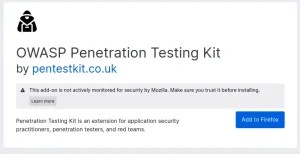
    12. OWASP Penetration Testing Kit (PTK):

    With features like dynamic and static analysis, JWT inspection, a built-in proxy, request tampering, and more, this all-inclusive extension is becoming more and more popular.

    13. XSSpect:

    Info about XSSpect

    An application created especially to automate XSS injection that enables ethical hackers to rapidly check for Cross-Site Scripting flaws without ever leaving the browser.

    14. User-Agent Switcher:

    more about User-Agent Switcher:

    Enables you to switch the user agent in your browser, which is helpful for testing how websites react to various hardware, operating systems, and browsers.

    15. Dark Reader:

    More about Dark Reader


    A dark mode for all websites helps lessen eye strain during extended periods of espionage and analysis, even though it isn’t a hacking tool per se.

    Benefits of Browser Extensions For Hackers

    S.No. Benefits How?
    1. Increased Efficiency They save a great deal of time in reconnaissance and vulnerability testing by automating repetitive tasks.
    2. Streamlined Workflow Hackers can minimize context hopping between programs by carrying out a variety of checks and changes right within their browser.
    3. Real-time Insights As a page loads or is interacted with, extensions give instant feedback about network queries, web technologies, and potential vulnerabilities.
    4. Enhanced Reconnaissance They swiftly compile vital data about target websites, such as contact information, linked assets, and underlying technology.
    5. Direct Web Interaction Testing Web application security testing is made easier by extensions, which enable direct manipulation of HTTP requests, cookies, and forms within the browser.
    6. Low Barrier to Entry (for some tasks) Numerous extensions streamline intricate procedures, increasing the accessibility of specific hacking activities even for individuals with limited scripting knowledge.
    7. Customization and Specialization Numerous extensions address certain requirements, enabling hackers to create a customized toolkit for their specific specialty.
    8. Cost-Effectiveness Numerous robust and practical browser extensions are either free or inexpensive, offering substantial functionality without requiring a substantial financial outlay.

    Industries that need Ethical Hackers

    The following are some of the industries that need ethical hackers:

    1. Financial Sector (Banking, Insurance, Fintech): Ethical hackers are needed in this industry to safeguard vital banking and transaction systems, stop fraud, and preserve private financial information.
    2. Healthcare Industry: Protecting hospital infrastructure, medical equipment, and patient records (PHI) from online attacks and data breaches requires ethical hackers.
    3. Government and Military: To protect defense systems, confidential data, and national infrastructure from state-sponsored cyberwarfare, these organizations depend on ethical hackers.
    4. Technology and Software Development: To find and address flaws in software products, apps, and cloud services before their release, ethical hackers are crucial in this sector.
    5. E-commerce and Retail: To safeguard consumer information, stop credit card fraud, secure online payment systems, and maintain the integrity of e-commerce platforms, this industry requires ethical hackers.
    6. Manufacturing: Ethical hackers assist in protecting intellectual property, operational technology, and industrial control systems (ICS) against espionage and cyber-physical threats.
    7. Telecommunications: To safeguard customer data, communication networks, and stop service interruptions due to cyberattacks, this industry needs ethical hackers.
    8. Energy and Utilities: Protecting key infrastructure from potentially disastrous attacks, such as water treatment facilities, power grids, and smart energy systems, requires ethical hackers.
    9. Education: To safeguard research data, faculty and student information, and their vast networks from cyberattacks, educational institutions require ethical hackers.
    10. Consulting and Outsourcing Firms: These companies use ethical hackers to offer clients in a variety of industries specialized cybersecurity services, including penetration testing and vulnerability assessments.

    Job Profiles related to Ethical Hacking

    S.No. Job Profiles What?
    1. Penetration Tester (Pen Tester) To find vulnerabilities, experts in this most direct application mimic actual cyberattacks on networks, systems, and applications.
    2. Vulnerability Assessment Analyst Focuses on finding, measuring, and ranking vulnerabilities in networks and systems; frequently, automated techniques are used, but ethical hacking expertise is needed to understand findings and provide fixes.
    3. Security Consultant Advises companies on their overall security posture by carrying out policy reviews, security assessments, and frequent ethical hacks to highlight vulnerabilities and suggest fixes.
    4. Red Team Member/ Operator Participates in a team that mimics complex adversaries and tests an organization’s detection and response capabilities by launching multifaceted attacks (technical, physical, and social engineering).
    5. Application Security Engineer Focuses on finding and fixing security vulnerabilities in software applications at every stage of development. They frequently do static and dynamic analysis and ethical hacking on online and mobile applications.
    6. Cybersecurity Analyst Examines security problems, keeps an eye on systems for unusual activity, and frequently employs ethical hacking techniques to learn how attacks happen and how to stop them.
    7. Security Engineer Uses ideas from ethical hacking to design, construct, and manage safe IT infrastructure, making sure that systems are resistant to possible attacks.
    8. Malware Analyst Examines dangerous software to learn about its origins, capabilities, and behavior; this frequently entails reverse engineering and comprehending the tactics used by attackers.
    9. Incident Response Analyst Uses expertise in ethical hacking to respond to and analyze security breaches, comprehend the attacker’s path, contain the situation, and stop such incidents in the future.
    10. Security Architect Creates and plans the complete security architecture for a company, using expertise in ethical hacking to create robust and secure systems from the ground up.

    Conclusion

    After reading about the Top 15 Browser Extensions For Hackers in 2026, you might also want to get into action with such browser extensions. For that, you can get in contact with Craw Security offers a dedicated training & certification program, “Ethical Hacking Training Course in Delhi,” to IT Aspirants.

    During the training sessions, students will be able to try their skills on live machines via the virtual labs introduced on the premises of Craw Security. With that, you will be able to learn the skills remotely via online sessions.

    After the completion of the Ethical Hacking Training Course with AI in Delhi offered by Craw Security, students will receive a certificate validating their honed knowledge & skills during the sessions. What are you waiting for? Contact, Now!

    Frequently Asked Questions

    About Top 15 Browser Extensions For Hackers in 2026

    1. Which extensions are best?

    The following are some of the extensions best for hackers:

    1. Wappalyzer,
    2. BuiltWith,
    3. HackBar,
    4. Tamper Data, and
    5. FoxyProxy Standard.

    2. What are high-security websites?

    To protect sensitive data and preserve integrity, high-security websites employ several strong levels of defense. These layers usually include firewalls, HTTPS, strong authentication (such as MFA), frequent security audits, and ongoing software updates.

    3. Which browser do hackers use?

    Because of their powerful developer tools, vast extension ecosystems, and broad compatibility, browsers like Mozilla Firefox and Google Chrome are frequently used by ethical hackers.

    They are also frequently significantly customized with security-focused add-ons and proxied through specialist tools.

    4. Which browser has the most extensions?

    At the moment, Google Chrome offers the most extensions via its Chrome Web Store.

    5. Are browser extensions a security risk?

    Yes, because of their vulnerability to supply chain assaults, ability to inject malicious code, and access to private browsing data, browser extensions can pose a serious security concern.

    6. What are the best security extensions?

    uBlock Origin (for blocking ads and trackers), Privacy Badger (for preventing trackers), Malwarebytes Browser Guard (for blocking malware and frauds), and trustworthy password managers like Bitwarden or LastPass are often the best security plugins.

    7. What is the best password extension?

    Because of its robust security, open-source nature, generous free tier, and cross-platform compatibility, Bitwarden is widely regarded as the best password extension according to current recommendations and trends for 2026.

    Highly regarded options like 1Password and Dashlane are closely followed by Bitwarden because of their extensive feature set.

    8. What is the safest extension?

    Since even well-meaning extensions might provide problems, the idea of the “safest” extension is complex. But generally speaking, the safest extensions are those that put privacy and security first, are open-source, have a solid reputation, and require few permissions.

    9. What is the highest-paid Chrome extension?

    GMass, an email marketing and mail merge application for Gmail, has long been regarded as one of the highest-earning Chrome extensions, with monthly revenues in the hundreds of thousands of dollars, but exact numbers vary and are frequently not made public. It has a subscription-based business strategy.

    10. Do browsers have AI agent Chrome extensions?

    Absolutely! By 2026, the ecosystem of AI-powered extensions—often referred to as “AI agents”—in browsers such as Chrome is expanding quickly.

    11. How many extensions are safe?

    Since safety is dependent on permissions, developer reputation, and continuous audits, there is no set number of “safe” extensions; the fewer trustworthy extensions you use, the lower your risk.

    12. What is the best form of extensions?

    The greatest extensions are those that are open-source, frequently updated, have clear, transparent developers, and offer precise, well-defined functionality with few, reasonable permissions.

    13. What is the risk of extension?

    Extensions’ main risk is their capacity to access and alter your browsing information, which could result in phishing attempts, malware injection, privacy violations, and unsolicited ads or redirects.

  • Top 7 Cyber Security Certifications in India [2026 Updated]

    Top 7 Cyber Security Certifications in India [2026 Updated]

    Do you know how cybersecurity certifications can change your career growth? If not, then you can read this amazing article that introduces the Top 7 Cyber Security Certifications in India, helping in pacing your career.

    In the end, we will introduce you to a reputed training institute offering a dedicated training & certification program related to cybersecurity skills. What are we waiting for? Let’s get straight to the topic!

    What is Cybersecurity Certification?

    Learn about What is Cybersecurity Certification

    A formal credential known as a cybersecurity certification attests to a person’s knowledge, ability, and expertise in particular cybersecurity domains. It frequently shows mastery of industry best practices, technologies, and procedures.

    These certificates, which demonstrate to employers one’s proficiency in the profession, are usually obtained by passing an exam following the completion of pertinent training or the acquisition of necessary work experience.

    Let’s talk about the Top 7 Cyber Security Certifications in India that can help you in career building while working among professionals!

    The Evolving Cyber Threat Landscape

    Increasingly complex and varied attack techniques, which go beyond basic malware to extremely targeted and persistent threats, define the changing cyber threat landscape. This includes the exploitation of weaknesses in interconnected supply chains, the weaponization of AI for ransomware and sophisticated phishing, and an increasing emphasis on identity-based and critical infrastructure threats.

    Top 7 Cyber Security Certifications in 2026

    The following are the Top 7 Cyber Security Certifications:

    1. Certified Ethical Hacker (CEH)

    Ceh v11 course in Punjab

    The EC-Council’s CEH certification focuses on ethical hacking methods and strategies for lawfully breaking into networks and systems to find weaknesses.

    Numerous subjects are covered, such as social engineering, malware threats, system hacking, reconnaissance, scanning, enumeration, and other hacking tools. This certification, which shows a fundamental understanding of how attackers work, is perfect for cybersecurity professionals hoping to work in penetration testing, vulnerability assessment, and security auditing.

    2. CompTIA Security+

    Online CompTIA Security+ Training in Delhi

    The basic, vendor-neutral CompTIA Security+ certification verifies the fundamental cybersecurity abilities needed for entry-level and intermediate roles. It includes fundamental subjects like architecture and design, implementation, operations and incident response, governance, risk, and compliance, as well as threats, attacks, and vulnerabilities.

    This internationally recognized certification offers a thorough understanding of defensive security concepts and is a great place for people just starting in the cybersecurity industry.

    3. CISM (Certified Information Security Manager)

    CISM Certification Course in India

    The internationally renowned CISM certification, provided by ISACA, is intended for seasoned information security managers and those who plan, organize, supervise, and evaluate an organization’s information security.

    Information security risk management, information security governance, information security program development and administration, and information security incident management are its four core areas of focus.

    Professionals looking to progress into management and leadership positions in cybersecurity should pursue a CISM.

    4. CISA (Certified Information Systems Auditor)

    CISA Certification Training Course in Delhi

    The internationally acclaimed CISA certification for audit, control, and security professionals is also provided by ISACA. It focuses on information system auditing, making sure that business and IT systems within an organization are safeguarded and managed.

    Information systems governance and management, information systems acquisition, development, and implementation, information systems operations and business resilience, information asset protection, and the auditing process are among the subjects covered by the certification. For positions involving IT audit, risk management, and compliance, a CISA is essential.

    5. OSCP (Offensive Security Certified Professional)

    Informations of oscp

    Offensive Security offers the renowned and difficult hands-on penetration testing certification known as OSCP. In contrast to many other certifications, it demands candidates to successfully compromise several machines in a lab-like setting over the course of a 24-hour exam to demonstrate real hacking skills.

    Known for its “try harder” mentality, OSCP is widely regarded in the cybersecurity field for positions like vulnerability researcher, red team member, and penetration tester, demonstrating practical offensive security skills.

    6. CCSP (Certified Cloud Security Professional)

    Learn about CCSP

    The CCSP certificate, which is jointly offered by the Cloud Security Alliance (CSA) and ISC², is intended for seasoned IT workers who deal with cloud computing.

    Advanced expertise in cloud security architecture, design, operations, and service orchestration is validated. Concepts, architecture and design, data security, platform and infrastructure security, cloud application security, operations, and legal, risk, and compliance are the six domains that are covered.

    Organizations using cloud solutions highly value CCSP since it is crucial for protecting cloud environments.

    7. eLearnSecurity Junior Penetration Tester Training (EJPT)

    Information for EJPT

    For those wishing to begin a career in penetration testing, INE’s eLearnSecurity offers the eJPT, an introductory, practical certification.

    Through a 48-hour black-box penetration testing exam in an actual lab setting, it emphasizes practical abilities. System penetration testing, web application penetration testing, and networking fundamentals are included in the certification.

    For prospective penetration testers, it’s a great first step, offering fundamental real-world experience before pursuing more complex certifications like OSCP.

    Advantages of Cybersecurity Certifications

    S.No. Advantages How?
    1. Enhanced Credibility and Marketability By offering industry-recognized verification of your abilities and expertise, certifications help you stand out in a crowded job market and attract more employers.
    2. Higher Earning Potential Because of their specific knowledge and the great demand for their abilities, certified cybersecurity specialists frequently command higher wages and better compensation packages.
    3. Career Advancement Opportunities By proving your dedication to ongoing professional growth, certifications can lead to leadership positions, promotions, and new, more senior roles inside businesses.
    4. Specialized Skill Development Obtaining certifications gives you access to state-of-the-art technologies and techniques while enabling you to acquire in-depth, specialized expertise in particular cybersecurity domains such as cloud security, penetration testing, or incident response.
    5. Stay Updated with Evolving Threats To stay up to date with the newest threats, technologies, and best practices in the quickly evolving cybersecurity field, obtaining and retaining certifications necessitates ongoing study.
    6. Improved Job Security Because companies are constantly looking for skilled people to defend their digital assets, having credentials increases your job security in light of the growing need for cybersecurity professionals worldwide.
    7. Professional Networking Opportunities Numerous certification programs put you in touch with peers and professionals in the field, creating beneficial networking opportunities for cooperation, information exchange, and professional growth.
    8. Validation for Employers Employing certified specialists reassures businesses that their staff has the know-how to safeguard digital assets, enhance compliance, and lower overall cyber risk.

    How to Choose the Right Cyber Security Certification for You?

    Learn about How to Choose the Right Cyber Security Certification for You in 2025

    You can choose the right cybersecurity certifications for you in 2026 by considering the following factors:

    1. Align with Your Career Goals and Current Experience Level: Choose a certification that aligns with your present skill set and desired career path after deciding if you want to work in an entry-level, mid-career, or management capacity (e.g., CompTIA Security+ for beginners, CISSP for leadership, OSCP for offensive security).
    2. Evaluate Industry Demand and Specialization Trends: Find out which cybersecurity specialities—such as cloud security, AI security, incident response, and Zero Trust—are in high demand, then select certifications that attest to your proficiency in those fields.
    3. Consider the Certification’s Recognition and Reputation: Employers place greater value on internationally recognized and regarded certificates from respectable organizations (such as (ISC)2, ISACA, CompTIA, and Offensive Security).
    4. Assess the Prerequisites and Exam Format: Assess whether the exam type (multiple-choice, performance-based, hands-on lab) fits your preferred learning and testing style, as well as any necessary work experience or previous certifications.
    5. Factor in Cost, Time Commitment, and Training Resources: Assess the time needed for preparation, the cost of the exam and study materials, and the availability of high-quality training resources (such as official courses, practice tests, and study groups) that work with your schedule and budget.

    Industries that need Cybersecurity Professionals

    The following are some industries that need cybersecurity professionals:

    • Financial Services: They deal with enormous volumes of private and sensitive financial information, which makes them easy targets for fraud, data breaches, and cybercrime.
    • Healthcare and Pharmaceuticals: These industries handle extremely private patient health records and vital research data, necessitating strong defenses against ransomware and intrusions while maintaining HIPAA compliance.
    • Government and Defense: These organizations defend vital national infrastructure, confidential data, and national security against cyber warfare, espionage, and state-sponsored attacks.
    • IT and Technology Companies: They are both frequent targets and crucial suppliers of cybersecurity solutions since they create and host a large portion of the global digital infrastructure and software.
    • E-commerce and Retail: Strong cybersecurity is necessary to stop financial crime and preserve customer trust because they handle innumerable online transactions and keep client payment information.
    • Manufacturing: With the growth of IoT and industrial control systems (ICS), cybersecurity is essential to safeguarding intellectual property, operating technology, and avoiding production line interruptions.
    • Energy and Utilities: Because they oversee vital national infrastructure, such as water and power networks, these sectors are prime targets for cyberattacks that have the potential to severely disrupt society.
    • Telecommunications: Because they manage enormous amounts of user data and serve as the foundation for digital communication, cybersecurity is essential for both network integrity and user privacy.
    • Consulting Services: These companies help businesses in many industries evaluate risks, put solutions in place, and adhere to regulations by offering their specialist cybersecurity experience.
    • Education: Due to their increasing reliance on online learning platforms, sensitive student and faculty data, and significant research, educational institutions are susceptible to data breaches and disruptions.

    Learn about Six-Months Diploma in Artificial Intelligence (AI) and Machine Learning (ML) in Delhi at Craw Security

    Job Profiles after Cyber Security Certification

    S.No. Job Profiles What?
    1. Security Analyst This is frequently a first step into a mid-level position that involves keeping an eye on security systems, evaluating security incidents, looking into possible dangers, and putting basic security measures in place.
    2. Penetration Tester/ Ethical Hacker Focuses on creating cyberattack simulations to find weaknesses in networks, applications, and systems and to make suggestions for bolstering defenses.
    3. Security Engineer Creates, constructs, deploys, and maintains security tools and systems, frequently utilizing intrusion detection/prevention systems, firewalls, and encryption technologies.
    4. Incident Responder Aims to reduce damage and resume operations by identifying, evaluating, containing, and recovering from security incidents and breaches.
    5. Cloud Security Engineer Focuses on protecting cloud environments (such as AWS, Azure, and GCP), making sure that data is protected, that cloud services are configured correctly, and that compliance is maintained.
    6. Security Architect Creates and manages an organization’s overall security strategy and architecture, making sure that security measures are applied to all IT systems.
    7. Digital Forensics Analyst Investigate security issues and cybercrimes by gathering, storing, and evaluating digital evidence for internal inquiries or legal actions.
    8. Information Security Manager A leadership position in charge of creating, carrying out, and overseeing an organization’s information security policy, program, and staff of security experts.
    9. Security Consultant Gives clients professional guidance on risk assessments, cybersecurity best practices, compliance, and security solution deployment.
    10. Governance, Risk, and Compliance (GRC) Analyst Focuses on making sure a company properly manages cybersecurity risks and complies with applicable security laws, rules, and industry standards.

    Conclusion

    Now that we have read about the Top 7 Cyber Security Certifications in India, you might be wondering which certification could be right for you. For that, you can go for the specially dedicated certification program, “1-Year Cyber Security Diploma Course Powered by AI,” offered by Craw Security to IT Aspirants.

    During the training sessions, students will be able to try their skills on live machines via the virtual labs introduced on the premises of Craw Security. With that, remote learners can learn skills with the benefit of online sessions.

    After the completion of the 1-Year Cyber Security Diploma Course Powered by AI offered by Craw Security, students will receive a dedicated certificate validating their honed knowledge & skills during the sessions. What are you waiting for? Contact, Now!

    Frequently Asked Questions

    About the Top 7 Cyber Security Certifications in India

    1. What are the most popular cybersecurity certifications in India?

    The following are some of the most popular cybersecurity certifications in India:

    1. Certified Ethical Hacker (CEH),
    2. CompTIA Security+,
    3. CISSP (Certified Information Systems Security Professional),
    4. CISM (Certified Information Security Manager),
    5. CISA (Certified Information Systems Auditor)

    2. Which cybersecurity certification is best for beginners?

    One of the best cybersecurity certifications for beginners is the One-Year Cyber Security Diploma Course offered by Craw Security.

    3. How do I choose the right cybersecurity certification for my career goals?

    You should choose the right cybersecurity certifications for your career goals by considering the following factors:

    1. Define Your Career Path & Desired Role,
    2. Assess Your Current Experience Level,
    3. Research Industry Demand & Employer Preferences,
    4. Evaluate the Certification’s Reputation & Practicality, and
    5. Consider the Cost, Time, & Learning Style.

    4. What are the eligibility criteria for CEH, CISSP, and other top certifications?

    Usually, two years of information security job experience or successful completion of formal EC-Council training are prerequisites for CEH eligibility; A minimum of five years of paid, full-time experience in two or more of the eight CISSP domains is required; this requirement can be lowered with a related degree or another recognized certification. CISA requires five years of expertise in information systems auditing, control, or security; CISM demands five years of experience in information security management within the job practice areas; Completion of Offensive Security’s PEN-200 course is typically required for OSCP; While eJPT is an entry-level certification with no particular qualifications, a basic understanding of networking and systems is suggested.

    The CCSP requires five years of cumulative IT experience, three of which must be in information security and one of which must be in cloud security domains.

    5. Are cybersecurity certifications recognized internationally?

    Yes, the Cyber Security Diploma Course Powered by AI offered by Craw Security is one of the most internationally recognized certifications.

    6. How much does it cost to pursue top cybersecurity certifications in India?

    When taking into account exam costs, formal training, and study materials, the cost of pursuing top cybersecurity certifications in India varies greatly, usually ranging from ₹15,000 for foundational courses to over ₹5,00,000 for advanced international certificates.

    7. What is the average salary after completing a cybersecurity certification?

    The typical pay after earning a cybersecurity certification might vary greatly depending on several factors, including region, experience, and employment function.

    8. Can I get a cybersecurity job in India without certification?

    Although it is feasible, it is far more difficult to obtain a cybersecurity job in India without credentials, particularly for entry-level positions, as certificates are frequently seen by HR and recruiting managers as a key differentiator and confirmation of skills.

    A great portfolio, projects, and real-world experience can occasionally make up for it, but certificates are usually preferable to pass the first screening.

    9. Are online cybersecurity certifications valued by employers in India?

    Yes, Indian firms place great importance on online cybersecurity credentials.

    10. How long does it take to prepare for major cybersecurity certifications?

    Depending on the particular certification, your prior knowledge, and the amount of time you devote to studying, the preparation time for major cybersecurity certifications can vary greatly.

    For example, foundational certifications like CompTIA Security+ or eJPT typically take 1-3 months, intermediate certifications like CEH or CCSP take 3-6 months, and advanced certifications like CISSP, CISM, or CISA typically take 4-8 months or longer.

    11. Which institutes offer the best training for cybersecurity certifications in India?

    One of the best institutes for offering the best training for cybersecurity certifications in India is Craw Security, offering the Cyber Security Diploma Course.

    12. Do I need coding skills for cybersecurity certification exams?

    Extensive coding abilities are typically NOT necessary for the exam for fundamental certifications like CompTIA Security+ or management/audit-focused ones like CISM and CISA.

    Though not rigorously tested, knowledge of code snippets or basic scripting can be very beneficial for understanding vulnerabilities or cloud automation for CEH and CCSP. Similarly, practical coding/ scripting in languages like Python is frequently required for hands-on offensive security certifications like OSCP.

    13. What is the validity period of these certifications?

    Although the original OSCP (not OSCP+) is a lifetime certification, the majority of top cybersecurity certifications, such as CompTIA Security+, CEH, CISM, CISA, OSCP+, CCSP, and eJPT, have a three-year validity period and require annual maintenance fees and/or continuing education credits (CPEs) to be renewed.

    14. Is work experience required before appearing for the CISSP or CISM?

    Yes, both the CISSP and CISM certifications require professional experience.

    15. How often should I renew my cybersecurity certification?

    Every three years, the majority of significant cybersecurity certificates, such as those from EC-Council (like CEH), ISACA (like CISM, CISA), CompTIA (like Security+), and (ISC)² (like CISSP, CCSP), must be renewed.

    Usually, this is accomplished by paying an annual maintenance fee and accumulating a specific number of Continuing Professional Education (CPE) credits. Newer versions frequently have renewal restrictions, but others, like the original OSCP, were lifetime.

    Read More Blogs

    Multi-Factor Authentication: 2-Step, 3-Step, or More Mastering the Art
    Best Cyber Security Training Courses in Delhi NCR
    Top 20 Cybersecurity Interviews with Expert Answers
    Cyber Security Diploma Course in Delhi NCR

  • Best AI Courses in Delhi After 12th Class [2026 Updated]

    Best AI Courses in Delhi After 12th Class [2026 Updated]

    Best AI Courses in Delhi After 12th Class

    AI has made everyone’s lives easier for a better way of living, and due to ease of access to it, many cybercriminals have started to aim at attacking AI devices, which has now made a huge demand for AI professionals who can protect your data against such attacks.

    For those of you who want to learn such skills, you can join the AI Courses in Delhi After 12th Class offered by professional institutes. What are we waiting for? Let’s learn about it in detail!

    What is Artificial Intelligence?

    Artificial Intelligence (AI) is the field of computer science dedicated to creating machines that can perform tasks typically requiring human intelligence. These tasks include learning, problem-solving, decision-making, and understanding natural language.

    Learn about What is Artificial Intelligence? at Craw Security

    AI aims to develop systems capable of reasoning, adapting, and interacting with the world in intelligent ways. Let’s talk about what is there for you in the AI Courses After 12th Class!

    What Will You Learn in the AI Course?

    S.No. Factors What?
    1. Programming Fundamentals Often using Python to implement AI algorithms and work with data.
    2. Mathematical Foundations Including linear algebra, calculus, probability, and statistics is essential for understanding AI models.
    3. Machine Learning (ML) Covering supervised learning (classification, regression), unsupervised learning (clustering, dimensionality reduction), and reinforcement learning.
    4. Deep Learning Exploring neural networks, convolutional neural networks (CNNs) for image processing, and recurrent neural networks (RNNs) for sequential data.
    5. Natural Language Processing (NLP) Techniques for computers to understand, interpret, and generate human language.
    6. Computer Vision Enabling computers to “see” and interpret images and videos.
    7. Data Handling and Preprocessing Cleaning methods, transforming, and preparing data for AI models.
    8. Model Evaluation and Deployment Understanding how to assess the performance of AI models and how to put them into practical use.
    9. AI Ethics and Societal Implications Examining the ethical considerations, biases, and broader societal impact of AI technologies.
    10. Specific AI Applications Exploring how AI is used in various domains like healthcare, finance, transportation, and marketing.

    Why Choose AI Courses After 12th Class?

    Learn about Why Choose AI Courses After 12th Class

    You should choose AI Courses after the 12th class for the following reasons:

    • Early Entry into a Booming Field: AI is a rapidly expanding industry with high demand for skilled professionals, offering excellent career prospects right after graduation.
    • Acquire Future-Proof Skills: You’ll gain expertise in areas like machine learning, deep learning, and data analysis, which are highly sought after in the evolving technological landscape.
    • Diverse Career Options: An AI education opens doors to various roles such as AI Engineer, Data Scientist, Machine Learning Specialist, Robotics Engineer, and more, across numerous sectors.
    • High Earning Potential: Due to the specialized skills and high demand, AI professionals often command competitive salaries from the beginning of their careers.
    • Contribute to Innovation: You’ll be at the forefront of developing and implementing cutting-edge technologies that can solve complex real-world problems and drive innovation across industries.

    Benefits of Artificial Intelligence for Organizations

    S.No. Benefits How?
    1. Enhanced Efficiency and Productivity AI can automate routine tasks, freeing up human employees for more complex and creative work, leading to higher output.
    2. Improved Data Analysis and Decision-Making AI algorithms can process and analyze large datasets much faster and more accurately than humans, providing valuable insights for strategic decisions.
    3. Superior Customer Experience AI-powered chatbots and personalized recommendation systems can offer instant support and tailored experiences, boosting customer satisfaction.
    4. Cost Optimization By automating processes, reducing errors, and optimizing resource allocation, AI can significantly lower operational expenses.
    5. Better Risk Management and Fraud Detection AI can identify patterns and anomalies in data to predict potential risks and detect fraudulent activities more effectively.
    6. Driving Innovation AI can help organizations identify new market trends, generate novel ideas, and develop innovative products and services, fostering a competitive edge.
    7. Personalized Products and Services AI enables a deeper understanding of customer preferences, allowing organizations to offer highly personalized products, services, and marketing campaigns.
    8. Round-the-Clock Availability and Scalability AI-powered systems can operate 24/7 without breaks and can easily scale to handle increasing workloads, ensuring consistent service delivery.

    Course Curriculum: What You’ll Learn in AI Programs

    Module 01: Overview of Artificial Intelligence Module
    Module 02: Intelligence System Module
    Module 03: Research Areas of Artificial Intelligence Module
    Module 04: Agents and Environment Module
    Module 05: Popular Search Algorithms Module
    Module 06: Fuzzy Logic System Module
    Module 07: Natural Language Processing Module
    Module 08: Expert Systems Module
    Module 09: Robotics Module
    Module 10: What are Artificial Neural Networks (ANNs)?
    Module 11: Artificial Intelligence Issues Module
    Module 12: Artificial Intelligence Terminology

    Top AI Institutes in Delhi for Beginners

    S.No. Institutes Why?
    1. Craw Security Craw Security offers a “Diploma in Artificial Intelligence and Machine Learning” aimed at IT aspirants.
    2. Great Learning Great Learning provides various postgraduate programs and certificate courses in AI and machine learning, generally requiring a bachelor’s degree.
    3. Simplilearn Simplilearn offers postgraduate programs in AI and machine learning that usually require a bachelor’s degree for enrollment.
    4. Madrid Software Madrid Software Training lists AI courses but doesn’t explicitly detail a beginner-level diploma program on their main pages.
    5. UpGrad UpGrad primarily offers postgraduate diplomas and certificate programs in AI and related fields, generally requiring a bachelor’s degree or relevant work experience.

    What to Look for in an AI Course in Delhi?

    Infor about What to Look for in an AI Course in Delhi at Craw Security

    You can expect the following things in the AI Course in Delhi:

    1. Comprehensive Curriculum: Ensure the course covers foundational AI concepts, programming (like Python), machine learning, deep learning, and data analysis relevant to current industry needs.
    2. Hands-on Practical Experience: Look for courses that heavily emphasize practical application through projects, case studies, and coding exercises to build real-world skills.
    3. Experienced and Supportive Instructors: Check the qualifications and industry experience of the instructors, and ensure they are accessible for doubt clearing and mentorship.
    4. Placement Assistance and Career Guidance: Inquire about career support services such as resume building, interview preparation, and connections with potential employers.
    5. Affordable Fees and Flexible Learning Options: Consider the course fees to the value offered and explore if they provide flexible learning modes (online, offline, hybrid) that suit your schedule.

    Online vs Offline AI Courses in Delhi – Which Is Better?

    S.No. Topics Factors What?
    1. Online AI Courses in Delhi Flexibility and Convenience Online courses offer the significant advantage of learning at your own pace and on your own schedule. You can access course materials and lectures anytime, anywhere, fitting your studies around work or other commitments.
    Offline AI Courses in Delhi Direct Interaction and Networking Offline courses provide face-to-face interaction with instructors and peers, facilitating immediate doubt clarification, discussions, and valuable networking opportunities.
    2. Online AI Courses in Delhi Accessibility and Wider Options Online platforms often provide a broader range of AI courses from various national and international institutions, expanding your choices beyond the physical limitations of Delhi.
    Offline AI Courses in Delhi Structured Learning Environment A fixed schedule and classroom setting can provide a more disciplined and focused learning environment, which can be beneficial for learners who thrive on routine.
    3. Online AI Courses in Delhi Cost-Effective Generally, online AI courses tend to be more affordable than offline ones as they eliminate overhead costs associated with physical classrooms and infrastructure.
    Offline AI Courses in Delhi Hands-on Practical Experience Offline courses may offer more opportunities for in-person lab work, hands-on projects with physical resources, and direct supervision, which can be crucial for practical AI skill development.
    4. Online AI Courses in Delhi Self-Paced Learning You can revisit complex topics as needed and progress through the material at a speed that suits your understanding, allowing for a more personalized learning experience.
    Offline AI Courses in Delhi Immersive Learning Experience Being physically present in a classroom dedicated to learning can minimize distractions and create a more immersive and engaging educational experience.
    5. Online AI Courses in Delhi Digital Resources and Tools Online courses often integrate interactive digital resources, simulations, and online collaboration tools, which can enhance engagement and understanding of AI concepts.
    Offline AI Courses in Delhi Stronger Sense of Community and Support The in-person interaction in offline courses can foster a stronger sense of community among students and provide more direct support from instructors and classmates.

    Career Opportunities in Artificial Intelligence in 2026

    Learn about Career Opportunities in Artificial Intelligence

    The following are some of the job profiles that one can go for with their AI skills:

    1. AI/ Machine Learning Engineer: Designs, develops, and deploys machine learning models and AI algorithms to solve complex problems.
    2. Data Scientist: Analyzes large datasets to extract meaningful insights, build predictive models, and inform data-driven decisions using AI techniques.
    3. AI Research Scientist: Conducts fundamental and applied research to advance the field of AI, developing new algorithms and techniques.
    4. Natural Language Processing (NLP) Engineer: Focuses on enabling computers to understand, interpret, and generate human language for applications like chatbots and language translation.
    5. Computer Vision Engineer: Develops systems that can “see” and interpret visual information from the real world, used in applications like facial recognition and autonomous vehicles.
    6. Robotics Engineer (with AI focus): Designs, builds, and programs intelligent robots that can perform tasks autonomously using AI algorithms for perception and decision-making.
    7. AI Product Manager: Oversees the development and implementation of AI-powered products, bridging the gap between technical teams and business stakeholders.
    8. AI Ethics Specialist: Focuses on the ethical implications of AI, developing guidelines and frameworks to ensure AI systems are fair, transparent, and unbiased.
    9. AI Consultant: Advises organizations on how to integrate AI technologies to improve efficiency, automate processes, and achieve their business goals.
    10. AI in Cybersecurity Specialist: Develops and implements AI-powered security systems to detect and prevent cyber threats, leveraging machine learning for anomaly detection and threat intelligence.

    Conclusion

    Now that we have talked about the  AI Courses in Delhi After 12th Class, you might want to get the Best AI Diploma & Certification Programs in Delhi to learn AI skills. For that, you can get in contact with Craw Security, offering the Best Artificial Intelligence Course in Delhi to IT Aspirants.

    During the training sessions, students will be able to get hands-on experience with the virtual labs introduced on Craw Security premises. With that, online sessions offered by Craw Security will offer remote learning facilities.

    [wp_code id=”1″]

    After the completion of the Best Artificial Intelligence Course offered by Craw Security, students will get a dedicated certificate validating their honed knowledge & skills during the sessions. What are you waiting for? Contact, Now!

    Frequently Asked Questions

    About Best AI Courses in Delhi After 12th Class

    1. What are the eligibility criteria for AI courses after 12th in Delhi?

    If you really want to make a career in the IT Industry with AI skills, you can also go for the Best Artificial Intelligence Course in Delhi offered by Craw Security.

    2. Which stream is required in the 12th to pursue an AI course?

    It doesn’t matter from which stream you want to go for the AI career; you can definitely go for the Artificial Intelligence in Delhi offered by Craw Security.

    3. What are the best institutes in Delhi offering AI courses for beginners?

    One of the best institutes offering AI courses for beginners in Delhi is Craw Security, offering the Artificial Intelligence Course Delhi.

    4. How long do AI courses typically last after the 12th class?

    The Artificial Intelligence Training in Delhi, offered by Craw Security, comes with a duration of 60 Hours.

    5. What career opportunities are available after completing an AI course?

    The following are some of the career opportunities available after completing an AI Course:

    1. AI/ Machine Learning Engineer,
    2. Data Analyst,
    3. AI Software Developer,
    4. Data Annotation Specialist, and
    5. AI Support Specialist.

    6. What is the average fee for AI courses in Delhi?

    The average fee for AI courses in Delhi can vary significantly depending on the type and duration of the course, ranging from a few thousand for basic online certifications to several lakhs for comprehensive degree programs from top institutions.

    For shorter-term diploma or certification courses, you might expect to pay anywhere from ₹20,000 to ₹1.5 Lakh, while bachelor’s or master’s degrees can range from ₹2 Lakh to ₹15 Lakh or more for the entire program.

    7. Are there any government-certified AI courses in Delhi?

    The following are some of the options available related to government-certified AI courses in Delhi:

    1. National Institute of Electronics & Information Technology (NIELIT),
    2. Delhi Skill and Entrepreneurship University (DSEU),
    3. Skill India Digital Hub,
    4. IIT Delhi (through CEP), and
    5. AnalytixLabs (with IIT Guwahati).

    8. Can I pursue AI courses online while living in Delhi?

    Yes, you can pursue AI courses online while living in Delhi by joining the  Artificial Intelligence Training Course in Delhi offered by Craw Security.

    9. What topics are covered in beginner-level AI courses?

    The following are some of the topics covered in beginner-level AI courses:

    1. Introduction to Artificial Intelligence,
    2. Fundamentals of Programming with Python,
    3. Mathematical Foundations for AI,
    4. Introduction to Machine Learning, and
    5. Data Handling and Preprocessing.

    10. Do I need to know coding to enroll in an AI course after the 12th?

    While some introductory AI courses might not have strict coding prerequisites, having a foundational understanding of programming, preferably Python, is highly recommended and often assumed for most comprehensive AI courses after the 12th to effectively grasp and implement AI concepts.

    11. Which is better: a diploma, certification, or full-time degree in AI?

    There isn’t a single “better” option, as the ideal choice depends on your career goals, time commitment, and financial resources; a full-time degree offers the most comprehensive theoretical knowledge and career opportunities, a diploma provides focused, job-ready skills for quicker entry into specific roles, and a certification offers targeted skill enhancement for career advancement or a career change.

    12. Is Artificial Intelligence a good career choice after the 12th?

    Yes, Artificial Intelligence is generally considered a very promising career choice after the 12th due to the high demand for skilled professionals and the field’s significant growth potential.

    13. Are there AI courses available with job placement assistance in Delhi?

    Yes, Craw Security offers 100% Job Placement Assistance with the Artificial Intelligence Course.

    14. Can I pursue higher studies in AI abroad after completing a course in Delhi?

    Yes, you can pursue higher studies in AI abroad after the Best Artificial Intelligence Courses offered by Craw Security.

    15. What tools and technologies are taught in these AI courses?

    The following are some of the tools and technologies taught in these AI courses:

    1. Python Programming Language,
    2. Machine Learning Frameworks,
    3. Cloud Computing Platforms,
    4. Data Visualization Libraries, and
    5. Integrated Development Environments (IDEs) & Tools.

  • What is Data Loss Prevention (DLP)? Trends, Types, Features, Tools and Technologies, Challenges

    What is Data Loss Prevention (DLP)? Trends, Types, Features, Tools and Technologies, Challenges

    Introduction: What is Data Loss Prevention (DLP)?

    Data is essential to any firm in the ongoing digital era.  It is crucial to keep this priceless asset out of the wrong hands.  Data Loss Prevention (DLP) is useful in this situation.  Being the top cybersecurity training center in India, Craw Security is aware of how crucial DLP is to establish a strong security posture.  The complexities of DLP, its importance in 2025, and how companies might use it efficiently will all be covered in this essay.

    Why is Data Loss Prevention Important in 2025?

    Learn about Why is Data Loss Prevention Important

    The complex threat landscape in 2025 is dynamic and getting harder to understand.  The following elements highlight the increased significance of DLP:

    Escalating Cyber Threats The frequency and sophistication of cyberattacks are increasing, and data breaches are seriously harming businesses’ finances and reputations. DLP serves as an essential line of protection against these dangers.
    Remote Work Expansion As remote work becomes more common, the attack surface grows, making it more difficult to keep an eye on and manage sensitive data. DLP systems go beyond the conventional network perimeter in terms of visibility and control.
    Stringent Data Privacy Regulations Strict data security precautions are required by regulations such as the CCPA, GDPR, and India’s own impending data protection rules. By stopping unwanted data disclosure, DLP assists enterprises in meeting these standards.
    Insider Threats Insider threats continue to be a major cause of data loss, whether intentional or unintentional. Unauthorized data exfiltration by workers or contractors can be identified and stopped by DLP systems.
    Cloud Adoption DLP solutions that may expand their protection to include data processed and stored in the cloud are required due to the increasing use of cloud services.

    Types of Data Loss and Common Threats

    Learn about Types of Data Loss and Common Threats

    Implementing a successful DLP strategy requires an understanding of the many forms of data loss and the dangers that cause them:

    • Exfiltration: Sensitive data being transferred or copied without authorization outside of the organization’s control. This may be unintentional (staff error) or intentional (malicious insiders, external attackers).
    • Accidental Loss: Human error-related data loss includes losing unencrypted devices, deleting files, and sending emails to the incorrect recipients.
    • Data Leakage: Unintentional disclosure of private information to unapproved parties, frequently brought about by improperly set up software or systems.
    • Physical Loss: Loss of tangible material, such as computers, USB drives, or documents, that contain private information.
    • Malware and Ransomware: Sensitive information can be destroyed, encrypted, or stolen by these malevolent programs.

    Common threats include:

    Some common threats include the following factors:

    Malicious Insiders Workers or former workers who purposefully steal or divulge information.
    External Attackers Cybercriminals target businesses in order to steal important data for malicious or financial gain.
    Social Engineering Influencing others to divulge private information or engage in behaviors that jeopardize data security.
    Phishing Misleading emails or messages are intended to fool recipients into installing malware or disclosing private information.

    How Does DLP Work? Core Principles Explained

    Details of How Does DLP Work?

    Sensitive data in use, motion, and rest is identified, tracked, and protected by DLP systems. The following are the fundamental ideas that guide their operations:

    1. Data Identification and Classification: Sensitive data must first be recognized and categorized by DLP systems using predetermined guidelines. This includes methods such as user-defined tags, contextual analysis (which assesses the location, user, and application accessing the data), and content analysis (which looks at the actual content of files and conversations). A DLP system, for instance, can be set up to identify patterns such as social security numbers, credit card information, or codenames for private projects.
    2. Policy Enforcement: DLP systems enforce policies that specify the usage, transport, and storage of sensitive data once it has been categorized. These regulations might be specific, outlining various guidelines according to applications, user roles, and data sensitivity levels. A policy might, for example, forbid financial data from being copied to individual USB sticks but permit its transfer to a secure shared network drive.
    3. Monitoring and Logging: Data-related activities are continuously monitored by DLP systems across a range of endpoints, networks, and cloud environments. By recording these activities, they provide an audit trail that can be used for compliance and investigation purposes.
    4. Alerting and Reporting: The DLP system creates alerts to notify security administrators instantly when a policy violation is found. In-depth reports offer information on possible hazards and trends in data security.
    5. Remediation: To stop data loss, DLP solutions can automatically stop unwanted file transfers, quarantine shady emails, encrypt private information, or even end user sessions.

    Key Features of Effective DLP Solutions

    Learn about Key Features of Effective DLP Solutions

    A successful DLP system should have a number of essential components:

    • Comprehensive Data Coverage: The capacity to identify and safeguard private information across networks (email, web traffic), endpoints (laptops, desktops), and cloud environments (SaaS apps, cloud storage).
    • Accurate Data Identification: Using sophisticated methods to precisely identify sensitive material, such as dictionary-based analysis, content fingerprinting, and keyword matching.
    • Granular Policy Management: Enabling administrators to draft comprehensive and adaptable policies according to a range of standards.
    • Real-time Monitoring and Enforcement: The capacity to keep an eye on data activity and implement policies instantly to stop data loss before it starts.
    • Centralized Management and Reporting: An easy-to-use interface for creating thorough reports, managing policies, and viewing alerts.
    • User Behavior Monitoring: Monitoring user activity and spotting potentially dangerous patterns of conduct that could result in data loss.
    • Incident Response Capabilities: Workflows and tools for efficiently responding to and fixing data loss situations.
    • Integration with Other Security Tools: Smooth interaction with identity and access management systems, CASB, SIEM, and other security solutions.

    Top Use Cases for DLP in Modern Businesses

    Numerous data security issues in a variety of industries are addressed by DLP solutions:

    Protecting Intellectual Property (IP) Avoiding the unapproved release of patents, corporate secrets, and other confidential data. A DLP system, for instance, has the ability to prevent unauthorized individuals from copying design papers.
    Ensuring Regulatory Compliance Assisting businesses in adhering to data privacy laws by stopping the disclosure of protected data, including personally identifiable information (PII).
    Governing Sensitive Financial Data Preventing bank account information, credit card numbers, and other financial data from being transmitted or stored without authorization.
    Securing Healthcare Records Preserving patient health information (PHI) while adhering to laws such as HIPAA.
    Controlling Cloud Data Ensuring that data exchanged and stored in cloud apps and services is secure and compliant.
    Monitoring and Controlling Communication Channels Preventing private information from leaking via social media, instant chat, and email.
    Managing Removable Media Limiting access to USB drives and other detachable storage devices in order to stop illegal data transfer.
    Preventing Insider Threats Identifying and stopping employees’ questionable data-related actions.

    DLP Tools and Technologies: What’s Available?

    Information aboutDLP Tools and Technologies What’s Available

    To satisfy various organizational needs, the DLP industry provides a range of tools and technologies:

    • Endpoint DLP: Individual devices (desktops and laptops) have software installed to track and manage data activity.
    • Network DLP: Devices or software that keep an eye on network traffic (web, email, file transfers) in order to identify and stop sensitive material from being transmitted.
    • Cloud DLP: Solutions for safeguarding data utilized and stored in cloud services and apps. This can be provided as a third-party service or integrated into the cloud platform itself.
    • Integrated DLP: Email security solutions, secure web gateways, firewalls, and other security products all incorporate DLP functionality.
    • Data Discovery and Classification Tools: Standalone solutions that assist businesses in locating and categorizing sensitive information throughout their surroundings, an essential first step in putting DLP into practice.

    Best Practices for Implementing DLP

    An effective DLP program must be carefully planned and carried out. These are a few recommended practices:

    Define Clear Goals and Objectives Determine the precise data protection issues you wish to resolve and the desired business results.
    Understand Your Data To determine the location and degree of sensitivity of your sensitive data, do a comprehensive data discovery and categorization exercise.
    Develop Comprehensive Policies Develop precise and well-defined DLP policies that satisfy both legal and business objectives.
    Start Small and Iterate Start with a pilot deployment that targets a particular region or kind of data, then progressively broaden the reach in response to the outcomes.
    Educate Your Employees Employees should receive in-depth instruction on data security procedures and the significance of DLP.
    Regularly Review and Update Policies Reviewing and updating your DLP policies on a regular basis is essential since business requirements and the threat landscape change.
    Test and Fine-Tune Your Configuration To make sure your DLP rules and configurations are efficient and reduce false positives, test them frequently.
    Involve Stakeholders Work together with various departments (legal, compliance, and IT) to guarantee support and handle their particular issues.
    Monitor and Respond to Alerts Clearly define procedures for keeping an eye on DLP alerts and handling possible data loss situations.

    Challenges and Limitations of DLP Systems

    Although DLP is an effective technology, companies should be mindful of its challenges and limitations:

    • Complexity of Implementation: DLP solution deployment and configuration can be difficult and time-consuming, requiring specific knowledge.
    • Potential for False Positives: Excessively stringent DLP regulations may result in false positives, which would interfere with legal business operations.
    • Performance Impact: System performance may be impacted by certain DLP solutions, particularly when scanning large amounts of data.
    • Evasion Techniques: Advanced attackers may try to get around DLP protections by employing a variety of evasion strategies.
    • User Resistance: Workers may reject and try to go around the controls if they feel that DLP is obtrusive.
    • Cost: A complete DLP solution’s implementation and upkeep might be expensive.

    Learn about Six-Months Diploma in Artificial Intelligence (AI) and Machine Learning (ML) in Delhi at Craw Security

    The Future of Data Loss Prevention: Trends and Predictions

    In order to handle new risks and technical developments, the field of data loss prevention is always changing.  Important patterns and forecasts for the future consist of:

    Increased Integration with AI and Machine Learning AI-driven DLP systems will advance in their ability to recognize unusual activity and more precisely identify insider threats.
    Enhanced Cloud DLP Capabilities DLP systems will provide more reliable and smooth data protection for multi-cloud situations as cloud use keeps increasing.
    Focus on User and Entity Behavior Analytics (UEBA) DLP will employ UEBA more and more to spot suspicious user activity patterns that can point to possible data breaches.
    Data-Centric Security Approaches A more comprehensive data-centric security approach that emphasizes safeguarding data at every stage of its lifecycle will increasingly incorporate DLP.
    Convergence with Other Security Disciplines A more comprehensive approach to data protection will be possible with closer integration between DLP, CASB, and other security solutions.
    Emphasis on Data Governance and Compliance DLP will be even more important in assisting businesses in complying with ever-tougher data privacy laws.

    FAQs

    About Data Loss Prevention (DLP)

    1: What is Data Loss Prevention (DLP)?

    The term “data loss prevention” (DLP) describes a collection of methods, tools, and procedures intended to detect, track, and shield private information from unwanted access, use, or transmission. Preventing data loss and guaranteeing adherence to data privacy laws are the two main objectives of DLP.

    2: Why is DLP important for businesses?

    In order to handle the dangers of working remotely, comply with strict data privacy rules, limit insider threats, secure data in the cloud, and protect precious data from growing cyber threats, DLP is essential for businesses in 2025. Significant financial losses, harm to one’s reputation, and legal repercussions can result from data breaches.

    3: How does a DLP solution work?

    Sensitive data is first identified and categorized using pre-established policies in a DLP solution. It then enforces these standards to stop illegal activities like copying, sharing, or sending sensitive data while monitoring data in use, motion, and rest. The system has the ability to limit activities, issue notifications, and take other corrective measures when it detects a policy violation.

    4: What types of data does DLP protect?

    Personal identifiable information (PII), financial information (credit card numbers, bank account details), intellectual property (trade secrets, patents), healthcare records (PHI), private business communications, and any other information the organization deems important can all be protected by DLP.

    5: What are the main causes of data loss in organizations?

    Malicious insider threats, foreign cyberattacks, human error-related loss, data leakage through improperly configured systems, and the destruction of tangible media holding private data are the primary sources of data loss.

    6: What are the key features to look for in a DLP solution?

    Comprehensive data coverage, precise data identification, granular policy management, real-time monitoring and enforcement, centralized management and reporting, incident response capabilities, user behavior monitoring, and integration with other security tools are important characteristics to search for in a DLP solution.

    7: Can DLP prevent insider threats?

    Yes, both intentional and unintentional insider risks can be avoided with DLP. DLP can identify and stop workers’ or contractors’ illegal attempts to access, copy, or send sensitive data by keeping an eye on user behavior and enforcing data handling regulations.

    8: How is DLP different from data encryption?

    By regulating how data is handled and sent, DLP aims to stop data loss or misuse. On the other side, data encryption safeguards data by rendering it unintelligible to unauthorized parties. DLP offers more extensive controls over data processing and consumption, whereas encryption protects data both in transit and at rest. Both of these are frequently employed as supplementary security measures.

    9: What industries benefit most from DLP?

    DLP is especially advantageous for sectors that manage substantial amounts of sensitive data and must adhere to stringent regulatory requirements. These include the fields of law, technology, government, healthcare, and finance. However, putting DLP into practice can help any firm that values its data and wishes to avoid breaches.

    10: Is DLP only for large enterprises, or can small businesses use it too?

    There are currently DLP solutions that meet the needs and budgets of small and medium-sized organizations (SMBs), whereas earlier DLP solutions were frequently costly and complex, making them better suited for large enterprises. For SMBs, cloud-based DLP solutions in particular provide more scalable and accessible possibilities.

    11: What challenges are involved in implementing DLP?

    The intricacy of deployment and configuration, the danger of false positives, the requirement for specialized knowledge, the possible influence on system performance, and user resistance are some of the difficulties that may arise while putting DLP into practice. To overcome these obstacles, careful planning, extensive testing, and staff training are essential.

    12: Are there different types of DLP systems?

    Indeed, DLP systems come in a variety of forms, such as cloud DLP (protecting data in cloud environments), network DLP (monitoring data in transit), endpoint DLP (protecting data on devices), and integrated DLP (features built into other security products).

    13: How can companies ensure DLP compliance with regulations?

    By tailoring their DLP policies to meet the particular criteria of certain regulations (such as the GDPR, CCPA, and HIPAA), businesses can guarantee DLP compliance. DLP solutions can assist in keeping track of data access and usage audit trails, detecting and stopping regulated data leaks, and producing reports for compliance.

    14: Does DLP protect data on mobile devices and the cloud?

    Yes, data that is accessed and stored on mobile devices and in cloud environments can also be protected by contemporary DLP solutions. This entails keeping an eye on data accessed via mobile apps, managing data synchronization with cloud services, and implementing rules for data kept in SaaS apps and cloud storage.

    15: What are the common mistakes to avoid when deploying DLP?

    When implementing DLP, some pitfalls to avoid include not understanding your data, implementing restrictive or complicated policies without doing adequate testing, ignoring employee training, not reviewing and updating policies on a regular basis, and not integrating DLP with other security solutions. For deployment to be successful, a stepwise approach and ongoing monitoring are necessary.

    Conclusion

    By 2025, data loss prevention will be a necessity for businesses rather than a luxury.  Craw Security, the Best Cybersecurity Training Institute in India, highlights how important DLP is to creating a strong security posture.  Businesses may successfully safeguard their priceless data assets in an increasingly complex digital environment by comprehending the significance of DLP, the many kinds of data loss and risks, how DLP operates, and the best practices for implementation.  Purchasing the appropriate DLP solutions and knowledge is an essential first step in securing the future of your company.

    To know more about our world-class Penetration Testing Services in India, you can give us a call at our 24X7 hotline mobile number +91-9513805401 and have a word with our superb penetration testers with more than 10 years of quality work experience.

  • Cyber Terrorism: The Invisible Threat in the Digital Age

    Cyber Terrorism: The Invisible Threat in the Digital Age

    Cyber Terrorism: The Invisible Threat in the Digital Age

    The threat landscape in today’s hyper-connected world has changed beyond conventional crime and warfare.  Cyber terrorism, a type of terrorism that uses digital attacks to sow fear, inflict harm, and interfere with vital infrastructure, is one of the most concerning trends.  There has never been a greater need for qualified cybersecurity specialists as technology continues to pervade every part of our lives.  Our goal at Craw Security, the top cybersecurity training center in India, is to equip the upcoming generation of cyber defenders to take on these imperceptible but deadly dangers.

    What is Cyber Terrorism?

    Any planned, politically driven attack against data, programs, or information systems that either threatens or causes violence is commonly referred to as cyberterrorism. Any cyberattack that incites fear or intimidation among the target population of a nation, state, or city may fall under this category. Typically, this occurs when critical infrastructure that is essential to social, economic, political, and commercial functions is damaged or disrupted.

    Learn about What is Cyber Terrorism?

    Computer servers, other devices, and networks that are accessible over the public internet are used to carry out cyberterrorist attacks. Such attacks frequently target restricted networks, including secure government networks. The banking sector, military installations, power plants, air traffic control facilities, and water infrastructure are among the other targets.

    According to the U.S. Federal Bureau of Investigation (FBI), cyberterrorism is characterized as a “premeditated, politically motivated attack on information, computer systems, computer programs, and data that leads to violence against noncombatant targets by subnational groups or clandestine agents.”   The FBI defines a cyberterrorist attack as a category of cybercrime that is specifically aimed at inflicting bodily injury.

    Other organizations and experts classify less harmful attacks as acts of cyberterrorism, particularly when they aim to be disruptive or advance the attackers’ political agenda.  The North Atlantic Treaty Organization (NATO) characterizes cyberterrorism as a cyberattack that utilizes or takes advantage of computer or communication networks to inflict “sufficient destruction or disruption to generate fear or to intimidate a society into an ideological goal.”

    Cyber terrorists are frequently politically motivated, in contrast to ordinary hackers who could be driven by financial gain. They target:

    • Government institutions,
    • Critical infrastructure (power grids, water supply systems, transportation),
    • Financial sectors,
    • Healthcare systems,
    • Mass communication platforms, etc.

    Without using actual weapons, the objective is to cause mayhem, provoke fear, or halt operations.

    Methods used for Cyberterrorism

    Learn about Methods used for Cyberterrorism

    Cyberterrorist groups aim to create widespread disorder, interfere with essential infrastructure, back political activism or hacktivism, and cause bodily harm and fatalities. To accomplish these goals, cyberterrorism perpetrators employ a range of techniques, including:

    • Advanced persistent threat (APT) attacks employ complex and targeted infiltration techniques to access networks. The attackers remain undetected for a period after entering the network with the intention of stealing data. Entities possessing sensitive information of great worth, like those in finance, healthcare, manufacturing, and defense, are standard targets for APT assaults.
    • Computer viruses, worms, and malware target IT control systems. They are employed to target utilities, transport networks, power grids, vital infrastructure, state agencies, and military systems.
    • Attacks known as denial of service (DoS) aim to stop authorized users from visiting specific websites, devices, or computer systems. These attackers frequently target governments and vital infrastructure.
    • Hacking is obtaining unauthorized access to steal important data, frequently from organizations, governments, and institutions.
    • One kind of virus, called ransomware, aims to hold data or information systems hostage until the victim pays the ransom, usually by encrypting them. Data exfiltration is another aspect of several ransomware attacks.
    • Phishing attempts use a target’s email to gather information that can be used to gain access to systems or steal the victim’s identity.

    What are Examples of Cyberterrorism?

    Examples of cyberterrorism include:

    Disruption of major websites Stopping traffic to websites that service a large number of users and whose disruption could cause widespread public inconvenience is the goal.
    Unauthorized access Attackers frequently seek to alter communications that govern military systems or other vital technologies, or they may attempt to obtain access to specific systems.
    Disruption of critical infrastructure systems Threat actors target a water treatment facility, cause a regional power outage, or sabotage an oil or gas pipeline in an attempt to cripple or disrupt cities, cause a public health catastrophe, jeopardize public safety, or cause widespread fear and fatalities.
    Cyberespionage Cyberespionage assaults are carried out or sponsored by rogue governments or nation-states in order to spy on other countries and get sensitive, private, or secret information, such as troop positions or military plans.

    Real-World Examples

    The idea of cyberterrorism is not merely theoretical. A number of well-known instances demonstrate its possible impact:

    Gujarat Teen Malware Attack During Op Sindoor (2025) Recently, the Gujarat ATS from India captured a minor individual on the pretext of launching multiple cyberattacks on the Government of India websites during Operation Sindoor.
    WannaCry Ransomware Attack (2017) This attack, while not specifically terrorism, brought attention to the vulnerability of global infrastructure and disrupted telecom and healthcare services in more than 150 nations.
    Stuxnet Worm (2010) Stuxnet, which was allegedly a U.S.-Israeli collaboration, targeted Iran’s nuclear installations and demonstrated how a cyber weapon might

    physically interfere with a country’s vital functions.

    ISIS Cyber Activities Hacking, encrypted messaging applications, and social media have all been used by terrorist groups to plot attacks, recruit new members, and disseminate propaganda.

    The Growing Need for Cybersecurity Experts

    Because of its large population and quickly developing digital economy, India is becoming a major target for cyber threats.  Every firm, whether public or private, requires skilled cybersecurity experts who are able to identify, stop, and handle cyberterrorism.

    Craw Security is essential in this situation.  Craw Security, the top cybersecurity training center in India, provides thorough, industry-recognized courses that give students both theoretical and practical expertise in:

    • Ethical Hacking,
    • Penetration Testing,
    • Network Security,
    • Malware Analysis,
    • Incident Response,
    • Cyber Forensics, etc.

    Strategies to defend against cyberterrorism

    Cyberterrorism used to primarily target government organizations.  However, companies and other organizations are now also being targeted, so they need to counter cyberterrorism by putting in place strong cybersecurity measures and being vigilant.  First and foremost, they need to make sure that every Internet of Things device is safe and not reachable through public networks.

    They must employ continuous monitoring strategies and perform routine system backups to guard against ransomware and related threats.  To defend their computers against these attack methods, they also need to use firewalls, antivirus programs, and antimalware software.

    To safeguard company data, businesses must also have controls and IT security procedures in place.  This entails restricting access to private information and implementing stringent password and authentication protocols, such as multifactor or two-factor authentication.

    International efforts to combat cybercrime and cyberterrorism

    In India, the Government of India has taken several measures to counter cyber attacks in order to curb cyber terrorism initiated by various cyber groups associated with several terrorist outfits.  Information Technology Act (IT Act), 2000, is the primary legislation in India governing cybercrime and electronic commerce.  It makes using electronic records in government files easier and gives legal validity to electronic transactions. Based on the United Nations’ Model Law on Electronic Commerce, the Act seeks to guarantee the legal conduct of digital transactions and lessen cybercrimes.

    A public-private partnership, the National Cyber Security Alliance aims to raise understanding of cybersecurity and build a more connected and safe world.  It is aiding in the worldwide battle against cyberterrorism and cybercrime.  Likewise, the U.S. Department of Homeland Security (DHS) collaborates with partners in the corporate and public sectors.  It disseminates information on possible terrorist behavior, ways to safeguard national security, and counterterrorism strategies that the United States and all other nations can use to fight the (increasing) issue of cyberterrorism.

    The first international treaty in history to address cybercrime and cyberwarfare is the Council of Europe’s Convention on Cybercrime, also referred to as the Budapest Convention on Cybercrime. Its goal is to get nations to work together, share information, and harmonize their national laws.  The Convention has been ratified by 69 nations as of 2024.  Twenty-two more have been invited to join.

    A significant cybercrime treaty has also been suggested by the UN, and it is expected to include a number of issues, such as international collaboration, law enforcement agencies’ access to digital evidence, and procedural protections.  Finalization of its text and all related talks is anticipated in 2024.

    Why Choose Craw Security?

    Several reasons have been encountered by our students’ group that help them to understand why a person should choose Craw Security to learn the best possible cybersecurity TTPs (Tactics, Techniques, and Procedures) to groom well in the information security industry.

    Learn about 1 Year Cyber Security Diploma Course in Delhi

    Learners from diverse backgrounds and varied nationalities can seek enrollment in multiple courses proposed by Craw Security on its Official Website.  Moreover, certain specialized reasons are mentioned below in the following table:

    Expert Instructors Learn from qualified experts who have combated cybercrime in the real world.
    Hands-on Training Through labs, simulations, and real-world case studies, acquire useful information.
    Global Certifications Become certified in CompTIA Security+, CEH, and other esteemed courses.
    Placement Assistance Acquire lucrative cybersecurity jobs by joining a large industry network.
    Customized Learning Paths Craw Security has customized training that fits your demands, regardless of your level of experience.

    Conclusion

    Cyberterrorism is a dynamic threat that necessitates ongoing attention to detail and knowledge. Defenders must change along with the complexity of digital threats. Not only do we teach cybersecurity at Craw Security, but we also develop cyber warriors who are prepared to protect people, businesses, and nations from the perils of the digital world.

    Be a part of the solution by joining Craw Security now.  Here, you will be a part of the great community of ethical hackers and cybersecurity enthusiasts that provide you with authentic information on cybersecurity best practices under the international-standard cybersecurity training by our superb training professionals.

    Moreover, you would be the first to shape the future of cybersecurity by enrolling in the proficient 1 Year Diploma in Cybersecurity Course Powered by AI via Craw Security, the Best Cybersecurity Training Institute in India and other prominent countries in the world.  To learn more about the topic, kindly visit the official website of Craw Security or give us a call at our 24X7 hotline mobile number, +91-9513805401, and have a word with our superb team of globally standard educational counselors.

  • Top 50 Machine Learning Interview Questions and Answers

    Top 50 Machine Learning Interview Questions and Answers

    Introduction

    Machine Learning skills are needed in various industries that work on technology innovation. Thus, several organizations are providing vacancies for machine learning professionals in huge numbers.

    If you are also going for such interviews, you can be prepared for them by reading the Top 50 Machine Learning Interview Questions and Answers. Now, without further ado, let’s read!

    What is Machine Learning?

    A branch of artificial intelligence called machine learning (ML) aims to make it possible for computers to learn from data without the need for explicit programming. Machine learning algorithms find patterns in data, learn from them, and then use that information to forecast or decide on fresh, unseen data.

    Allowing computers to gradually improve their performance on a given task as they are exposed to additional data is the main principle. Let’s talk about the Top 50 Machine Learning Interview Questions and Answers!

    Top 50 Machine Learning Interview Questions and Answers

    Top 50 Machine Learning Interview Questions and Answers

    1. What is Machine Learning, and how does it differ from traditional programming?

    Unlike traditional programming, which involves coding explicit instructions to solve issues, machine learning is a branch of artificial intelligence where systems learn from data to perform better on a task.

    2. What are the different types of Machine Learning?

    The following are the different types of machine learning:

    1. Supervised Learning,
    2. Unsupervised Learning,
    3. Reinforcement Learning,
    4. Semi-Supervised Learning, and
    5. Self-Supervised Learning.

    3. What is supervised learning? Give examples.

    Image classification (identifying objects in pictures) and spam detection (classifying emails) are two examples of supervised learning, a type of machine learning in which a model learns from labelled data, which consists of input features and their corresponding correct output labels, to predict outcomes for new, unseen data.

    4. What is unsupervised learning? Provide some use cases.

    Machine learning that learns from unlabeled data to uncover hidden patterns or inherent structures without direct supervision is known as unsupervised learning. Customer segmentation, recommendation systems, anomaly detection (such as fraud), and dimensionality reduction for data visualization are examples of use cases.

    5. What is reinforcement learning?

    In the machine learning technique known as reinforcement learning, an agent gains the ability to make the best choices by interacting with its surroundings and getting rewarded or punished for its behaviors.

    6. What are the main differences between supervised and unsupervised learning?

    The primary distinction is that unsupervised learning uses unlabeled data to find hidden patterns, whereas supervised learning uses labeled input-output data to develop a mapping function.

    7. What is overfitting in machine learning, and how can you prevent it?

    In machine learning, overfitting happens when a model performs poorly on new, unseen data because it has learned the training data, including its noise and random fluctuations, too well. You can prevent it while considering the following factors:

    1. Increase Training Data,
    2. Cross-Validation,
    3. Regularization,
    4. Early Stopping, and
    5. Simplify the Model Architecture.

    8. What is underfitting, and why does it happen?

    What is underfitting, and why does it happen

    Poor performance on both the training data and unseen data is the outcome of underfitting, which happens when a machine learning model is too basic to identify the underlying patterns in the training data.

    It usually occurs when the model lacks enough pertinent characteristics, is not sufficiently complicated, or is not trained for an extended period.

    9. What are bias and variance in machine learning models?

    Variance is the inaccuracy caused by the model’s sensitivity to changes in the training data, whereas bias is the error caused by the learning algorithm’s overly simplistic assumptions.

    10. Explain the bias-variance tradeoff.

    The difficulty of concurrently reducing bias (error from overly simplistic assumptions) and variance (error from sensitivity to training data fluctuations), two sources of error that hinder supervised learning algorithms from generalizing significantly beyond their training dataset, is known as the bias-variance tradeoff.

    11. What is cross-validation, and why is it used?

    By dividing the dataset into several subsets, training the model on some of the subsets, and testing it on the remaining ones, the technique known as cross-validation is used to assess how well a machine learning model performs on unseen data.

    This helps to avoid overfitting and provides a more reliable estimate of the model’s generalization ability.

    12. How do you handle missing or corrupted data in a dataset?

    Techniques like imputation (filling in missing values), deletion (removing rows or columns with an excessive amount of missing data), or the use of algorithms resilient to missing values are all part of handling missing or damaged data.

    13. What is the difference between classification and regression?

    Regression predicts continuous numerical values, whereas classification predicts discrete groups or labels.

    14. What is a confusion matrix? Explain its components.

    A table that summarizes a classification model’s performance by displaying the numbers of true positives, true negatives, false positives, and false negatives is called a confusion matrix.

    15. What are precision, recall, and F1-score?

    The F1-score is their harmonic mean (2 * Precision * Recall / (Precision + Recall)), where precision and recall are metrics for the accuracy and completeness of positive predictions, respectively (TP / (TP + FP) and TP / (TP + FN)).

    16. What are the ROC curve and AUC in classification problems?

    The AUC (Area Under the Curve) calculates the total two-dimensional area beneath the ROC curve, which indicates the model’s capacity to discriminate between classes, while the ROC (Receiver Operating Characteristic) curve plots the true positive rate against the false positive rate at different threshold settings.

    17. What are the key assumptions of linear regression?

    Linearity, homoscedasticity, independence of errors, and residual normality are the fundamental presumptions of linear regression.

    18. What is regularization in machine learning? Explain L1 and L2 regularization.

    Regularization is a group of methods that discourages overly complex models by preventing overfitting by including a penalty term in the model’s loss function. The following is an explanation of L1 and L2 regularization:

    1. L1: By adding the coefficients’ absolute values to the loss function, L1 regularization (Lasso) performs feature selection and produces sparse models by driving some of the coefficients to zero.
    2. L2: To lessen the impact of less significant characteristics without completely deleting them, L2 regularization (Ridge) adds the squared value of the coefficients to the loss function.

    This lowers the coefficients towards zero but seldom makes them absolutely zero.

    19. What are decision trees, and how do they work?

    A decision tree is a supervised learning model that resembles a tree and makes predictions by learning basic decision rules derived from data features. This effectively creates a structure resembling a flowchart, with each internal node standing for an attribute test, each branch for the test’s result, and each leaf node for a class label or prediction.

    20. What is ensemble learning? Explain bagging and boosting.

    To increase overall accuracy and resilience, ensemble learning aggregates the predictions of several separate learning models. The following is an explanation of bagging and boosting:

    Bagging: To minimize variance and avoid overfitting, bagging (also known as bootstrap aggregating) involves training several separate models on various random subsets of the data (with replacement).

    Learn about What is ensemble learning?

    The models’ predictions are then averaged (for regression) or subjected to a majority vote (for classification).

    Boosting: To decrease bias and increase accuracy, boosting trains several models in succession, with each new model attempting to fix the mistakes made by the ones before it, frequently by giving the incorrectly categorized examples a higher weight.

    21. What is a Random Forest? How does it work?

    To increase accuracy and decrease overfitting, a Random Forest ensemble learning technique generates several decision trees using various data and feature subsets and averages their predictions.

    22. What is a Support Vector Machine (SVM)?

    To maximize the margin between classes, a Support Vector Machine (SVM), a potent supervised learning method, determines the best hyperplane to divide data points of various classes in a high-dimensional space.

    23. What is the kernel trick in SVM?

    By using kernel functions to compute the dot products in the higher-dimensional space, the SVM algorithm can implicitly map data into a higher-dimensional space without explicitly determining the coordinates of the data in that space. This allows for the creation of non-linear decision boundaries using linear classifiers.

    24. What is Principal Component Analysis (PCA)?

    Often used for feature extraction and data visualization, Principal Component Analysis (PCA) is a dimensionality reduction technique that converts a dataset into a new set of orthogonal variables (principal components) that represent the most variance in the original data.

    25. How does the k-Nearest Neighbors (k-NN) algorithm work?

    To classify a new data point, the k-Nearest Neighbors (k-NN) algorithm locates the k nearest data points in the training set and either predicts the average or median of their values (for regression) or assigns it the class that is most prevalent among those neighbors (for classification).

    26. What is a Naive Bayes classifier? What are its assumptions?

    Based on Bayes’ theorem, a Naive Bayes classifier is a probabilistic machine learning algorithm that is computationally efficient but may be less effective if the assumption that the characteristics are conditionally independent given the class label is broken.

    27. Explain the difference between parametric and non-parametric models.

    Non-parametric models have fewer assumptions and can get more sophisticated as data volume increases, whereas parametric methods learn a fixed set of parameters and make strong assumptions about the underlying data distribution.

    28. What is gradient descent? Explain how it works.

    Gradient descent is an iterative optimization technique that repeatedly moves in the direction of the function’s steepest descent, which is the gradient’s negative, to discover the minimum of a function (usually a loss function in machine learning).

    29. What are the learning rate and epoch in training neural networks?

    An epoch is one full run of the entire training dataset through the learning algorithm, and the learning rate regulates the step size at each iteration as it moves towards a loss function minimum.

    30. What is feature engineering, and why is it important?

    The act of developing, choosing, and altering features from unprocessed data to enhance machine learning models’ performance is known as feature engineering. The following are the importance of feature engineering:

    1. Improves model performance,
    2. Enhances model interpretability,
    3. Reduces overfitting,
    4. Enables the use of simpler models, and
    5. Addresses data limitations.

    31. What is feature selection, and what methods can you use?

    To improve model performance, reduce complexity, and improve interpretability, feature selection is the process of finding and choosing the most pertinent subset of features from a dataset.

    Filter methods (like correlation and chi-squared), wrapper methods (like recursive feature elimination), and embedded methods (like L1 regularization and tree-based feature importance) are common approaches.

    32. How do you deal with imbalanced datasets?

    Oversampling the minority class, undersampling the majority class, utilizing cost-sensitive learning, using synthetic data generation techniques (such as SMOTE), or selecting suitable evaluation metrics are some strategies for handling imbalanced datasets.

    33. What are the differences between bagging and boosting algorithms?

    While boosting trains models sequentially, with each new model concentrating on correcting the errors of the previous ones, bagging trains multiple independent models on different subsets of the data in parallel and aggregates their predictions, primarily aiming to reduce variance.

    34. What is XGBoost, and why is it popular?

    Extreme Gradient Boosting, or XGBoost, is a scalable and highly effective gradient boosting algorithm that uses decision trees. It has gained popularity because of its speed, performance, ability to handle missing values, regularization techniques, and flexibility in defining the objective function.

    35. What is deep learning, and how is it different from traditional machine learning?

    In contrast to traditional machine learning, which frequently depends on manual feature engineering and shallower models, deep learning is a branch of machine learning that uses artificial neural networks with multiple layers (deep neural networks) to automatically extract features without explicit programming. This allows deep neural networks to learn complex patterns from vast amounts of data.

    36. What is an artificial neural network (ANN)?

    The structure and operation of the human brain serve as the inspiration for an artificial neural network (ANN), a computer model made up of interconnected nodes (neurons) arranged in layers that receive and transmit data to extract intricate patterns.

    37. What are activation functions in neural networks?

    The following are some of the activation functions in neural networks:

    1. Introduce non-linearity,
    2. Determine neuron output,
    3. Bound output values,
    4. Gradient flow control, and
    5. Computational efficiency.

    38. What is backpropagation in neural networks?

    Artificial neural networks are trained using the supervised learning technique known as backpropagation, which computes the gradient of the loss function concerning the network’s weights and biases and then updates these parameters in the opposite direction as the gradient to minimize the loss.

    39.What are convolutional neural networks (CNNs) used for?

    By using convolutional layers to automatically learn spatial hierarchies of features from the input data, Convolutional Neural Networks (CNNs) are mostly utilized for image and video analysis tasks, such as image classification, object recognition, and picture segmentation.

    40. What is a recurrent neural network (RNN), and where is it used?

    Recurrent neural networks (RNNs) are a particular kind of neural network that is used for tasks like speech recognition, time series analysis, and natural language processing (such as language modeling and machine translation) because they are made to process sequential data by keeping an internal memory of prior inputs.

    41. What is transfer learning in deep learning?

    In deep learning, transfer learning is a technique that typically results in faster training and better performance by using the knowledge gathered by training a model on a large, general dataset as a starting point for training a new model on a smaller, more particular target dataset.

    42. How do you evaluate the performance of a regression model?

    Measures like Mean Squared Error (MSE), Root Mean Squared Error (RMSE), Mean Absolute Error (MAE), and R-squared are commonly used to assess a regression model’s effectiveness since they quantify the difference between the expected and actual values.

    43. What is the curse of dimensionality?

    The term “curse of dimensionality” describes several difficulties and problems that come up when working with high-dimensional data, including increased computational complexity, data sparsity, and the possibility of overfitting, in which the quantity of data required to generalize effectively increases exponentially with the number of features.

    44. What is data normalization, and why is it needed?

    The process of scaling numerical features to a standard range, usually between 0 and 1 or with a mean of 0 and a standard deviation of 1, is known as data normalization. It is necessary to help models converge more quickly, enhance the performance and stability of algorithms that are sensitive to feature scales (such as gradient descent and distance-based methods), and keep features with larger values from controlling the learning process.

    45. What is hyperparameter tuning?

    Finding the ideal set of hyperparameters—parameters that are established before the learning process—for a machine learning model to attain the greatest performance on a particular task is known as hyperparameter tuning.

    46. What is the difference between bag-of-words and TF-IDF in NLP?

    While TF-IDF (Term Frequency-Inverse Document Frequency) weighs words based on their frequency in a document and their inverse frequency across the entire corpus, emphasizing words that are important to a document within the collection, Bag-of-Words (BoW) in NLP represents text as the frequency of each word in a document, ignoring grammar and word order.

    Learn aboutSix-Months Diploma in Artificial Intelligence (AI) and Machine Learning (ML) in Delhi at Craw Security

    47. What is a confusion matrix, and how do you interpret it?

    The counts of true positives (TP), true negatives (TN), false positives (FP), and false negatives (FN) are shown in a confusion matrix, which is a table that summarizes a classification model’s performance.

    This information helps determine different evaluation metrics and gives information about the kinds of errors the model is making.

    48. What is an ROC curve, and how is it used?

    By plotting the true positive rate (TPR) against the false positive rate (FPR), a ROC (Receiver Operating Characteristic) curve shows the diagnostic ability of a binary classifier as its discrimination threshold is varied.

    It can be used to compare and visualize the performance of various classification models or to choose an ideal operating point (threshold) for a single model based on the desired balance between sensitivity and specificity.

    49. What is the difference between online and batch learning?

    While batch learning trains a model on the full dataset at once, online learning trains a model incrementally by analyzing one data point or a tiny batch at a time, continuously reacting to incoming input.

    50. What are some common challenges faced during machine learning model deployment?

    The following are some of the common challenges faced during machine learning model deployment:

    1. Maintaining performance over time (Model Drift),
    2. Ensuring scalability & reliability,
    3. Integrating with existing systems,
    4. Monitoring & explainability, and
    5. Managing infrastructure & costs.

    Benefits of Machine Learning for Organizations

    S.No. Benefits How?
    1. Automation of Repetitive Tasks By automating repetitive and time-consuming tasks, machine learning algorithms can free up human workers to work on more strategic projects.
    2. Deeper Data Insights Making better decisions can result from machine learning’s ability to examine enormous volumes of data and find hidden patterns, trends, and correlations that humans might overlook.
    3. Improved Prediction and Forecasting ML models can more accurately foresee future events, which helps with risk assessment, demand planning, and sales forecasting.
    4. Personalized Customer Experiences Organizations can provide customized recommendations, goods, and services by using machine learning (ML) to analyze customer data, which increases customer happiness and loyalty.
    5. Enhanced Efficiency and Optimization ML can save costs by optimizing several operational factors, including energy use, resource allocation, and supply chain management.
    6. Better Fraud Detection and Security By spotting unusual trends in network activity and financial transactions, machine learning algorithms can enhance cybersecurity and fraud detection.
    7. Faster and More Accurate Decision-Making Organizations can make rapid, data-driven choices due to the speed at which ML-powered systems can process information and produce insights.
    8. Development of Innovative Products and Services By making it possible to develop new AI-powered goods and services that creatively meet consumer needs, machine learning (ML) can spur innovation.

    Industries that need Machine Learning Skills

    The following are some of the industries that need machine learning skills:

    • Finance: For algorithmic trading, risk management, fraud detection, and individualized financial guidance.
    • Healthcare: For medical image analysis, personalized medicine, drug development, and illness diagnosis.
    • Retail and E-commerce: For demand forecasting, inventory control, customer behavior research, and tailored product suggestions.
    • Transportation and Logistics: For supply chain management, driverless cars, delivery route optimization, and predictive auto maintenance.
    • Manufacturing: For supply chain effectiveness, process optimization, quality assurance, and predictive maintenance of machines.
    • Technology: For creating natural language processing tools, search algorithms, recommendation systems, and products driven by AI.
    • Marketing and Advertising: For sentiment analysis, consumer segmentation, targeted advertising, and campaign optimization.
    • Entertainment: For individualized user experiences, content recommendation algorithms, and even content production.
    • Agriculture: For resource management, pest and disease detection, agricultural production forecasting, and precision farming.
    • Energy: For predicting energy demand, optimizing energy use, and performing predictive maintenance on machinery.

    Job Profiles related to Machine Learning

    S.No. Job Profiles What?
    1. Machine Learning Engineer Creates, develops, and implements machine learning algorithms and models for a range of uses.
    2. Data Scientist Uses machine learning to create prediction models, analyzes big datasets, and shares findings with stakeholders.
    3. AI Research Scientist Research to create new methods and algorithms in the field of machine learning.
    4. Natural Language Processing (NLP) Engineer Focuses on utilizing machine learning to create systems that can comprehend, interpret, and produce human language.
    5. Computer Vision Engineer Creates machine learning models to give computers the ability to “see” and comprehend pictures and movies.
    6. Deep Learning Engineer Focuses on creating and deploying deep learning models and neural networks for challenging tasks.
    7. Machine Learning Operations (MLOps) Engineer Focuses on implementing, overseeing, and controlling machine learning models in operational settings.
    8. Business Intelligence (BI) Analyst with ML Skills Makes strategic decisions by deriving deeper insights from corporate data using machine learning techniques.
    9. Robotics Engineer (with ML focus) Creates intelligent robots with sensing, planning, and control capabilities based on machine learning.
    10. Machine Learning Architect Creates an organization’s whole machine learning infrastructure and solutions, making sure they are efficient and scalable.

    Conclusion

    Now that you have read the Top 50 Machine Learning Interview Questions and Answers, you might be feeling ready to crack the interview questions with ease. Other than that, those who want to learn machine learning skills can join the Machine Learning Course in Delhi offered by Craw Security to IT Aspirants.

    During the training sessions, students will be able to use various techniques under the supervision of professionals on the premises of Craw Security. With that, students will be able to get the facility of remote learning via online sessions offered by Craw Security.

    After the completion of the Machine Learning Course in Delhi offered by Craw Security, students will receive a dedicated certificate validating their honed knowledge & skills during the sessions. What are you waiting for? Contact, Now!

  • Diploma in Artificial Intelligence After 10th & 12th [AI 2026]

    Diploma in Artificial Intelligence After 10th & 12th [AI 2026]

    Introduction: Diploma in Artificial Intelligence After 10th and 12th

    As you know that AI has taken over a huge area of a lot of Industries nowadays, you need to know that the vacancies and demand for AI professionals have also increased. If you want to become one of those professionals, you can go for the “Diploma in Artificial Intelligence After 10th?” offered by reputed institutes.

    But where can you find such institutes? For that, you can go through this amazing article and learn about the uses, benefits, and sources for learning AI Skills. What are we waiting for? Let’s get straight to the topic!

    What Is a Diploma in Artificial Intelligence?

    Information of What Is a Diploma in Artificial Intelligence

    A targeted program that offers fundamental knowledge and abilities in AI ideas, machine learning, and related technologies is the Diploma in Artificial Intelligence. Usually less than a full degree, and it gives people the practical skills they need for entry-level AI jobs or further education.

    Programming, data analysis, and the fundamentals of AI algorithms are frequently covered in the curriculum. Let’s talk about how beneficial a Diploma in Artificial Intelligence is After 10th & 12th!

    What Will You Learn in a Diploma in Artificial Intelligence?

    S.No. Factors What?
    1. Fundamentals of Computer Science This covers programming concepts, data structures, and algorithms, frequently using Python.
    2. Mathematics for AI You will acquire a solid foundation in probability, statistics, calculus, and linear algebra—all of which are essential for comprehending AI algorithms.
    3. Machine Learning This fundamental field includes reinforcement learning, unsupervised learning (clustering, dimensionality reduction), and supervised learning (regression, classification).
    4. Deep Learning Neural networks will be examined, including recurrent neural networks (RNNs) for sequential data and convolutional neural networks (CNNs) for image processing.
    5. Natural Language Processing (NLP) Learning how to interpret and comprehend human language will help you use tools like sentiment analysis and chatbots.
    6. Computer Vision With uses in object detection and other fields, this entails teaching computers to “see” and comprehend pictures and movies.
    7. AI Ethics and Societal Implications You’ll discover the societal effects, prejudices, and ethical issues around AI technologies.
    8. Programming for AI You will become proficient in Python and other programming languages that are frequently used in AI, as well as learn how to use pertinent frameworks and libraries (e.g., TensorFlow, PyTorch).
    9. Data Handling and Preprocessing Techniques for preparing, cleaning, and manipulating data for AI models will be covered.
    10. Model Evaluation and Deployment You’ll learn how to deploy AI models in practical applications and assess their effectiveness.

    Why Choose AI After 10th Class?

    Infor mation of Why Choose AI After 10th Class

    You should choose AI after the 10th class for the following reasons:

    1. Early Entry into a High-Growth Field: AI is a quickly developing field with enormous promise for the future, providing early career chances.
    2. Acquire In-Demand Skills: You’ll acquire useful abilities in machine learning, data analysis, and programming—skills that are highly valued by businesses around the globe.
    3. Diverse Career Paths: Understanding AI makes it possible to work in a variety of fields in positions like machine learning engineer, data scientist, AI developer, and more.
    4. Contribute to Innovation: You have the opportunity to lead the way in creating innovative technologies that address pressing issues and influence the future.
    5. Strong Earning Potential: Because of their specialized nature and the great demand for their knowledge, professionals with AI talents frequently fetch high pay.

    Benefits of Artificial Intelligence for Organizations

    S.No. Benefits How?
    1. Increased Efficiency and Productivity AI can increase overall productivity by automating time-consuming and repetitive processes, freeing up staff members to concentrate on more strategic and creative work.
    2. Improved Decision-Making Large volumes of data may be reliably and swiftly analyzed by AI algorithms, which can then find patterns and insights to help organizations make better, data-driven decisions.
    3. Enhanced Customer Experience Chatbots and recommendation engines, two AI-powered solutions, can offer quicker, more individualized customer support, which will boost client happiness and loyalty.
    4. Cost Reduction AI may drastically cut operating expenses for businesses by automating operations, streamlining procedures, and minimizing errors.
    5. Better Risk Management Proactive risk reduction is made possible by AI’s ability to evaluate massive datasets to spot possible threats, forecast market movements, and spot fraudulent activity.
    6. Innovation and Competitive Advantage AI can help businesses stay ahead of the competition by seeing emerging trends, coming up with original ideas, and facilitating the creation of new goods and services.
    7. Personalized Offerings Deep study of consumer behavior and preferences made possible by AI enables businesses to provide highly customized goods, services, and advertising campaigns.
    8. 24/7 Availability and Scalability Artificial intelligence (AI)-powered systems can run nonstop, offering 24/7 support and readily scaling to meet changing demands.

    Artificial Intelligence Diploma Module

    1. Artificial Neural Network and Regularization
    2. Introduction to Deep Learning
    3. Computer Vision & OpenCV
    4. Image Classification
    5. Object Detection
    6. Introduction to NLP
    7. Text Preprocessing
    8. Sentiment Analysis
    9. Sequence Model

    Tips to Succeed in an AI Diploma Program

    Learn about Tips to Succeed in an AI Diploma Program

    The following are the tips to succeed in an AI Diploma Program:

    • Build a Strong Foundation in Math and Programming: Set aside time to learn the fundamentals of mathematics (calculus, statistics, probability, linear algebra) and improve your programming abilities, especially with Python.
    • Engage Actively in Learning: Engage in class discussions, raise questions, and don’t be afraid to ask for clarification on any difficult subjects. Understanding is deepened by active interaction.
    • Practice Regularly with Hands-on Projects: Work on real-world projects to put what you’ve learned into practice. This strengthens your understanding and creates a portfolio to display your abilities.
    • Collaborate and Network with Peers: Make connections with your peers to work together on projects and study groups. Your learning process can be aided by networking, which can offer diverse viewpoints.
    • Stay Curious and Keep Learning: AI is a field that is always changing. Attend webinars or workshops, read journals, and use internet resources to stay current on the newest tools, research, and trends.


    [wp_code id=”1″]


    Top Institutes Offering AI Diplomas for 10th Pass Students

    S.No. Institutes Why?
    1. Craw Security A “Diploma in Artificial Intelligence and Machine Learning” is one of the cybersecurity training programs offered by Craw Security that is focused on the sector.
    2. Madrid Software On their main pages, Madrid Software Training advertises courses in artificial intelligence but does not specifically mention a diploma program for pupils who have passed the tenth grade.
    3. UpGrad To enroll in UpGrad’s postgraduate diploma and certificate programs in artificial intelligence and related subjects, students often need a bachelor’s degree or appropriate professional experience.
    4. Great Learning A bachelor’s degree is normally required for eligibility in the postgraduate programs and certificate courses in AI and machine learning offered by Great Learning.
    5. Simplilearn A bachelor’s degree is typically required to enroll in Simplilearn’s postgraduate AI and machine learning programs.

    Is AI the Right Path for You After 10th?

    Even though AI presents fascinating prospects, not everyone should pursue it after tenth grade. It calls for a great ability to reason, solve problems, and frequently have a strong interest in technology and mathematics.

    Before deciding on this specialized topic at such an early stage of their academic careers, students should carefully assess their interests and strengths.

    Future Scope of Artificial Intelligence in India and Beyond

    Learn about Future Scope of Artificial Intelligence

    Artificial intelligence has a very bright future in India and beyond, with the potential to transform a wide range of sectors, including healthcare, banking, transportation, and agriculture, while fostering previously unheard-of levels of efficiency and creativity.

    With its expanding digital infrastructure and tech expertise, India is emerging as a major hub for AI adoption and development, tackling particular regional issues and influencing the global AI scene.

    Anticipate AI will be widely incorporated into daily life, improving automation, personalization, and decision-making across a variety of global areas.

    Career Opportunities After an AI Diploma

    S.No. Job Profiles What?
    1. AI/ Data Analyst Use AI models to analyze and understand data to generate insights for business choices. This includes preprocessing, data cleansing, and the use of fundamental machine learning methods.
    2. Junior AI Developer Develop and deploy AI models and systems in collaboration with top AI engineers. Coding, testing, and algorithm optimization are frequently part of this.
    3. Machine Learning Intern Help create and train machine learning models, conduct experiments, and record findings to obtain real-world experience.
    4. AI Research Assistant Assist AI researchers in planning experiments, gathering and evaluating data, and evaluating novel AI algorithms—often in contexts that are academic or research-oriented.
    5. AI Software Engineer Assist in developing the software framework that underpins AI applications; this may entail incorporating AI models into already-existing systems.
    6. Data Annotation Specialist To train AI models for tasks like image recognition and natural language processing, label and classify data (text, audio, and images).
    7. AI Support Specialist Offer troubleshooting and technical support for AI-powered systems and apps.
    8. Business Intelligence Analyst (with AI focus) Make use of analytics tools powered by AI to spot market trends and offer suggestions for company strategy.
    9. Robotics Technician (with AI focus) Help develop, maintain, and program AI-powered robots for a range of sectors, including healthcare and industry.
    10. Natural Language Processing (NLP) Assistant Assist NLP engineers with projects involving the development of sentiment analysis software, chatbots, and language translation systems.

    Conclusion

    Now that we have talked about the “Diploma in Artificial Intelligence After 10th,” you might be wondering where you can learn more about AI in depth. For that, you can get in contact with Craw Security, offering the Best Artificial Intelligence Training in Delhi to IT Aspirants.

    During the training sessions, students will be able to try their skills on live AI devices under the guidance of professionals on the premises of Craw Security. With that, the online sessions offered by Craw Security will facilitate students in remote learning.

    After the completion of the Best Artificial Intelligence Course in Delhi offered by Craw Security, students will receive a certificate validating their honed knowledge & skills during the sessions. What are you waiting for? Contact, Now!

    Frequently Asked Questions

    About Diploma in Artificial Intelligence After 10th?

    1. What is a Diploma in Artificial Intelligence after the 10th class?

    After the 10th grade, students can enroll in a specialized curriculum called the Diploma in Artificial Intelligence, which aims to provide them with an introduction to the fundamental ideas and abilities of AI.

    2. Can I pursue AI courses right after completing the 10th standard?

    Yes, you can pursue the Best Artificial Intelligence in Delhi offered by Craw Security after the 10th.

    3. What are the eligibility requirements for an AI diploma after the 10th?

    If you have a keen interest in learning Artificial Intelligence skills, you can join the Artificial Intelligence Course offered by Craw Security, which is also for beginners.

    4. Which institutes offer AI diploma programs for 10th-pass students?

    Craw Security is one of the most reputed training institutes offering the Best Artificial Intelligence in Delhi for 10th-pass students.

    5. How long is the AI diploma course after the 10th Class?

    The Artificial Intelligence Training in Delhi, offered by Craw Security, comes with a duration of 60 Hours.

    6. What subjects are covered in an AI diploma course?

    The following are some of the subjects that are covered in an AI Diploma Course:

    1. Fundamentals of Programming,
    2. Mathematical Concepts,
    3. Core AI Concepts,
    4. Machine Learning, and
    5. Data Handling and Analysis.

    7. Is a diploma in AI valuable for future job prospects?

    Yes, a diploma in artificial intelligence (AI) can help with future employment opportunities, particularly for entry-level positions and as a springboard to more advanced coursework and positions in a quickly expanding industry.

    A diploma can offer the fundamental understanding and practical abilities required to enter this exciting field, where there is a high demand for AI talents across a variety of sectors.

    8. What are the career options after completing an AI diploma?

    The following are the career options after the completion of the AI Diploma:

    1. AI/ Data Analyst,
    2. Junior AI Developer,
    3. Machine Learning Intern/ Assistant,
    4. Data Annotation Specialist, and
    5. AI Support Technician.

    9. Can I pursue higher education in AI after completing the diploma?

    Absolutely! After the tenth, an AI diploma might be a good starting point for a bachelor’s or master’s degree in data science, computer science with an AI concentration, artificial intelligence, or a similar discipline.

    10. Is online learning available for AI diploma courses?

    Yes, Craw Security offers the Artificial Intelligence in Delhi in online mode also.

    11. What is the average fee for an AI diploma after the 10th?

    Depending on the school and the length of the program, the typical cost of an AI diploma in India after the tenth grade can vary greatly, ranging from ₹6,000 to ₹1.36 Lakh overall.

    12. How do I choose the right AI diploma program?

    You can choose the right AI diploma program while considering the following factors:

    1. Assess the Curriculum & Focus,
    2. Evaluate the Institute’s Reputation & Faculty,
    3. Consider the Duration and Mode of Learning,
    4. Check for Practical Training & Projects, and
    5. Understand the Fees & Potential Career Support.

    13. What kind of projects or practical experience will I get?

    You will get various kinds of projects and practical experiences with the Artificial Intelligence in Delhi offered by Craw Security.

    14. Will I need a computer science background to study AI?

    No, you just need to be interested in learning the AI skills for the Artificial Intelligence Training in Delhi offered by Craw Security while having a problem-solving attitude.