Author: Pawan Panwar

  • Top 10 Wi-Fi Hacking Apps In India [2026 Updated]

    Top 10 Wi-Fi Hacking Apps In India [2026 Updated]

    Introduction: Wi-Fi Hacking Apps in 2026

    In this amazing article, you will learn about the Top 10 Wi-Fi Hacking Apps in India that can help you understand how actual professionals do Wi-Fi Hacking. Moreover, you will learn about the ethics that you need to understand while working with such tools.

    Apart from that, we have mentioned a reputed training ground so you can get trained under the supervision of professionals. What are we waiting for? Let’s get straight to the topic!

    What are Wi-Fi Hacking Tools?

    Wi-Fi hacking tools are software or devices used to test, analyse, or exploit vulnerabilities in wireless networks. They can help assess network security by cracking passwords, intercepting data, or monitoring traffic.

    These tools are intended for ethical use in penetration testing and securing networks. The Top 10 Wi-Fi Hacking Apps in India can give you a lot of information about how Wi-Fi works. Let’s move forward!

    The following are the Top 10 Wi-Fi Hacking Apps in India

    1. Kali Linux Nethunter:

    One tool for mobile penetration testing is Kali Linux Nethunter. It’s a Kali Linux operating system variant made especially for Android smartphones. Nethunter offers a variety of tools for network evaluations, such as vulnerability assessment, penetration testing, and Wi-Fi analysis.

    Learn about Kali Linux Nethunter at Craw Security

    This includes Wi-Fi auditing tools like wireless cracking, packet sniffing, and de-authentication attacks.

    2. Zanti:

    Learn more of Zanti

    Zanti is a platform for professional penetration testing. It offers several tools for evaluating networks, including ones for wireless security. Zanti enables security experts to find and take advantage of wireless network vulnerabilities, including weak passwords, incorrect configurations, and flaws in wireless protocols.

    3. Arcai.com Netcut:

    Learn more about Arcai.com Netcut

    Arcai.com. With the help of the Netcut app, users can control the devices linked to their wireless network. It can be used for good, such as setting device priorities or controlling bandwidth usage, but it can also be abused for bad. This is how Wi-Fi hacking might be connected to it:

    • Disconnecting Devices: By using Netcut, an attacker could cut off authorized devices from the Wi-Fi network, possibly preventing them from accessing the internet or making it more difficult for them to identify unauthorized activity.
    • Isolating Devices: A network device could be isolated using Netcut, which would make it simpler for an attacker to use other hacking methods to target that device.

    4. Wifi WPS WPA Tester APP:

    The Wi-Fi Protected Setup (WPS) protocol has a flaw that the Wifi WPS WPA Tester app aims to take advantage of. Although WPS was created to make setting up a WiFi network easier, it has known security vulnerabilities.

    Learn about Wifi WPS WPA Tester APP

    This application attempts to break the Wi-Fi password by exploiting these flaws, which could grant unauthorized users access to the network.

    5. Fing:

    Learn more of Fing at craw security

    Fing is a tool for network analysis and scanning. It can assist in identifying devices, including unauthorized ones, that are linked to a Wi-Fi network. Legitimate network administrators can use this information for security and troubleshooting. It’s crucial to remember that Fing is not a hacking tool in and of itself.

    6. WiFi Analyzer:

    An application called WiFi Analyzer aids in the analysis of Wi-Fi networks. It can visualize the strength of Wi-Fi signals, identify the strongest Wi-Fi channels in a given area, and identify sources of interference.

    Learn about WiFi Analyzer

    Although it isn’t a hacking tool per se, attackers can use this information to their advantage by figuring out how to disrupt a target’s connection or identify weak spots in a Wi-Fi network.

    7. WIFI Kill Pro:

    An application called WIFI Kill Pro can cut off other devices from a Wi-Fi network. It can be used legally to temporarily disconnect devices for maintenance or to troubleshoot network problems.

    Learn more of WIFI Kill Pro

    But it can also be abused to prevent other users from accessing the network, which is a type of denial-of-service attack.

    8. Wifi Warden:

    Learn Wifi Warden at Craw Security

    One tool for network monitoring is WiFi Warden. Unauthorized devices connected to a Wi-Fi network can be detected and identified by it. The data collected by Wifi Warden may be exploited by hackers to target particular devices or obtain unauthorized access to the network, even though it is mainly utilized for valid security reasons.

    9. Router Keygen:

    Software that tries to create default router passwords or takes advantage of known flaws in router firmware to obtain access is referred to as a router keygen.

    Learn about Router Keygen

    These tools frequently take advantage of flaws in particular router models or rely on databases of popular default passwords. It is against the law and unethical to use Router Keygen to gain unauthorized access to someone else’s Wi-Fi network.

    10. WiFi WPS Connect:

    WiFi WPS Connect aims to take advantage of flaws in the WPS (Wi-Fi Protected Setup) protocol. Although WPS was created to make setting up a Wi-Fi network easier, it has known security vulnerabilities.

    WiFi WPS Connect

    This application attempts to break the Wi-Fi password by exploiting these flaws, which could grant unauthorized users access to the network.

    How to Use WiFi Apps Responsibly?

    Information of How to Use WiFi Apps Responsibly

    S.No. Factors How?
    1. Obtain Proper Authorization Before performing any network security assessments, make sure you have the owner or administrator’s express consent.
    2. Respect Privacy Observe others’ right to privacy by not accessing or gathering any information that you are not permitted to have.
    3. Comply with Laws and Regulations Recognize and abide by all applicable laws and rules about network access, computer security, and data privacy.
    4. Use Tools Ethically Any tools or methods should be used sensibly and morally. Steer clear of using them maliciously, such as interfering with network services, stealing information, or hurting other people.
    5. Protect Yourself Use strong passwords, keep your software up to date, and be wary of dubious emails and websites as ways to defend yourself against online threats.
    6. Educate Yourself Keep learning about the latest threats and cybersecurity best practices.
    7. Be Transparent Be open and honest about your actions and the extent of your work if you are performing a security assessment.
    8. Minimize Risk Reduce the possibility of unforeseen outcomes, such as unintentional data breaches or service interruptions.
    9. Report Vulnerabilities If you find any vulnerabilities, responsibly notify the relevant parties, such as the vendor of the impacted software or the network owner.
    10. Promote Responsible Use Motivate others to use technology in an ethical and responsible manner.


    Frequently Asked Questions

    About the Top 10 Wi-Fi Hacking Apps In India

    1. What are Wi-Fi hacking apps, and are they legal in India?

    Software created to obtain unauthorised access to wireless networks is known as a Wi-Fi hacking app. It is against the law in India to use these apps without the required authorisation.

    2. Can Wi-Fi hacking apps be used for ethical purposes?

    Yes, with the right authorization, cybersecurity experts can use certain Wi-Fi hacking tools for ethical purposes, like penetration testing.

    3. What are the risks of using Wi-Fi hacking apps without permission?

    The following are some of the risks of using Wi-Fi hacking apps without permission:

    1. Legal Consequences,
    2. Civil Liability,
    3. Reputational Damage,
    4. Security Risks and
    5. Ethical Violations.

    4. How can I learn ethical hacking using these Wi-Fi apps?

    By practising on your secured network, reading tutorials, and comprehending network security principles, you can learn ethical hacking with Wi-Fi apps.

    5. Which is the most beginner-friendly Wi-Fi hacking app?

    Beginners can learn ethical hacking in a safe environment with Kali Linux’s WiFi tools, such as Aircrack-ng.

    6. Are there any free Wi-Fi hacking tools available?

    Following are some of the free Wi-Fi hacking Tools:

    1. Aircrack-ng,
    2. Wireshark,
    3. Kismet,
    4. Reaver, and
    5. Wifite.

    7. Can Wi-Fi hacking apps help improve network security?

    Although cybersecurity experts can use certain Wi-Fi hacking tools for penetration testing to find vulnerabilities, they are not usually used to directly enhance network security.

    8. Is it safe to download Wi-Fi hacking apps from third-party sources?

    No, it is very dangerous to download Wi-Fi hacking apps from unaffiliated sources. You might download malicious software, such as malware, which could damage your device and jeopardise your privacy.

    9. What are the consequences of unethical Wi-Fi hacking in India?

    The following are the consequences of unethical Wi-Fi hacking in India:

    1. Legal Consequences,
    2. Civil Liability,
    3. Reputational Damage,
    4. Security Risks, and
    5. Ethical Violations.

    10. How do I ensure my own Wi-Fi network is protected from hacking attempts?

    In the following steps, you can ensure that your own Wi-Fi network is protected against hacking attempts:

    1. Strong Password,
    2. WPA2/ WPA3 Encryption,
    3. Regular Firmware Updates,
    4. Disable WPS, and
    5. Change Default Settings.

    Conclusion

    Now that you have read about the Top 10 Wi-Fi Hacking Apps in India, you might be wondering where you could learn more about it in depth. For that, you can get in contact with Craw Security, which is one of the most proficient training grounds for matters related to cybersecurity.

    Moreover, Craw Security is offering a dedicated training & certification program, “IOT Penetration Testing in Delhi,” for IT Aspirants who want to grow their knowledge and skills related to IoT Devices.

    [wp_code id=”1″]

    During the sessions, students will be able to test their knowledge & skills on live IoT devices via the virtual labs introduced on the premises of Craw Security. With that, students will be facilitated with remote learning via the online sessions.

    After the completion of the Internet of Things Penetration Testing in Delhi offered by Craw Security, students will get a certificate validating their honed knowledge & skills during the sessions. What are you waiting for? Contact Now!

  • Top 10 Most Popular Female Ethical Hackers in India

    Top 10 Most Popular Female Ethical Hackers in India

    Top 10 Most Popular Female Ethical Hackers In 2026

    Discover the top 10 most famous female ethical hackers in India. Learn about their achievements, contributions to cybersecurity, and how they are shaping the future of ethical hacking. Explore their backgrounds, notable projects, and impact on the global cybersecurity landscape. Top female ethical hackers in India, famous women hackers in India, female cybersecurity experts in India, leading female ethical hackers, women in ethical hacking India, top women in cybersecurity India, female cybersecurity professionals in India, ethical hacking profiles in India, successful women hackers in India, prominent female hackers in India.

    What is Ethical Hacking?

    Information about What is ethical hacking?

    Probing and evaluating computer systems and networks to find weaknesses that malevolent hackers might exploit is known as ethical hacking.  White-hat hackers, another name for ethical hackers, employ their expertise to fortify security protocols and safeguard private data.  They play an essential role in preserving the integrity and security of digital environments by simulating cyberattacks to find vulnerabilities before real attackers can take advantage of them.

    Rise of Female Ethical Hackers in India

    Women’s involvement in ethical hacking has significantly increased in India in recent years.  The industry’s established gender stereotypes are being challenged by the notable advancements made by women in cybersecurity.  In addition to improving the security environment, their efforts are motivating a new wave of female cybersecurity experts.  This increase is indicative of a larger movement in tech industries toward diversity and inclusion, where women are being acknowledged more and more for their accomplishments and abilities.

    Purpose of the List

    Highlighting the top 10 most famous female ethical hackers in India is the aim of this list.  By highlighting their achievements, the list hopes to honor their contributions, celebrate their influence on the cybersecurity industry, and inspire more women to seek ethical hacking jobs.  These profiles will highlight the varied skills and accomplishments of female ethical hackers, highlighting their vital role in the continuous battle against online threats.

    Female Ethical Hackers in India

    Learn about Female Ethical Hackers in India

    In India, the status of women in cybersecurity has changed over time, from underrepresented to rapidly increasing.  At first, men predominated in the area, and few women chose to work in cybersecurity.  However, more women entered the sector as educational possibilities and cybersecurity awareness increased.  As the industry moves in the right direction toward increased gender diversity, female ethical hackers are breaking down barriers and making significant contributions now.

    The cybersecurity landscape is changing as a result of the increasing influence of female ethical hackers.  Their involvement contributes a variety of viewpoints and creative approaches to problem-solving.  In addition to helping to secure digital assets, women in ethical hacking are spearheading projects, coaching prospective hackers, and pushing for more inclusive procedures in the field.  Their presence serves as a reminder of how crucial diversity is to solving difficult security problems and creating a more welcoming computing community.

    Challenges and Achievements

    Women ethical hackers frequently have particular difficulties, such as underrepresentation in IT fields and gender biases.  Many have accomplished outstanding achievements in spite of these challenges, gaining respect and distinction in their field.  Among their accomplishments are spearheading important cybersecurity initiatives, winning honors, and developing fresh ethical hacking methods.  Their achievements and tenacity serve as motivation and highlight the significant contributions women make to the cybersecurity field.

    Criteria for Ranking

    Selection Criteria

    A number of important factors were taken into consideration when choosing the top ten female ethical hackers.  These include the effect of their contributions to the field, their proven proficiency in ethical hacking, and their impact on cybersecurity knowledge and procedures.  Both their technical accomplishments and their contribution to the advancement of cybersecurity were taken into account throughout the selection process.

    Factors Considered

    • Contributions to Cybersecurity: Assessing the importance of their efforts in locating and fixing security flaws.
    • Impact on the Industry: Evaluating the ways in which their contributions have enhanced cybersecurity measures and impacted industry practices.
    • Recognitions: Taking into account the honors, credentials, and public recognition they have earned for their ethical hacking efforts.
    • Public Visibility: Examining how they inspire others and how they appear in conferences, professional networks, and the media.

    Top 10 Female Ethical Hackers in India

    1. Nidhi Gupta

    Background:

    Education Delhi University Bachelor of Science in Computer Science; Certified Information Systems Security Professional (CISSP) and Certified Ethical Hacker (CEH) certifications.
    Early Career Worked in software development for a while before switching to cybersecurity.
    Entry into Ethical Hacking Started investigating ethical hacking by taking part in cybersecurity forums and bug bounty programs.


    Notable Achievements:

    Key Contributions Gained notoriety in the bug bounty community for finding serious flaws in well-known websites like Facebook and Twitter.
    Projects Worked on a number of well-known penetration testing projects for top tech firms.
    Recognitions Obtained numerous bug bounty prizes and certifications from prominent figures in the field.


    Impact:

    Influence on the Industry Promoted the value of vulnerability reporting and ethical hacking, which helped to improve security procedures.
    Public Awareness Has appeared in numerous tech journals and frequently speaks at cybersecurity conferences.


    2. Priya Sharma

    Background:

    Education Earned an OSCP (Offensive Security Certified Professional) certification and a master’s degree in information security from the Indian Institute of Technology (IIT) Bombay.
    Early Career Became an independent consultant after working as a security analyst.
    Entry into Ethical Hacking Attended classes and joined ethical hacking communities to hone her skills.


    Notable Achievements:

    Key Contributions Oversaw security audits for large financial organizations, finding and fixing serious flaws.
    Projects Created an automated vulnerability assessment tool that is extensively utilized in the sector.
    Recognitions Given the Cybersecurity Excellence Awards’ “Women in Cybersecurity” award.


    Impact:

    Influence on the Industry Crucial in advancing security best practices in the banking industry.
    Public Awareness Actively teaching aspiring hackers and participating in cybersecurity awareness efforts.


    3. Aditi Mehta

    Background:

    Education CISM (Certified Information Security Manager) certification and a bachelor’s degree in information technology from Pune University.
    Early Career Began working as an intern at a cybersecurity company before progressively assuming greater responsibility.
    Entry into Ethical Hacking Played capture the flag (CTF) tournaments and pursued ethical hacking as a side project.


    Notable Achievements:

    Key Contributions Found a number of zero-day vulnerabilities and offered important information for improving security protocols.
    Projects Carried out thorough security evaluations for e-commerce systems.
    Recognitions Recognized for her work in malware analysis and included in Forbes’ list of “Top Women in Cybersecurity.”


    Impact:

    Influence on the Industry Shaped industry norms for malware prevention and vulnerability management.
    Public Awareness Contribute frequently to cybersecurity forums and blogs, offering thoughts and knowledge.


    4. Sneha Reddy

    Background:

    Education CompTIA Security+ certification and a bachelor’s degree in cybersecurity from the National Institute of Technology (NIT) Warangal.
    Early Career Worked for a number of IT firms as a cybersecurity consultant.
    Entry into Ethical Hacking Via online classes and hands-on experience, I developed an interest in ethical hacking.


    Notable Achievements:

    Key Contributions Found security holes in a number of well-known platforms and apps, which resulted in better security updates.
    Projects Helped improve the ability of digital payment systems to detect fraud and secure them.
    Recognitions Honored for her efforts to secure online transactions by the Information Security Council.


    Impact:

    Influence on the Industry Contributed significantly to the enhancement of payment system security protocols.
    Public Awareness Actively engaged in public speaking engagements and the advancement of cybersecurity education.


    5. Ananya Jain

    Background:

    Education CREST (Council of Registered Ethical Security Testers) certified; holds a master’s degree in cybersecurity from the University of Delhi.
    Early Career Acquired expertise as a security analyst and penetration tester.
    Entry into Ethical Hacking University studies and real-world security issues sparked my interest in ethical hacking.


    Notable Achievements:

    Key Contributions Supervised a group that helped with national cybersecurity efforts by identifying flaws in government websites.
    Projects Focused on creating an IoT device security architecture.
    Recognitions Given the Indian Cybersecurity Forum’s “Young Security Professional of the Year” award.


    Impact:

    Influence on the Industry Impact on the Sector: Strengthened security protocols for IoT and government systems.
    Public Awareness She is well-known for her informative IoT security webinars and workshops.


    6. Megha Patel

    Background:

    Education Gujarat Technological University awarded me a bachelor’s degree in computer engineering. I also hold certifications in computer hacking forensic investigation (CHFI) and CEH.
    Early Career Before switching to ethical hacking, I worked in network security.
    Entry into Ethical Hacking Took part in ethical hacking competitions and joined research organizations focused on cybersecurity.


    Notable Achievements:

    Key Contributions Made contributions to studies on cyber forensics and network security flaws.
    Projects Performed forensic investigation for cybersecurity issues and helped secure company networks.
    Recognitions Received recognition for her efforts in forensic investigations and network security studies.


    Impact:

    Influence on the Industry Enhanced forensic techniques and security protocols for networks.
    Public Awareness Produces papers on forensic analysis and network security and frequently gives presentations at conferences.


    7. Radhika Verma

    Background:

    Education CISSP-certified individual with a master’s degree in information assurance from the Indian Institute of Management (IIM), Ahmedabad.
    Early Career Acquired expertise in audits and consulting for cybersecurity.
    Entry into Ethical Hacking Obtained professional credentials and practical experience in order to pursue ethical hacking.


    Notable Achievements:

    Key Contributions Carried out in-depth security assessments for global firms and found significant weaknesses.
    Projects Worked on creating enterprise-level clients’ security policies and procedures.
    Recognitions Recognized for superiority in the creation of cybersecurity policies and advice.


    Impact:

    Influence on the Industry Advanced security procedures and the creation of policies in big businesses.
    Public Awareness Writes and speaks in public to advocate for good cybersecurity practices.


    8. Ishita Singh

    Background:

    Education Holds an Offensive Security Certified Expert (OSCE) certification and holds a bachelor’s degree in information systems from the University of Bangalore.
    Early Career Began as a junior security analyst and swiftly progressed to positions with greater complexity.
    Entry into Ethical Hacking Online courses and cybersecurity concerns sparked my interest in ethical hacking.


    Notable Achievements:

    Key Contributions Found and disclosed serious flaws in a number of well-known tech platforms.
    Projects Created a campaign to raise awareness of cybersecurity in educational institutions.
    Recognitions Honored for her efforts in cybersecurity education and vulnerability research.


    Impact:

    Influence on the Industry Training initiatives and increased security awareness for educational institutions.
    Public Awareness Actively engaged in public speaking and cybersecurity education.


    9. Kavita Bhatia

    Background:

    Education Amity University Master’s degree in Cyber Forensics; Certified Information Systems Auditor (CISA) certification.
    Early Career Shifted to ethical hacking after working in cyber forensics.
    Entry into Ethical Hacking Because of her experience in forensics, she became interested in ethical hacking.


    Notable Achievements:

    Key Contributions Carried out well-known forensic investigations and helped create novel forensic methods.
    Projects Worked to train law enforcement organizations and secure digital forensic procedures.
    Recognitions Honored for her work in ethical hacking and cyber forensics.


    Impact:

    Influence on the Industry Improved cybersecurity and sophisticated forensic methods for law enforcement.
    Public Awareness Participates in forensic education and public speaking.


    10. Neha Rao

    Background:

    Education A cybersecurity bachelor’s degree from the Indian Institute of Technology (IIT) Delhi, with certifications in OSCP and CEH.
    Early Career Began as an intern in cybersecurity and advanced to senior positions in ethical hacking.
    Entry into Ethical Hacking Obtained professional credentials and industrial internships in order to pursue ethical hacking.


    Notable Achievements:

    Key Contributions Found and disclosed a number of serious flaws in well-known software programs.
    Projects Created a set of automated vulnerability scanning tools.
    Recognitions Honored for her contributions to cybersecurity research and her inventive technologies.


    Impact:

    Influence on the Industry Helped create new techniques and tools for vulnerability scanning.
    Public Awareness She is well-known for her contributions to cybersecurity tool research and development.

    Impact of Female Ethical Hackers Globally

    Learn about Impact of Female Ethical Hackers Globally

    Global Contributions

    Because of their experience and creative methods, female ethical hackers have significantly improved cybersecurity worldwide.  Critical vulnerabilities in widely used systems and applications have been identified and mitigated as a result of their efforts.  Through their involvement in global bug bounty initiatives and cybersecurity studies, these women have improved the security posture of significant technological platforms and organizations across the globe.  In addition to improving security procedures, their study and conclusions have raised the bar for ethical hacking.

    Recognition

    For their contributions to cybersecurity, female ethical hackers have won multiple worldwide honors and recognitions.  Among these honors are:

    • Bug Bounty Awards: Acknowledged for identifying and disclosing high-impact weaknesses in significant tech firms.
    • Industry Awards: Recognized by prestigious organizations and cybersecurity forums with titles like “Top Cybersecurity Researcher” and “Women in Cybersecurity.”
    • Publication Features: Recognized for their innovative work and thought leadership in cybersecurity in international newspapers and tech media.

    Collaborations

    Numerous female ethical hackers have taken part in international projects and worked with international organizations.  These partnerships consist of:

    Partnerships with Tech Giants Collaborating with significant IT firms to strengthen security protocols and resolve issues.
    Government Projects Helping to build cybersecurity policies and efforts at the national and international levels.
    Academic and Research Institutions Collaborating with academic institutions and research organizations to promote cybersecurity education and research.

    The Future of Female Ethical Hackers in India

    Details of The Future of Female Ethical Hackers in India

    Growing Opportunities

    More possibilities for women in the cybersecurity industry are being created by the growing demand for ethical hackers.  The demand for qualified individuals is being driven by the quick development of digital technologies and the increase in cyber threats.  Women are pursuing a variety of cybersecurity-related careers, such as consulting, penetration testing, and security analysis.  Businesses are actively working to diversify their workforces, giving women professionals a chance to grow in their careers.

    Emerging Trends

    The future of Indian women in cybersecurity is being shaped by a number of new trends:

    • Artificial Intelligence and Machine Learning: Women now have more opportunities to create and implement cutting-edge security solutions due to the integration of AI and ML in cybersecurity.
    • Cloud Security: There is an increasing demand for cloud security specialists as more businesses switch to cloud-based infrastructures.
    • Cybersecurity Automation: The development of automated security solutions is giving ethical hackers new tasks to perform in order to maintain and enhance these systems.

    Encouraging Diversity

    The following initiatives aim to encourage and assist more women to pursue careers in ethical hacking:

    Educational Initiatives Training courses, workshops, and scholarships to support women in pursuing professions in cybersecurity.
    Mentorship Programs Programs that pair up ambitious female hackers with seasoned industry mentors.
    Community Support Forming support organizations and networks to give women in cybersecurity information and advice.

    Career Advice for Aspiring Female Ethical Hackers

    Educational Pathways

    Aspiring professionals who want to work in ethical hacking should think about the following educational options:

    • Degrees: A bachelor’s or master’s degree in information technology, cybersecurity, computer science, or a similar discipline.
    • Certifications: Get the appropriate certifications, such as Certified Information Systems Security Professional (CISSP), Certified Ethical Hacker (CEH), Certified Information Security Manager (CISM), Offensive Security Certified Professional (OSCP), 1 Year Cybersecurity Diploma Powered by AI through Craw Security, and many more.
    • Courses: Enroll in specialized classes and boot camps that cover the principles of cybersecurity, penetration testing, and ethical hacking.

    All of these certifications are provided by Craw Security, which is the Official Learning Partner for many famous cybersecurity training providers in the world, such as Offensive Security (OffSec), EC-Council, Red Hat Inc., CompTIA Technologies, CISCO Technologies, FutureSkills Prime, A MeitY–NASSCOM, Digital Skilling Initiative, etc.

    Skill Development

    • Technical Skills: Proficiency with network protocols, security tools, and programming languages (Python, JavaScript).
    • Analytical Skills: The capacity to recognize and evaluate security threats and vulnerabilities.
    • Hands-On Experience: To gain experience, take part in hands-on activities, capture the flag (CTF) challenges, and actual security evaluations.

    Networking

    Participating in professional networks and cybersecurity communities is essential for job advancement:

    Cybersecurity Forums Participate in online discussion boards and forums to network with colleagues and remain current on market trends.
    Professional Associations To gain access to information and networking possibilities, join groups like ISACA, ISC2, and local cybersecurity associations.
    Conferences and Meetups Attend cybersecurity meetups, conferences, and workshops to network with professionals, exchange knowledge, and learn from experts.

    Conclusion

    The top 10 female ethical hackers in India have significantly advanced the cybersecurity space.  Their accomplishments demonstrate the increasing visibility and impact of women in a formerly male-dominated field.  These women have greatly improved cybersecurity measures around the world by spotting important flaws, creating creative security solutions, and promoting best practices.  In addition to enhancing digital security, their work establishes a standard for competence and commitment to ethical hacking.

    Women’s roles in cybersecurity are changing quickly, and female ethical hackers are at the forefront of rewriting industry norms and procedures.  Their presence is dismantling barriers and proving that gender does not limit expertise or inventiveness.  It is anticipated that women’s contributions will become increasingly crucial in tackling the intricate problems of cybersecurity as the profession develops.  Their accomplishments are a potent reminder of the need for inclusivity and diversity in influencing the direction of security and technology.

    Fostering a diverse and dynamic workforce requires encouraging more women to pursue jobs in cybersecurity and ethical hacking.  It is recommended that aspiring female ethical hackers seek pertinent coursework, earn certifications, and participate actively in cybersecurity communities.  They can continue to spur innovation in the sector and help create a safer digital environment by doing this.  Women’s distinct viewpoints and abilities are vital to the cybersecurity sector, and their participation is essential to strengthening security protocols and safeguarding digital assets around the world.

    If you are a female or know one who is starting her early career and is willing to start in the cybersecurity domain, give her the reference of Craw Security, which is one of the leading cybersecurity training institutes in India, delivering quality training and education to all the interested learners.  To learn more about the upcoming batches and demo sessions, you can visit the Official Website of Craw Security or give us a call at our hotline number, +91-9513805401, and have a word with our superb educational counsellors with many years of expertise.

  • What is OSINT? How Open Source Intelligence Is Changing the World

    What is OSINT? How Open Source Intelligence Is Changing the World

    What is OSINT? How Open Source Intelligence Is Changing the World

    Are you a penetration testing practitioner? Then you might know about “What is OSINT?” If not, then learning about OSINT is necessary for your career and practical experience. Here we will talk about how it will help you with your tasks.

    In the end, we will talk about a reputed training institute offering a dedicated training & certification program for penetration testing skills. What are we waiting for? Let’s get straight to the topic!

    What is OSINT?

    Learn about What is OSINT? at Craw Security

    The practice of gathering and evaluating information from publicly accessible sources to provide useful insights is known as open-source intelligence, or OSINT. Social media, news reports, official government documents, scholarly works, and even data from the deep and black web can all be considered sources.

    Its goal is to collect data for a range of intelligence applications, including business intelligence, cybersecurity, and law enforcement. Let’s talk about “What is OSINT?” in-depth!

    History of OSINT

    Early military intelligence served as the foundation for OSINT procedures, with systematic attempts to gather data from open sources dating back to the 19th century. During World War II, it gained official recognition and was widely used for strategic analysis by intelligence organizations such as BBC Monitoring and the U.S. Foreign Broadcast Monitoring Service.

    OSINT became the complex and widespread field it is now as a result of the explosion of the internet and social media in the late 20th and early 21st centuries, which significantly increased the amount and accessibility of open-source information.

    How is OSINT used in Cybersecurity?

    Learn about OSINT used in Cybersecurity

Threat Intelligence Gathering 
Vulnerability Management and Attack Surface Reduction
Penetration Testing and Red Teaming
Incident Response and Digital Forensics
Supply Chain Risk Management

    The following are some of the uses of OSINT in cybersecurity:

    1. Threat Intelligence Gathering: To create proactive threat intelligence, OSINT gathers data on new threats, hacker forums, malware patterns, and attacker tactics, techniques, and procedures (TTPs).
    2. Vulnerability Management and Attack Surface Reduction: To lessen their attack surface, organizations utilize OSINT to find publicly accessible assets (such as misplaced servers, improperly set up cloud storage, or employee credentials) that might act as entry points for attackers.
    3. Penetration Testing and Red Teaming: To prepare for more successful assaults, OSINT assists attackers (ethical hackers) in gathering vital preparatory knowledge about a target organization, its personnel, technology stack, and network architecture during penetration tests and red team engagements.
    4. Incident Response and Digital Forensics: OSINT helps incident responders follow threat actors, identify compromised accounts or leaked data, determine the sources of an attack, and comprehend the extent of a breach.
    5. Supply Chain Risk Management: By examining their public digital footprint and any events that have been recorded, OSINT is used to evaluate the security posture and possible weaknesses of supply chain partners and third-party providers.

    Benefits of Using OSINT for Organizations

    S.No. Benefits How?
    1. Cost-Effectiveness Compared to other intelligence-gathering techniques that may need costly equipment, specialist staff, or clandestine activities, OSINT is substantially less expensive because it mostly uses publicly available information.
    2. Proactive Threat Intelligence To proactively prepare and implement countermeasures, organizations might keep an eye on open sources for early warnings of new cyber threats, malware campaigns, or talks on hacker forums related to their industry or assets.
    3. Enhanced Vulnerability Management By identifying an organization’s publicly visible digital footprint—such as forgotten subdomains, compromised login credentials, or improperly set up public services—OSINT helps them find and fix vulnerabilities before malevolent actors take advantage of them.
    4. Improved Incident Response and Forensics OSINT can help identify the source of stolen data, locate threat actors, provide vital context during a security incident, and guide quick response tactics to reduce damage.
    5. Better Risk Assessment and Due Diligence To reduce risks, organizations can utilize OSINT to perform comprehensive background checks on possible partners, workers, or vendors, evaluating their reputation, possible affiliations, and any prior occurrences.
    6. Competitive Intelligence Organizations can obtain a competitive advantage and make well-informed business decisions by examining publicly accessible data about rivals, such as product launches, marketing tactics, customer sentiment, and patent filings.
    7. Brand Reputation Management Businesses may keep an eye on public opinions and conversations around their brand, goods, or services thanks to OSINT.

    This makes it possible to promptly detect and address unfavorable news, false information, or possible problems before they become more serious.

    8. Physical Security Enhancement To help with security planning and safeguard people and property, OSINT can be utilized to obtain intelligence about possible risks to tangible assets, executive trips, or major events.

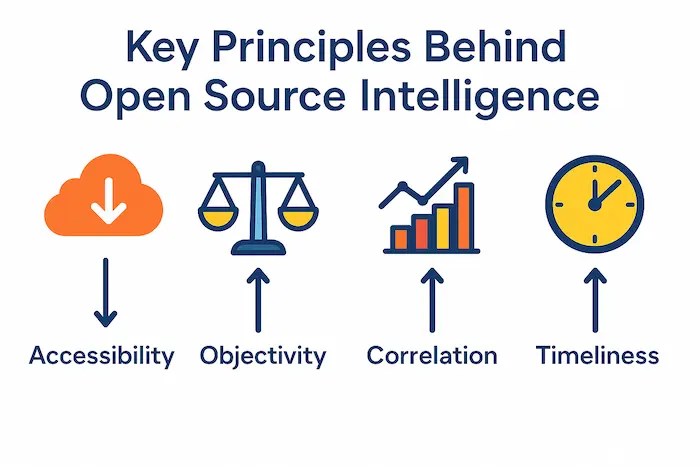
    Key Principles Behind Open Source Intelligence

    Details of Key Principles Behind Open Source Intelligence

    The following are the key principles behind Open Source Intelligence:

    • Legality and Ethics: Legal frameworks, privacy rules, and ethical standards must all be closely followed during the data collection process to prevent information from being misused or accessed without authorization.
    • Accuracy and Verification: To guarantee its accuracy and dependability, data obtained from open sources needs to be cross-referenced and confirmed by several different sources.
    • Relevance and Purpose-Driven Collection: To prevent indiscriminate data hoarding, OSINT collection should always be directed by clear intelligence requirements and a purpose.
    • Operational Security (OPSEC) and Anonymity: To prevent detection or compromise, practitioners must use strategies to safeguard their digital traces and identities while collecting.
    • Contextualization and Analysis: To convert raw OSINT data into actionable intelligence, it needs to be thoroughly examined and contextualized.
    • Documentation and Auditability: Thorough documentation of the sources, methods, and results is necessary to guarantee accountability, transparency, and reproducibility.
    • Proportionality: To prevent collecting too much or too intrusive data, the extent and invasiveness of OSINT collection should be commensurate with the intelligence goal.

    Common Sources of OSINT Data

    S.No. Sources What?
    1. Search Engines It is essential to use general search engines like Google, Bing, and DuckDuckGo in conjunction with sophisticated search operators like Google Dorking.
    2. Social Media Platforms Personal information, relationships, interests, and current events are available on Facebook, X (previously Twitter), Instagram, LinkedIn, Reddit, and specialized forums.
    3. News Media Current events, historical background, and public opinion can be found via online newspapers, periodicals, news archives, and broadcast media.
    4. Public Records Business registrations, property records, court documents, census data, patents, and official reports are all accessible on government websites.
    5. Academic and Professional Publications Specialized information, affiliations, and technological insights can be found in research papers, academic publications, conference proceedings, and professional directories.
    6. Online Directories Identification of people and organizations is aided by phone books, business listings (such as the Yellow Pages, industry-specific directories), and professional networking sites (such as LinkedIn).
    7. Forums and Online Communities Discussions regarding hacking methods, sensitive information, and leaked data can be found in specialist communities, discussion boards, dark web forums, and pastebins.
    8. Websites and Blogs Information on an organization’s technology, infrastructure, and workforce can be found on company websites, individual blogs, archived webpages (through services like the Wayback Machine), and publicly accessible source code repositories (like GitHub).
    9. Geospatial Data Geotagged images, public mapping services, and satellite imagery (Google Maps, Google Earth) offer location intelligence and insights into physical settings.
    10. Technical Data Network infrastructure facts can be found using WHOIS records (domain registration information), DNS records, IP address lookups, open port scans (using tools like Shodan), and SSL/TLS certificate information.

    Risks and Challenges Associated with OSINT

    Details of Risks and Challenges Associated with OSINT

    The following are some of the risks and challenges associated with OSINT:

    1. Information Overload and “Noise”: Because of the enormous amount of publicly available data, it can be quite challenging to weed out unnecessary information and find useful insight.
    2. Accuracy and Verification Issues: It is very difficult to verify the truth and dependability of a lot of the material found online since it is unreliable, biased, or purposefully misleading.
    3. Legal and Ethical Boundaries: It can be difficult to navigate different international rules about copyright, data privacy, and ethical data acquisition, and failure to do so may have legal ramifications.
    4. Misinterpretation and Lack of Context: It is easy for raw OSINT data to be misunderstood and contextualized, which might result in inaccurate assessments or conclusions.
    5. Operational Security (OPSEC) Risks: Unintentionally disclosing one’s identity, objectives, or the goal of an inquiry when gathering OSINT might jeopardize an operation or put the collector in danger.
    6. Keeping Up with Evolving Data Landscapes: Information availability is continually changing due to the quick development of social media platforms, search engine algorithms, and data privacy laws, necessitating regular adaptation.
    7. Bias and Algorithmic Influence: Algorithms frequently impact social media feeds and search engine results, which can limit the variety of material displayed or reinforce preexisting prejudices, compromising the collection’s objectivity.
    8. Limited Access to Deep/ Dark Web: Even while OSINT emphasizes open sources, accessing and effectively analyzing data found on the deep and black web frequently calls for specific tools and knowledge that go beyond what is typically provided by OSINT approaches.

    Legal and Ethical Considerations in OSINT

    S.No. Factors What?
    1. Legality of Data Collection To prevent any unwanted access or actions, OSINT must closely abide by national and international regulations about cybersecurity, data protection, and public information access.
    2. Privacy Rights People have the right to privacy even when data is publicly available, and OSINT practitioners need to think about the moral ramifications of gathering, keeping, and utilizing personal data.
    3. Terms of Service (ToS) Violations Legal action, account suspension, or IP blacklisting may result from data scraping or automated collecting from websites that violate their terms of service.
    4. Misinformation and Disinformation It is the ethical duty of OSINT practitioners to critically assess information and refrain from acting upon or sharing unconfirmed or purposefully misleading information.
    5. Consent Ethical issues come up when processing sensitive personal data that might unintentionally become public, even though OSINT mostly works with publicly available data and typically does not require explicit agreement.
    6. Proportionality and Necessity OSINT collection should always be proportionate to the intelligence goal and required for the task at hand, both in terms of scope and intrusiveness.
    7. Human Rights OSINT operations must ensure that data is not utilized to infringe upon fundamental human rights, such as nondiscrimination, freedom of expression, and privacy.
    8. Data Minimization Avoid needlessly accumulating sensitive or personal data by just gathering that which is directly relevant and required for the intelligence goal.
    9. Transparency and Accountability Organizations implementing OSINT should have defined procedures and be accountable for their data collection and utilization methods, even when precise operational information may be kept confidential.
    10. Avoiding Impersonation/ Deception To retain an ethical position when acquiring information, OSINT should generally refrain from using any kind of impersonation, misrepresentation, or misleading tactics.

    OSINT Tools and Techniques

    Learn about Top 10 OSINT Tools and Techniques

    The following are some of the OSINT tools and techniques:

    1. Google Dorking: Utilizing sophisticated search operators and syntax with search engines (such as Google and Bing) to locate sensitive data, misconfigured websites, or specialized information that isn’t usually found by basic searches.
    2. Social Media Analysis: Collecting data about people, groups, or organizations by looking through public profiles, posts, connections, hashtags, and trends on sites like X, Facebook, LinkedIn, and Reddit.
    3. WHOIS and DNS Lookups: DNS lookups are used to find related IP addresses, mail servers, and subdomains; WHOIS databases are queried to obtain domain registration information (registrant contact, creation date, and nameservers).
    4. Network Scanners (e.g., Shodan, Censys): Mapping an organization’s external attack surface by using specialized search engines such as Shodan and Censys to find internet-connected devices, open ports, banners, and service configurations worldwide.
    5. Metadata Analysis: Obtaining deeper insights by extracting secret information that is encoded in files (such as EXIF data from photos that give GPS locations and camera models, or document attributes that display author names, software versions, and change history).
    6. Web Archiving Services (e.g., Wayback Machine): Seeing earlier iterations of websites and web pages using tools like the Internet Archive’s Wayback Machine to find content that has subsequently been altered or deleted.
    7. Specialized OSINT Frameworks and Tools: Using specialized software such as SpiderFoot for automated reconnaissance across several sources, Maltego for displaying correlations between data points, and Recon-ng as a modular reconnaissance framework.
    8. Paste Sites and Data Breach Archives: Monitor data breach aggregation services (like Have I Been Pwned?) and public paste sites (like Pastebin) for talks regarding possible hacks, exposed credentials, or sensitive documents.
    9. Geospatial Tools: Utilizing satellite imagery, geotagged data from images or social media, and mapping services (Google Maps, Google Earth) to follow movements, assess locations, and identify landmarks.
    10. GitHub and Code Repositories: Looking for accidentally released sensitive data, such as API keys, credentials, proprietary code, or corporate documentation, in public code repositories like GitHub, GitLab, and Bitbucket.

    Future Trends in Open Source Intelligence

    S.No. Trends What?
    1. Hyper-Automation and AI/ ML Integration For automated data collection, sophisticated pattern identification, sentiment analysis, and the quick processing of large, unstructured information, OSINT will increasingly use AI and machine learning.
    2. Deepfake and Synthetic Media Detection OSINT will put a lot of effort into creating sophisticated detection and verification strategies to separate authentic material from manipulated media as deepfakes and AI-generated content, that get more complex.
    3. Enhanced Focus on Dark Web and Encrypted Communications To detect illegal activity, OSINT will place more focus on legally accessing, tracking, and evaluating conversations and data on the dark web as well as deriving conclusions from the metadata of encrypted communications.
    4. Convergence with Other Intelligence Disciplines To provide a more complete and integrated intelligence picture, OSINT will more easily interface with other intelligence disciplines such as SIGINT (signals intelligence) and HUMINT (human intelligence).
    5. Specialized OSINT for Niche Data Types More specialized OSINT tools and methods will be developed for certain data sources, including blockchain transactions, IoT device data, specialist industrial control system (ICS) data, or geographic datasets.
    6. Ethical OSINT and Privacy-by-Design The development of OSINT techniques and technologies with “privacy-by-design” principles, which guarantee data collection is legal, transparent, and minimizes privacy infringement, will be fueled by growing ethical and legal concerns.
    7. Crowdsourced OSINT for Good Decentralized networks of researchers will be able to work together on intricate investigations for journalistic, humanitarian, or public interest goals as the power of crowdsourcing, as exemplified by organizations like Bellingcat, grows.
    8. Global Standardization and Cross-Border Collaboration There will be more attempts made to create international guidelines for OSINT procedures and promote greater cross-border cooperation between intelligence agencies and organizations as threats grow more widespread.
    9. Real-Time Intelligence and Predictive Analytics Predictive analytics will become essential to forecast possible dangers, spot new patterns, and offer proactive insights before incidents happen, increasing the need for real-time OSINT.
    10. Impact of Quantum Computing (Longer Term) Although it is a longer-term trend, OSINT could be severely impacted by quantum computing since it could break existing encryption techniques and allow for much faster processing of large datasets, which would demand the development of new OSINT tools and cryptographic techniques.

    Conclusion

    Now that we have talked about “What is OSINT?” you might want to know where you could learn more about OSINT deeply. For that, you can get in contact with Craw Security, offering the Penetration Testing Course with AI in Delhi to IT Aspirants.

    During the training sessions, students will learn about OSINT deeply under the guidance of professional penetration testing experts. With that, Craw Security offers the facility of remote learning to students via online sessions.

    After the completion of the Penetration Testing Course with AI in Delhi offered by Craw Security, students will receive a dedicated certificate validating their honed knowledge & skills during the sessions. What are you waiting for? Contact, Now!

    Frequently Asked Questions

    About What is OSINT?

    1. What is OSINT?

    The process of gathering and evaluating publicly accessible data to generate intelligence and actionable insights is known as OSINT (Open-Source Intelligence).

    2. How does OSINT differ from traditional intelligence gathering?

    While traditional intelligence collecting frequently depends on proprietary, secret, or classified techniques like signals intelligence (SIGINT) or human intelligence (HUMINT), OSINT only collects information from publicly accessible sources.

    3. What are some common sources used in OSINT?

    The following are some of the common sources used in OSINT:

    1. Social Media Platforms,
    2. Search Engines,
    3. Public Records,
    4. News Media & Blogs, and
    5. Technical Data.

    4. Who uses OSINT in today’s world?

    National security and intelligence agencies, law enforcement, military intelligence, cybersecurity experts (such as penetration testers and threat intelligence analysts), private investigators, journalists, academic researchers, and even corporations use OSINT extensively for risk management and competitive intelligence in today’s world.

    5. How is OSINT changing global cybersecurity practices?

    By facilitating proactive threat intelligence, strengthening vulnerability management, boosting incident response, and offering an attacker’s perspective, OSINT is radically changing worldwide cybersecurity practices and moving defenses from reactive to anticipatory.

    6. Is OSINT legal to use?

    Because OSINT only uses legally accessible and publicly available information, it is typically acceptable to utilize.

    7. What tools are commonly used for OSINT?

    The following are some of the tools commonly used for OSINT:

    1. Search Engines & Advanced Operators (Google Dorking),
    2. Specialized OSINT Frameworks & Automated Tools,
    3. Network & Device Scanners (e.g., Shodan, Censys),
    4. Social Media Analysis Tools, and
    5. Web Archiving & Metadata Analysis Tools.

    8. Can OSINT be used for unethical or malicious purposes?

    Yes, without a doubt. Although OSINT is an effective tool for legal uses, the same methods and publicly accessible information may regrettably be used for nefarious and immoral actions such as fraud, social engineering, doxxing, stalking, and even organizing physical assaults.

    9. How can businesses benefit from OSINT?

    Businesses benefit from OSINT in the following ways:

    1. Enhanced Cybersecurity & Risk Management,
    2. Competitive Intelligence & Market Research,
    3. Improved Due Diligence & Fraud Prevention,
    4. Reputation Management & Crisis Response, and
    5. Optimized Sales, Marketing, & Customer Insights.

    10. Where can I learn more or get trained in OSINT techniques?

    You can join the Penetration Testing Course with AI in Delhi, offered by Craw Security, to learn more about OSINT techniques from professionals.

  • Best Antivirus for Mac: Top 13 Security Apps You Can Trust

    Best Antivirus for Mac: Top 13 Security Apps You Can Trust

    Best Antivirus for Mac: Top 13 Security Apps You Can Trust

    iPhones and Macs have become part of every individual and organization’s needs in the current situation for their speedy performance & security measures. To ensure the best protection of those devices, there are a lot of the Best antiviruses for Mac available in the market.

    Let’s talk about some of them and choose the best one for you out of all. Moreover, in the end, we can talk about the best exercises that you can learn through a dedicated course. What are we waiting for? Let’s get straight to the topic!


    What is Antivirus?

    Details of What is Antivirus? At Craw Security

    A computer application called antivirus software is made to identify, stop, and eliminate dangerous software—also referred to as malware—from your devices. It operates by looking for recognized malware signatures and questionable activity in files, applications, and incoming data.

    Its main objective is to safeguard your data and system against disruption, theft, or damage brought on by ransomware, Trojan horses, worms, viruses, and other online dangers. Let’s talk about the “Best antivirus for Mac!”


    Top 13 Mac Antiviruses In 2025

    Details of Top 13 Mac Antivirus in 2025


    Following are the top 13 Best Mac Antivirus software in 2025:

    1. Intego Mac Internet Security X9:

    Specifically made for Macs, it has a strong firewall and has good detection rates for malware unique to macOS. It is a complete security suite for Mac users and frequently includes helpful extras like data backup and system cleansing tools.

    2. Surfshark One:

    This bundle offers strong malware detection and real-time protection by combining antivirus software with a potent VPN. Users who value both privacy and security will find this lightweight solution suitable, as it doesn’t cause severe system slowdowns.

    3. AVG Internet Security for Mac:

    Provides a lightweight scanner that doesn’t significantly affect system performance along with efficient real-time protection. Offers a strong layer of defense by including ransomware protection in addition to email and online protection.

    4. Avast Premium Security:

    Regularly receives top marks in independent lab tests and offers robust protection against ransomware, malware, and phishing. It offers a comprehensive security suite with additional features like webcam protection, VPN, and data breach monitoring.

    5. McAfee Total Protection:

    In addition to offering complete web security and 100% malware detection rates, certain plans also permit coverage for an infinite number of devices. It is a strong choice for customers with several devices because of its features, which include a strong firewall, a secure VPN powered by TunnelBear, and identity protection measures.

    6. Trend Micro Antivirus for Mac:

    Provides exceptional phishing prevention together with strong security features, which are essential for secure online banking and browsing. It successfully detects a variety of dangers, such as viruses and spyware, and is made to be easy to use.

    7. Norton 360:

    Norton 360, a well-known cybersecurity leader, provides thorough defense against ransomware, malware, and phishing, frequently with a 100% detection rate. It comes with a password manager, cloud backup (although PC cloud backup is limited to Windows), a secure VPN, and Dark Web monitoring.

    8. Avira Prime:

    Provides a very strong antivirus engine that has little effect on system performance and continuously high detection rates. With its unrestricted VPN, password manager, and system optimization tools, this all-inclusive suite offers a great deal of protection and functionality.

    9. Bitdefender Antivirus for Mac:

    Well-known for its cloud-based scanning and great performance, it offers superior malware detection without causing your Mac to lag. For a comprehensive security approach, it has features like Time Machine prevention, Safe Files for ransomware prevention, and an adware blocker.

    10. CleanMyMac X:

    It is mostly a utility for system optimization and cleanliness, but it also has a simple virus eradication function. Although it’s helpful for clearing out your Mac, it’s usually regarded as an add-on utility rather than a complete antivirus program.

    11. BitMedic Pro Antivirus:

    It offers real-time antivirus and adware protection and was created especially for macOS. It frequently receives high independent test scores. In addition to features like custom scans and browser privacy cleaning, it concentrates on essential antivirus tasks.

    12. Sophos Home Premium for Mac:

    Strong defense against malware, ransomware, and harmful websites is provided by this user-friendly collection of enterprise-grade security technologies. It is appropriate for families because it offers remote control for numerous devices and parental web blocking.

    13. Malwarebytes Premium Security:

    Renowned for having powerful malware detection and removal tools, especially for locating and eliminating tenacious threats. It provides web protection and real-time protection, with a primary focus on malware prevention and a limited feature set.


    Benefits of Antivirus for Mac

    S.No. Benefits How?
    1. Comprehensive Malware Protection Compared to built-in security capabilities, dedicated antivirus software offers a more reliable and regularly updated defense against a greater range of macOS-specific and new malware threats.
    2. Real-time Threat Detection Instantaneously preventing and quarantining dangerous files before they can execute and do harm, it actively monitors your system and downloads in real-time.
    3. Protection Against Cross-Platform Malware By identifying and eliminating malware unique to Windows, antivirus software for Mac can stop your computer from serving as a conduit for malicious files distributed to Windows users.
    4. Enhanced Phishing and Scam Protection Advanced web protection technologies that proactively prevent harmful websites and phishing efforts intended to steal your personal information are included in many antivirus programs.
    5. Ransomware Defense In order to identify and stop ransomware from encrypting your important data and requesting a ransom, modern Mac antivirus programs have multiple layers of protection.
    6. Adware and Potentially Unwanted Program (PUP) Removal They efficiently detect and eliminate bothersome adware and perhaps undesired applications that can impair system functionality, show obtrusive advertisements, and jeopardize privacy.
    7. Privacy and Identity Protection In addition to malware, several suites include tools like password managers, VPNs, and dark web surveillance to improve online privacy and safeguard your financial and personal information.
    8. Improved System Performance and Cleanup In order to combat the slowdown frequently brought on by malware or bloatware, several antivirus products come with optimization tools that can help remove unnecessary files, control startup items, and enhance system performance.

    Best Free Mac Antivirus in 2025

    Learn about best free mac antivirus

    The following are some of the free Mac Antivirus programs:

    1. Avast Security for Mac: Provides basic malware protection, which includes real-time scanning and detection of threats such as spyware, ransomware, and viruses. Include email and web shields to assist in stopping harmful websites and stop malicious attachments from getting to your mailbox.

    2. Avira Free Antivirus for Mac: offers a powerful antivirus engine that efficiently identifies PC-based threats and malware unique to macOS, stopping your Mac from transmitting them.

    It is portable and frequently includes extra free utilities like a password manager for increased privacy and a VPN (with data limits).

    3. AVG Antivirus for Mac: Offers strong, real-time protection against spyware, ransomware, and viruses while having no effect on system performance. incorporates email and web security tools to assist in preventing harmful files and links, making internet browsing safer.

    4. Bitdefender Virus Scanner for Mac: An extremely lightweight program that focuses mostly on on-demand scanning to find viruses on Windows and macOS. It is great for fast scans and cleaning particular files or folders, but it does not provide real-time security.

    5. Intego VirusBarrier Scanner: An extremely lightweight program that focuses mostly on on-demand scanning to find viruses on Windows and macOS. It is great for fast scans and cleaning particular files or folders, but it does not provide real-time security.

    6. Malwarebytes Antivirus for Mac: Outstanding at identifying and eliminating potentially unwanted programs (PUPs) and adware, which can be a common annoyance for Mac users.

    While the premium edition includes real-time protection, the free version provides an on-demand scanner for current infections.


    Other Antivirus Software For Mac Software Tested

    S.No. Antivirus What?
    1. Total AV Antivirus Pro In addition to having helpful supplementary features like a VPN and system tune-up tools, this antivirus often receives good marks in independent lab testing for malware detection.

    The subscription plans offer extensive real-time protection and web security capabilities across several platforms, while the free version has limitations.

    2. Eset Home Security Although ESET provides a strong firewall and efficient malware detection, its Mac version usually lacks some of the capabilities found in its Windows equivalent.

    Although some customers find its online and email protection for Mac less reliable than rivals, it frequently excels at identifying viruses that other scanners might overlook.

    3. Total Defense Antivirus for Mac This solution frequently licenses Bitdefender’s powerful scanning engine, which offers extensive defense against ransomware and malware on Windows and macOS.

    Since it is based on a different engine, it might not be directly certified by independent labs, but it usually provides strong anti-phishing capabilities and real-time security.

    4. ClamXav ClamXav, which is based on the open-source Clam Antivirus engine, offers simple and effective malware scanning tailored for macOS.

    It is a fantastic option for people who value simple, efficient malware protection without a lot of extra features because of its reputation for simplicity and minimal system impact.

    5. F-Secure Total for Mac In addition to offering robust malware protection, F-Secure Total delivers a more complete security suite that includes a VPN, password manager, and identity monitoring.

    Although it performs well in independent lab testing for protection, some users have complained that its parental controls are simple to get around and that its complete scans can take a long time.

    Why can you trust Macworld’s antivirus experts?

    Learn about why can you trust macworld’s antivirus experts

    One can trust Macworld’s antivirus experts for the following reasons:

    • Mac-Specific Focus: Since Macworld focuses on Apple products, its professionals are specialists in macOS vulnerabilities and the distinct security environment of the Mac ecosystem.
    • Long-Standing Reputation: With decades of experience, Macworld has a lengthy history and a solid reputation as a reliable source for news and reviews of Apple products.
    • Hands-on Testing Methodology: They test antiviral software thoroughly and practically on real Mac systems, evaluating things like feature efficacy, performance impact, and installation.
    • Malware Sample Testing: In order to thoroughly verify detection rates and real-time scanning capabilities, their assessments frequently include a variety of recent Mac malware samples.
    • Consideration of User Experience: They assess the software’s usability, interface design, and handling of typical user interactions and notifications in addition to its raw performance.
    • Comparative Analysis: Usually, they contrast various antiviral programs with one another, offering a useful comparative viewpoint on advantages and disadvantages.
    • Transparency in Methodology: They frequently include insights into their testing procedure, including the macOS versions and testing conditions used, even though they aren’t always completely thorough for every review.
    • Regular Updates and Re-evaluations: Reputable sites like Macworld regularly update their ratings and reassess antivirus software to reflect the latest threats and product updates because the cybersecurity landscape is constantly changing.


    How to choose the best Mac Antivirus for your needs?

    S.No. Factors Why?
    1. Level of Protection and Detection Rates For the detection of both macOS-specific and cross-platform malware, such as ransomware and phishing threats, look for tools that routinely receive good scores in independent lab testing (such as AV-Comparatives and AV-Test).
    2. Performance Impact on Your Mac Select antivirus software that ensures minimal slowdowns to your system’s speed and responsiveness throughout daily use by running silently in the background and performing scans efficiently.
    3. Features Beyond Basic Antivirus Depending on your total security requirements, take into account extra security solutions like a firewall, VPN, password manager, webcam/ mic protection, parental controls, or identity theft monitoring.
    4. Ease of Use and User Interface Select software with a user-friendly, uncluttered interface that makes it simple to change settings, comprehend scan findings, and access all security features without any technical difficulties.
    5. Cost and Customer Support Make sure the service offers helpful customer care channels like live chat or phone for assistance, and assess whether the cost fits within your budget by taking into account free trials or money-back guarantees.

    Conclusion

    Now that we have talked about the Best antivirus for Mac, you might be wondering what the best solutions available for the security of Mac in the IT Industry are. For that, you can get in contact with Craw Security, offering the Ethical Hacking Training Course with AI in Delhi to IT Aspirants.

    During the training sessions, students will be able to practice their skills and learn about various other security measures for Mac under the guidance of professional ethical hackers. With that, remote learning will be possible with online sessions.

    After the completion of the Ethical Hacking Training Course with AI in Delhi offered by Craw Security, students will receive a dedicated certificate validating their honed knowledge & skills during the sessions. What are you waiting for? Contact, Now!


    Frequently Asked Questions

    About the Best antivirus for Mac

    1. Do Macs need antivirus software?

    Dedicated antivirus software is still advised for complete protection against the increasing diversity and complexity of ransomware, adware, phishing, and macOS-specific malware, even if Macs come with robust built-in security protections.

    2. How does antivirus software protect your Mac?

    By checking files and programs for known malware signatures, examining questionable activity, and preventing or eliminating threats instantly, antivirus software safeguards your Mac. This includes protections against ransomware and phishing.

    3. Should my Mac antivirus include a VPN?

    By encrypting your internet traffic and hiding your IP address, a VPN adds increased privacy and security to your Mac antivirus suite, even though it isn’t technically required for antivirus operation.

    4. What is the best-value Mac antivirus?

    According to recent evaluations, TotalAV is commonly regarded as the best-value Mac antivirus because of its robust security, easy-to-use interface, and frequently affordable initial pricing—though renewal fees should be taken into account.

    5. How to spot fake Mac antivirus software?

    Fake Mac antivirus software can be identified by its aggressive marketing strategies, bad grammar or spelling, inability to close the program or install genuine antivirus software, and uninvited pop-up alerts alleging infections.

    6. What can’t Mac antivirus protect from?

    Even the greatest Mac antivirus software cannot completely guard against all threats, especially those that come from user error (such as downloading files from unreliable sites or falling for phishing scams), zero-day vulnerabilities (exploits that developers or security companies are unaware of), or device theft.

  • Top 10 Website Malware Scanners In 2026

    Top 10 Website Malware Scanners In 2026

    Top 10 Website Malware Scanners: Protect Your Site from Threats

    Websites are always surrounded by a huge amount of malware and viruses, and for their safety, you can use available malware scanners for better protection. Here we will talk about the Top 10 Website Malware Scanners in 2026 available in the IT Industry for security matters.

    In the end, we will introduce you to a reputed training institute offering a dedicated training & certification program related to website application security skills. What are we waiting for? Let’s get straight to the topic!

    What are Website Malware Scanners?

    Details of What are Website Malware Scanners

    Website malware scanners are programs that check the code and content of a website for vulnerabilities, hidden scripts, and malicious software. They assist in detecting and warning website owners about threats such as ransomware, malware, and phishing scams.

    These scanners are essential for preserving website security and safeguarding users. Let’s talk about “Website Malware Scanners!”

    Top 10 Website Malware Scanners

    S.No. Website Malware Scanners What?
    1. Sucuri SiteCheck A well-liked and user-friendly web scanner for fast checks. It is also a component of a broader security platform that provides DDoS protection, a firewall, and malware cleanup.
    2. SiteLock Offers a variety of online security services, such as vulnerability patching, malware detection and removal, and website acceleration.
    3. Jetpack Protect (for WordPress) A solution designed specifically for WordPress that offers site security features and virus detection.
    4. MalCare (for WordPress) Renowned for its firewall, one-click eradication, and thorough malware screening.
    5. Invicti (formerly Netsparker) An effective DAST (Dynamic Application Security Testing) tool that automatically finds malware-exploitable flaws like SQL injection and XSS.

    Additionally, it emphasizes precise outcomes through proof-based scanning.

    6. Acunetix Over 7,000 known vulnerabilities, including those that can result in malware infestations, are found using this top web vulnerability scanner.
    7. Burp Suite An effective vulnerability scanner is a popular penetration testing tool. For in-depth examination, security experts frequently prefer it.
    8. Tenable Nessus It is mostly a thorough vulnerability scanner for systems and networks, but it can also scan web applications for security holes that can allow malware to infect them.
    9. Qualys Web Application Scanning (WAS) This cloud-based solution, which is a component of the Qualys platform, checks web apps for a variety of vulnerabilities, including ones that malware could exploit.
    10. OWASP ZAP (Zed Attack Proxy) A web application security scanner that is open-source and free. For finding a variety of vulnerabilities, it’s a great tool for developers and security testers.

    Why Malware Scanning Is Essential in 2026?

    Why Malware Scanning Is Essential in 202500

    Malware Scanning is essential in 2026 for the following reasons:

    • Evolving Threat Landscape: Because cybercriminals are always creating new malware varieties and attack methods, it is imperative to maintain ongoing attention.
    • Increased Sophistication of Attacks: Malware is getting increasingly sophisticated and frequently uses cunning evasion techniques to get past conventional security measures.
    • Ransomware-as-a-Service (RaaS) Proliferation: More threat actors are launching these damaging assaults against businesses of all sizes due to the availability of access to ransomware kits.
    • AI as a Double-Edged Sword: Although AI can strengthen security, attackers are also using it to produce increasingly sophisticated and customized malware.
    • Data Breaches and Financial Costs: Costly data breaches brought on by malware infestations usually result in large financial losses from recovery, penalties, and legal bills.
    • Reputation and Trust: A website with malware undermines consumer confidence and seriously harms a company’s reputation.
    • Compliance and Regulations: To safeguard sensitive data, numerous industry standards and data protection laws require strong security measures, such as routine virus scanning.
    • Automated and Continuous Monitoring: Automated and continuous malware scanning is essential for real-time detection and quick reaction to new threats; manual scans are insufficient.

    Industries that need malware scanning

    S.No. Industries Why?
    1. Healthcare Contains enormous volumes of extremely sensitive patient data, such as personal information and medical records, which are highly useful for fraud and identity theft.

    Additionally, disruptions can have a direct effect on patient care and life.

    2. Financial Services Oversees substantial financial resources and private client information, which makes them easy targets for ransomware, theft, and fraud.
    3. Government and Public Sector They are targets for espionage, disruption, and data exfiltration because they store vast amounts of sensitive personal information about citizens, classified intelligence, and vital national infrastructure.
    4. Manufacturing Depends more and more on networked technologies, such as Industrial Control technologies (ICS), which can affect global supply chains, interfere with production, and steal intellectual property if they are compromised.
    5. Energy and Utilities Runs vital infrastructure that is necessary for everyday living and national security, such as water treatment facilities and electrical grids.

    Widespread outages and serious disruptions to society can result from attacks.

    6. Retail and E-commerce Handles a lot of personal data and payment information from customers, which makes them vulnerable to identity theft, credit card fraud, and data breaches.
    7. Technology (IT and Software) Frequently creates and maintains confidential client data, source code, and valuable intellectual property. They may also serve as a point of entry for supply chain intrusions.
    8. Professional Services (Law Firms, Consulting, Accounting) Oversees extremely private client data, financial information, and intellectual property, which makes them appealing for corporate extortion or espionage.
    9. Education Stores staff and student personal information, researches intellectual property, and frequently has weaker security resources, leaving them open to ransomware and data theft.
    10. Small and Medium Businesses (SMBs) They frequently lack the resources necessary for thorough cybersecurity, which makes them more vulnerable to opportunistic attackers looking to take advantage of weaknesses or use them as a springboard to more established partners.

    How to Choose the Right Malware Scanner for Your Website?

    How to Choose the Right Malware Scanner for Your Website

    You can choose the right malware scanner for your website by considering the following factors:

    1. Scope of Scan (External vs. Server-Side): Assess whether you require a thorough examination of your server files and database (server-side), which is more thorough, or just exterior tests that are visible to the public.
    2. Detection Capabilities and Accuracy: To guarantee accurate identification of existing and developing threats, look for scanners that limit false positives and use a variety of detection techniques (signature-based, heuristic, behavioral).
    3. Malware Removal and Remediation: Since detection alone is insufficient, check to see if the scanner has automatic cleanup capabilities or explicit directions for manual removal.
    4. Integration and Ease of Use: Select a scanner that offers an easy-to-use interface for setup, configuration, and monitoring, and that easily connects with the platform of your website (such as a WordPress plugin).
    5. Additional Security Features and Support: A Web Application Firewall (WAF), vulnerability scanning, real-time monitoring, and dependable customer service for prompt assistance during incidents are examples of solutions that provide a broader security suite.

    Job Profiles related to Web Application Security

    S.No. Job Profiles What?
    1. Application Security Engineer Creates, develops, and applies security features and secure coding techniques to online applications.
    2. Web Penetration Tester/ Ethical Hacker By mimicking actual attacks, it proactively finds security flaws in online applications.
    3. Security Analyst (with AppSec focus) Keeps an eye on, evaluates, and handles security events that are especially connected to web applications.
    4. Security Architect (Application/ Cloud Focus) Creates the overarching security plan and architecture for cloud-native services and web applications.
    5. DevSecOps Engineer Incorporates security procedures and resources into web application development at every stage of the process.
    6. Vulnerability Management Specialist (Web Applications) Oversees the detection, evaluation, and correction of security vulnerabilities in online applications.
    7. Incident Response Analyst (with AppSec focus) Examines and resolves security events and breaches that particularly impact web applications.
    8. Security Consultant (Web Application Security) Offers businesses professional guidance and services about the security of their web applications.
    9. Product Security Engineer Incorporates security into the planning and creation of particular software features or products.
    10. Security Researcher/ Malware Analyst (Web-focused) Analyzes online-based malware, finds new vulnerabilities in web applications, and creates protections against new threats.

    Conclusion

    Now that we have gone through the Top 10 Website Malware Scanners, you might want to learn about website application security professionally. For that, you can get in contact with Craw Security, offering the Web Application Security Training Course to IT Aspirants.

    During the training sessions, students will be able to learn about various website malware scanners that ensure the safety of websites. With that, for remote learning, Craw Security offers online sessions.

    After the completion of the Web Application Security Training Course with AI in Delhi offered by Craw Security, students will receive a dedicated certificate validating their honed knowledge & skills during the sessions. What are you waiting for? Contact, Now!

    Frequently Asked Questions

    About Top 10 Website Malware Scanners in 2025

    1. What is a website malware scanner, and how does it work?

    A website malware scanner is a tool that checks a website’s files, databases, and code for malicious software. It does this by employing several methods, such as anomaly detection, heuristic analysis, and signature-based detection, which match known malware patterns to identify and frequently assist in removing or quarantining threats.

    2. How often should I scan my website for malware?

    Since new dangers are always emerging, you should check your website for malware at least once a day, or even more frequently if it’s an important site that gets changes frequently.

    3. Are free malware scanners effective for website protection?

    Free virus scanners can be useful for quick checks and basic website protection, but they frequently have drawbacks like less thorough scanning (just external scans, not server-side), fewer sophisticated detection techniques, and typically no automated removal or continuous protection features.

    4. What features should I look for in a website malware scanner?

    You should look for the following features in a website malware scanner:

    1. Comprehensive Scanning,
    2. Advanced Detection Techniques,
    3. Automated Malware Removal & Remediation,
    4. Real-time Monitoring & Alerts, and
    5. Additional Security Features & Integration.

    5. Can malware scanners detect all types of website threats?

    Because new, sophisticated, and zero-day malware variants are always appearing and can elude even the most powerful detection techniques, malware scanners are unable to identify every kind of website threat.

    6. Will using a malware scanner slow down my website?

    Malware will drastically slow down your website, but modern malware scanners—especially remote or cloud-based scanners that use their own server resources for scanning—are made to have as little of an impact as possible on website speed.

    7. How do I remove malware found by a scanner?

    Typically, you take your website offline, create a backup, use the scanner’s automated removal feature (if available), manually remove or clean infected files and database entries by comparing them to clean versions, update all software, and change passwords to remove malware that has been detected by a scanner.

    8. Are malware scanners compatible with all website platforms?

    Though some may have specialist plugins or deeper integrations for particular CMS systems, the majority of malware scanners offer broad compatibility with popular website platforms, including WordPress, Joomla, Drupal, and custom-coded sites.

    9. What is the difference between manual and automated malware scanning?

    While automated scanning uses software tools to quickly and regularly check against known malware signatures and suspicious behaviors, manual scanning involves a human expert carefully examining code, files, and server configurations for malicious activity. This method frequently finds complex or novel threats.

    10. Can a malware scanner prevent future attacks on my website?

    No, a malware scanner’s primary function is to identify infections that already exist; although its insights can enhance security, they often don’t stop future attacks on their own.

  • Penetration Testing Summer Internship In Delhi [2026 Updated]

    Penetration Testing Summer Internship In Delhi [2026 Updated]

    Penetration Testing Summer Internship In Delhi

    Want to make a career in the IT Industry with penetration testing skills? If yes, then you are at the right place. Here, we will talk about a Penetration Testing Summer Internship in Delhi that will help you make a career in the cybersecurity domain under the guidance of experts.

    In the end, we will introduce you to a reputed training institute offering this amazing internship program with the help of professional pentesters. What are we waiting for? Let’s get straight to the topic!

    What is a Penetration Testing Internship?

    Info about What is a Penetration Testing Internship

    Through a supervised work experience, a penetration testing internship teaches participants how to mimic cyberattacks on computer networks, systems, or applications. After identifying security flaws and responsibly exploiting them, interns record their findings and offer remedial suggestions.

    Under the supervision of seasoned penetration testers, it offers experience in ethical hacking and aids in the development of future cybersecurity experts. Let’s talk about the “Penetration Testing Summer Internship in Delhi!”

    Key Skills Gained in Penetration Testing Internships

    S.No. Skills What?
    1. Vulnerability Identification & Exploitation Practical expertise in identifying and ethically taking advantage of security vulnerabilities in networks, apps, and systems using tools and techniques.
    2. Tool Proficiency Proficiency with industry-standard penetration testing tools, such as John the Ripper, Nmap, Metasploit, Burp Suite, Wireshark, and other vulnerability scanners.
    3. Reporting & Documentation The capacity to effectively communicate results, hazards, and suggested corrective actions in thorough and expert penetration test reports.
    4. Network Security Fundamentals A better comprehension of network architectures, protocols, and typical vulnerabilities (such as unpatched systems and misconfigurations).
    5. Web Application Security Specific knowledge of OWASP Top 10 common web application vulnerabilities, such as SQL Injection, XSS, weak authentication, and broken access control, and the ability to attack them.
    6. Operating System Security Familiarity with typical hardening strategies, privilege escalation tactics, and security setups across several operating systems (Windows, Linux).
    7. Ethical Hacking Methodologies OWASP, PTES (Penetration Testing Execution Standard), and NIST are examples of formal penetration testing frameworks that are used in practice.
    8. Programming/ Scripting for Security Gaining proficiency with scripting languages (like as Python, Bash, and PowerShell) for data analysis, task automation, and creating unique vulnerabilities.
    9. Problem-Solving & Critical Thinking Improved capacity to tackle challenging security issues, adopt an attacker’s mindset, and identify vulnerabilities in novel ways.
    10. Communication & Collaboration Enhanced communication abilities to work well in a security team and convey findings to both technical and non-technical audiences.

    Why Choose a Summer Internship in Penetration Testing?

    Details about Why Choose a Summer Internship in Penetration Testing

    You should choose a summer internship in penetration testing for the following reasons:

    1. Hands-on Practical Experience: Applying theoretical knowledge to real-world systems in a regulated, moral setting is made possible by a summer internship, which provides priceless practical experience.
    2. Career Exploration & Specialization: It gives you an up-close look at a pentester’s daily tasks, which can help you decide if this is the proper career path and pinpoint your areas of interest (web, network, mobile, etc.).
    3. Networking Opportunities: Through networking with mentors, industry experts, and other aspiring pentesters, internships pave the way for future partnerships and employment prospects.
    4. Skill Development & Portfolio Building: You’ll develop important technical skills and work on real projects, building a strong portfolio that will demonstrate your ability to potential employers.
    5. Accelerated Learning Curve: Compared to academic study alone, the immersive nature of an internship, combined with mentorship, greatly accelerates your comprehension of intricate security concepts and practical implementation.

    Top Benefits of Completing a Penetration Testing Internship

    S.No. Benefits How?
    1. Direct Practical Application Applying your theoretical understanding of cybersecurity to real systems and networks in a regulated setting gives you priceless practical experience.
    2. Industry-Standard Tool Proficiency The use of vital penetration testing tools such as Metasploit, Burp Suite, Nmap, and other vulnerability scanners is mastered by interns.
    3. Comprehensive Skill Development You develop abilities in vulnerability evaluation, ethical exploitation, reporting, and secure configuration analysis in addition to technical tools.
    4. Enhanced Problem-Solving & Critical Thinking By cultivating a hacker’s attitude, the internship enhances your capacity to evaluate intricate systems and spot hidden security flaws.
    5. Professional Networking You establish connections with seasoned pentesters, security experts, and possible future employers, which can lead to job openings and mentoring.
    6. Valuable Resume Builder & Portfolio A finished internship gives you tangible project experience to highlight your practical talents and greatly improves your resume.
    7. Accelerated Learning Curve Your comprehension and practical implementation of security topics are significantly accelerated by the immersive, hands-on experience of an internship under the guidance of professionals.
    8. Clarified Career Path It provides a realistic look at a pentester’s typical workday, allowing you to confirm your interest in the topic and pinpoint potential areas of future specialization.

    Why Delhi Is the Best Place for a Penetration Testing Internship?

    Delhi is the best place for a penetration testing internship for the following reasons:

    • Thriving Cybersecurity Ecosystem: The cybersecurity sector in Delhi is growing quickly, and there are several companies that specialize in penetration testing, offering lots of internship possibilities.
    • High Demand for Security Professionals: In Delhi and the NCR, there is a notable and increasing need for qualified penetration testers in a variety of industries as cyber risks increase.
    • Presence of Diverse Industries: Interns are exposed to a variety of attack surfaces and practical security issues with a focus on the IT, financial, government, and e-commerce industries.
    • Access to Training and Mentorship: Numerous cybersecurity training facilities and seasoned experts can be found in Delhi, which provides organized instruction and priceless mentoring possibilities.
    • Government Initiatives and Public Sector Opportunities: Delhi’s public sector and government agencies are spending more on cybersecurity, opening up special internship opportunities in national security.

    Learn about 1 Year Cyber Security Diploma Course in Delhi

    Hands-On Experience: Practical Tools and Techniques

    The following are some of the tools you will encounter during the penetration testing summer internship in Delhi:

    1. Kali Linux: With hundreds of security tools included, this pre-built operating system was created especially for penetration testing and serves as the main environment for the majority of engagements.
    2. Nmap (Network Mapper): To find hosts and services on a network, locate open ports, and carry out OS fingerprinting, it is necessary for reconnaissance.
    3. Metasploit Framework: An extensive catalog of exploits, payloads, and post-exploitation modules for obtaining and preserving access to target systems is provided by this potent exploitation framework.
    4. Burp Suite (Community or Professional): The preferred web application proxy and vulnerability scanner, which can be used to undertake a variety of web application assaults, detect online vulnerabilities (such as XSS and SQLi), and intercept, examine, and modify HTTP/S traffic.
    5. Wireshark: A network protocol analyzer is a tool used to record and examine network traffic to troubleshoot network problems, uncover sensitive material that hasn’t been encrypted, and comprehend communication patterns.
    6. John the Ripper/ Hashcat: Strong password-cracking programs that employ brute-force, dictionary, and other techniques to test the strength of hashed passwords.
    7. OWASP ZAP (Zed Attack Proxy): Similar to Burp Suite, this free and open-source web application security scanner is frequently used for both automated and manual vulnerability testing of web applications.
    8. SQLmap: An automated tool for database takeover and SQL injection that finds and takes advantage of SQL injection vulnerabilities in web applications to manipulate databases and extract data.
    9. Vulnerability Scanners (e.g., Nessus, OpenVAS): Tools for automated vulnerability evaluation that find known security flaws, unpatched vulnerabilities, and system and network configuration errors.
    10. Custom Scripts (Python, Bash, PowerShell): To automate operations, customize vulnerabilities, analyze data, or create unique tools for certain testing scenarios, interns frequently learn how to write or alter scripts.

    Career Opportunities After Penetration Testing Internship

    S.No. Job Profiles What?
    1. Junior Penetration Tester/ Ethical Hacker This is the most straightforward step, when security assessments are actively conducted and vulnerabilities in systems, networks, and applications are found.
    2. Security Analyst (SOC Analyst) In a Security Operations Center, you can use your knowledge of attack methods to keep an eye on security systems, identify dangers, and handle problems.
    3. Vulnerability Management Specialist This position entails methodically locating, ranking, and overseeing the fixing of security flaws in all of an organization’s assets.
    4. Application Security Engineer Within software development teams, you can use your understanding of web application vulnerabilities to create, develop, and execute secure coding practices.
    5. Security Consultant In addition to conducting audits and offering recommendations for enhancements based on your penetration testing findings, you will counsel firms on their security posture.
    6. DevSecOps Engineer Make sure security is ingrained in programs from the beginning by integrating security procedures and resources into the software development lifecycle.
    7. Incident Response Analyst Make use of your knowledge of breach mechanisms to minimize harm by investigating, containing, and recovering from cyberattacks.
    8. Security Researcher In a research-oriented position, you could concentrate on finding new vulnerabilities, creating exploits, or assessing new risks.
    9. Bug Bounty Hunter (Freelance/ Full-time) To earn money, use your penetration testing expertise to identify and disclose flaws in open bug bounty programs.
    10. Cybersecurity Trainer/ Educator Teach aspiring cybersecurity professionals about ethical hacking and penetration testing to share your real-world expertise.

    How to Apply for a Penetration Testing Internship in Delhi?

    Now that we have talked about the Penetration Testing Summer Internship in Delhi, you might be wondering where you could get the best training experience. For that, you can get in contact with Craw Security, offering the Penetration Testing Course with AI in Delhi to IT Aspirants.

    During the training sessions, practitioners will be able to learn various pentesting skills under the supervision of professional penetration testers. With that, remote learning will be possible via the online sessions.

    After the completion of the Penetration Testing Course with AI in Delhi offered by Craw Security, students will receive a dedicated certificate validating their honed knowledge & skills during the sessions. What are you waiting for? Contact, Now!

    Frequently Asked Questions

    About Penetration Testing Summer Internship in Delhi

    1. What is a Penetration Testing Summer Internship?

    A Penetration Test to identify and report security flaws in systems and applications; interns participate in a brief, supervised program called the Summer Internship that takes place during the summer.

    2. How long does the Penetration Testing Summer Internship last?

    The Penetration Testing Summer Internship  in 2026 offered by Craw Security lasts at most 6 months.

    3. What are the eligibility requirements for the internship?

    A recent graduate of any technical field, a working professional looking to change careers, a non-tech student with rudimentary computer skills, or a cybersecurity enthusiast is all considered for a Penetration Testing Summer Internship.

    Prior cybersecurity experience is frequently not required, but a strong interest in ethical hacking is essential.

    4. Do I need prior experience to apply for this internship?

    Since this internship is intended for recent graduates, working professionals changing careers, non-tech students, and cybersecurity enthusiasts with a love for ethical hacking, no prior experience is strictly required.

    5. What skills will I gain during the internship?

    One will gain the following skills during their internship:

    1. Practical Ethical Hacking Techniques,
    2. Proficiency with Industry Tools,
    3. Vulnerability Assessment & Reporting,
    4. Network & Web Application Security Understanding, and
    5. Problem-Solving & Critical Thinking.

    6. Is this internship paid or unpaid?

    The Penetration Testing Summer Internship offered by Craw Security is paid. You can get in contact with counselors with the provided details.

    7. How can I apply for the Penetration Testing Internship in Delhi?

    To apply for the Penetration Testing Summer Internship offered by Craw Security, you can go to the official website of Craw Security and contact the counselors.

    8. What tools and technologies will I work with during the internship?

    You will work with the following tools during the internship:

    1. Kali Linux,
    2. Nmap (Network Mapper),
    3. Metasploit Framework,
    4. Burp Suite (Community or Professional), and
    5. Wireshark.

    9. Will I receive a certification after completing the internship?

    Yes, after the completion of the penetration testing summer internship in 2026 offered by Craw Security, you will receive a dedicated certificate.

    10. What career opportunities are available after completing the Penetration Testing Internship?

    The following are some of the career opportunities after the completion of the penetration testing internship:

    1. Junior Penetration Tester/ Ethical Hacker,
    2. Security Analyst (SOC Analyst),
    3. Vulnerability Management Specialist,
    4. Application Security Engineer, and
    5. Security Consultant.

  • What is Zero Trust Security? Benefits & Implementation Tips

    What is Zero Trust Security? Benefits & Implementation Tips

    What is Zero Trust Security? Benefits & Implementation Tips

    Do you know about “What is Zero Trust Security?” If not, then you should really learn about how zero-trust security works for the protection of organizations’ confidential data against online threats.

    In the end, we will introduce you to a reputed training institute offering a dedicated training & certification program related to ethical hacking skills. What are we waiting for? Let’s get straight to the point!

    What is Zero Trust Security?

    Learn about What is Zero Trust Security

    The cybersecurity concept known as “zero trust security” is founded on the idea that “never trust, always verify.” It makes the assumption that no application, user, or device—whether inside or outside the network—should be taken for granted.

    The idea of least privilege is enforced by granting access to resources only after rigorous identity authentication, device validation, and ongoing monitoring. Let’s talk about “What is Zero Trust Security?

    Core Principles of Zero Trust Architecture

    Details about Core Principles of Zero Trust Architecture

    The following are the core principles of zero trust architecture:

    • Verify Explicitly: No matter where they are, all users and devices are verified and approved before being allowed access.
    • Use Least Privilege Access: For a restricted period, users and devices are only given the bare minimum of access to resources.
    • Assume Breach: Prepare for discovery and containment by designing security with the assumption that breaches will happen.
    • Segment Networks: In the event of a breach, network access is micro-segmented and granularly regulated to restrict lateral movement.
    • Monitor Continuously: The health of the gadget, user behavior, and network traffic are all regularly checked for unusual activities.
    • Automate and Orchestrate: Automated and coordinated security operations provide for consistent policy enforcement and quick reaction.
    • Enforce Policies Dynamically: Real-time context, such as user identity, device posture, and environmental characteristics, informs the enforcement of adaptive access policies.

    Key Benefits of Zero Trust Security

    S.No. Benefits How?
    1. Reduced Attack Surface Zero Trust drastically reduces the number of possible entry points for attackers by doing away with implicit trust and implementing granular access limits.
    2. Enhanced Data Protection By constantly confirming access requests, even when a user or device is already connected to the network, it offers strong protection for sensitive data.
    3. Improved Threat Detection and Containment Threats may be identified and isolated more quickly thanks to ongoing monitoring and micro-segmentation, which also reduces their overall impact and lateral movement.
    4. Better Compliance and Regulatory Alignment Organizations may comply with several regulatory obligations thanks to Zero Trust’s stringent access restrictions, audit trails, and data protection procedures.
    5. Stronger Remote Work Security Without depending on conventional, less secure VPNs, it safely expands remote and dispersed workforces’ access to apps and data.
    6. Mitigation of Insider Threats Zero Trust dramatically lowers the possibility of malevolent or unintentional insider acts by implementing the “never trust, always verify” philosophy for all users.
    7. Increased Agility and Adaptability Zero Trust offers a consistent security architecture across various IT landscapes, making it ideal for dynamic situations such as cloud and hybrid infrastructures.
    8. Potentially Reduced Costs (Long-term) Significant long-term cost savings can result from more efficient threat neutralization and lessened impact of breaches, even though an upfront investment would be necessary.

    Why Traditional Security Models Are No Longer Enough?

    Why Traditional Security Models Are No Longer Enough

    For the following reasons, traditional security models are no longer enough:

    1. Blurred Network Perimeter: The traditional network barrier has been essentially destroyed by the rise of cloud computing, remote work, mobile devices, and the Internet of Things, making it impossible to clearly distinguish an “inside” and “outside.”
    2. Implicit Trust within the Network: Attackers who obtain initial access can move laterally and freely within the network since traditional models, by nature, trust anything or anybody once they have crossed the perimeter.
    3. Sophisticated Evolving Threats: To get around signature-based detection and static perimeter defenses, cybercriminals are using increasingly sophisticated and versatile attacks (such as fileless malware, zero-day exploits, and AI-powered attacks).
    4. Insider Threats: Conventional approaches cannot identify and stop internal threats, such as malevolent insiders or unintentional breaches brought on by staff mistakes.
    5. Increased Attack Surface: The possible attack surface has grown rapidly due to the increasing number of data and applications located in various locations (cloud, SaaS, remote endpoints), surpassing protections that are centered on the perimeter.
    6. Ineffective Against Lateral Movement: Traditional security provides little to no segmentation or control once an attacker breaches the perimeter, making it simple for them to access sensitive assets by moving deeper into the network.
    7. Scalability and Adaptability Challenges: The dynamic nature of contemporary IT environments makes it difficult for traditional models to scale, and they frequently lack the flexibility to quickly adjust to emerging threats or changing business requirements.
    8. Reliance on Outdated Technologies: The intricacies of cloud-native applications, dispersed workforces, and the continuous flow of different data are beyond the capabilities of many conventional security measures, including simple firewalls and legacy VPNs.

    How to Implement Zero Trust in Your Organization?

    S.No. Factors Why?
    1. Define Your “Protect Surface” Sort and classify the data, apps, assets, and services (DAAS) that are most important to you and need the best protection.
    2. Map Transaction Flows To find essential communication channels and possible weaknesses, comprehend how users, apps, and gadgets interact with your protected surface.
    3. Architect a Zero Trust Network (Micro-segmentation) Divide your network into discrete, small sections to restrict lateral mobility and provide fine-grained access control.
    4. Establish Strong Identity and Access Management (IAM) Enable continuous authentication and strong multi-factor authentication (MFA) for all users and devices that access resources.
    5. Implement Least Privilege Access Give users and systems just the minimal amount of access necessary to complete their activities as quickly as feasible.
    6. Deploy Endpoint Verification and Management Make certain that any device trying to access resources is in good health, complies with regulations, and is regularly checked for security posture.
    7. Monitor Continuously and Automate To identify and eliminate attacks instantly, automate security responses, and conduct ongoing network activity monitoring.
    8. Educate and Train Your Workforce Make certain that every employee is aware of the Zero Trust tenets and their responsibility to preserve a safe workplace.

    Real-World Use Cases of Zero Trust Security

    The following are the real-world use cases of zero trust security:

    1. Securing Remote and Hybrid Workforces: By substituting granular, verified access for standard VPNs, Zero Trust guarantees safe access for staff members regardless of their location or network.
    2. Protecting Critical Data and Applications in Cloud Environments: For critical data and apps, it offers uniform security policies and controls across hybrid and multi-cloud cloud infrastructures.
    3. Enhancing Third-Party and Partner Access Security: Without disclosing the complete internal network, Zero Trust allows partners and vendors to have secure, time-bound, and least-privilege access to particular resources.

    Zero Trust vs Perimeter-Based Security

    S.No. Topics Factors What?
    1. Zero Trust Security Never Trust, Always Verify This is the fundamental principle. Before granting access, each user, device, application, and network flow must be verified and authorized.

    This process must be repeated during the session.

    Perimeter-Based Security Defined Network Boundary The “perimeter” of the network—the intersection of internal and external networks—is where security measures are most prevalent.
    2. Zero Trust Security Least Privilege Access Only the bare minimum of access rights required to carry out their approved tasks are given to users and devices.

    By doing this, the possible impact of a breach or compromised account is reduced.

    Perimeter-Based Security Trust Inside, Distrust Outside The fundamental premise is that all information inside the network perimeter is reliable, but all information outside is not.
    3. Zero Trust Security Assume Breach The approach is predicated on the idea that a security breach will inevitably occur.

    The goal is to restrict lateral mobility within the network to reduce the “blast radius” of any breach.

    Perimeter-Based Security Reliance on Boundary Devices Security tools such as firewalls, intrusion prevention systems, intrusion detection systems, and virtual private networks (VPNs) at the network edge are crucial to this paradigm.
    4. Zero Trust Security Micro-segmentation There are distinct permission procedures for each of the network’s smaller, isolated segments.

    By doing this, dangers are lessened and kept from spreading.

    Perimeter-Based Security Focus on External Threats Preventing external harmful activity and illegal access to the network is the main objective.
    5. Zero Trust Security Continuous Monitoring and Validation Access is dynamically modified in response to real-time risk assessments, user behavior, and device health, and security posture is continuously monitored.
    Perimeter-Based Security Vulnerability to Lateral Movement Because internal entities are naturally trusted, an attacker can frequently roam freely throughout the internal network if they are successful in breaching the perimeter.

    Common Challenges in Zero Trust Implementation

    Learn about Common Challenges in Zero Trust Implementation

    The following are some of the common challenges in zero trust implementation:

    • Complexity and Scope: Because implementing Zero Trust necessitates significant modifications to the entire IT infrastructure, it can be quite complex.
    • Legacy Systems Integration: It can be challenging and disruptive to integrate older, frequently proprietary systems with a Zero Trust framework.
    • User Experience (UX) Impact: If not handled appropriately, more authentication and authorization stages can have a detrimental impact on user happiness and productivity.
    • Data Classification and Policy Definition: It takes a lot of work to properly categorize all data and establish detailed access rules for each resource.
    • Lack of Visibility and Inventory: It’s frequently difficult to get a thorough grasp of every person, device, program, and data flow inside a company.
    • Skill Gap and Training: Organizations usually need extensive training for their IT and security personnel and lack internal experience in Zero Trust principles.
    • Continuous Monitoring and Enforcement: It takes strong tools and committed work to maintain real-time visibility, ongoing validation, and consistent policy enforcement.
    • Budget and Resource Allocation: The initial outlay of funds and resources for training, re-architecting networks, and purchasing new technologies can be high.

    Technologies That Support Zero Trust

    S.No. Technologies What?
    1. Identity and Access Management (IAM) & Multi-Factor Authentication (MFA) These are essential for confirming user identities and guaranteeing that only those with permission can access resources.
    2. Zero Trust Network Access (ZTNA) Instead of relying on network location, ZTNA solutions establish safe, personalized access to resources and apps based on context and identification.
    3. Micro-segmentation By separating networks into discrete, small sections, this technique restricts attackers’ ability to move laterally and stops intrusions.
    4. Endpoint Detection and Response (EDR)/ Extended Detection and Response (XDR) EDR/XDR tools keep an eye on endpoint behavior and offer thorough threat visibility and response capabilities.
    5. Cloud Access Security Brokers (CASB) CASBs apply Zero Trust principles to cloud environments by enforcing security standards for cloud services.
    6. Security Information and Event Management (SIEM)/ Security Orchestration, Automation, and Response (SOAR) Platforms for SIEM/SOAR combine security data, identify irregularities, and automate incident response procedures for ongoing observation.
    7. Data Loss Prevention (DLP) DLP solutions ensure data integrity and stop unwanted exfiltration by identifying, tracking, and safeguarding sensitive data.
    8. Next-Generation Firewalls (NGFW) Compared to conventional firewalls, NGFWs enable more granular security policies by offering deeper packet inspection and application-level control.
    9. Encryption Even in the event that a system is compromised, critical information is shielded from unwanted access by encryption of data both in transit and at rest.
    10. Behavioral Analytics This technology enables proactive security measures by using machine learning to identify anomalous device or user behavior that can point to a danger.

    Final Thoughts & Future of Zero Trust

    As a result of growing remote work and cloud adoption, Zero Trust is increasingly essential for Indian enterprises to fight changing cyber threats. The emphasis on data protection and regulatory compliance is speeding up its adoption, despite ongoing issues including cost, expertise shortages, and legacy system integration.

    Learn about Six-Months Diploma in Artificial Intelligence (AI) and Machine Learning (ML) in Delhi at Craw Security

    Growing awareness and government actions in India point to a promising future for Zero Trust as the cornerstone cybersecurity approach for all industries.

    Conclusion

    Now that we have talked about “What is Zero Trust Security?”, you might want to learn how to use such systems for your security professionally. For that, you can get in contact with Craw Security, offering the Ethical Hacking Training Course with AI in Delhi to IT Aspirants.

    During the training sessions, students will try their skills on live networks and systems via the virtual labs introduced on the premises of Craw Security. With that, students will be able to facilitate remote learning via online sessions.

    After the completion of the Ethical Hacking Training Course with AI in Delhi offered by Craw Security, students will receive a dedicated certificate validating their honed knowledge & skills during the sessions. What are you waiting for? Contact, Now!

    Frequently Asked Questions

    About What is Zero Trust Security?

    1. What is Zero Trust Security in simple terms?

    Whether a user, device, or application is inside or beyond the conventional network boundary, zero trust security means “never trust, always verify” them all.

    2. How does Zero Trust differ from traditional cybersecurity models?

    While typical models trust everything inside a defined network perimeter, Zero Trust assumes no implicit trust for anybody or anything, regardless of location.

    3. Why is Zero Trust important for modern organizations?

    The following are some of the important aspects of zero trust for modern organizations:

    1. Adapts to the Dissolving Network Perimeter,
    2. Mitigates Insider Threats & Lateral Movement,
    3. Protects Against Sophisticated Cyberattacks,
    4. Secures Hybrid & Multi-Cloud Environments, and
    5. Enhances Regulatory Compliance & Data Protection.

    4. What are the core principles of a Zero Trust Architecture?

    The following are the core principles of a zero-trust architecture:

    1. Never Trust, Always Verify,
    2. Verify Explicitly,
    3. Least Privilege Access,
    4. Assume Breach, and
    5. Continuous Monitoring & Validation.

    5. What are the main benefits of adopting Zero Trust Security?

    The following are the main benefits of adopting zero trust security:

    1. Enhanced Security Posture,
    2. Improved Breach Containment,
    3. Better Protection for Remote & Hybrid Workforces,
    4. Streamlined Compliance & Auditing, and
    5. Reduced Risk of Data Breaches.

    6. What are the first steps to implement Zero Trust in a company?

    The following are the first steps to implement zero trust in a company:

    1. Define the Protect Surface & Identify Critical Assets,
    2. Map Transaction Flows,
    3. Architect Zero Trust Principles,
    4. Identify Gaps & Assess Current Capabilities, and
    5. Start Small with a Pilot Project.

    7. Which technologies are essential for Zero Trust implementation?

    Micro-segmentation, Zero Trust Network Access (ZTNA), Identity and Access Management (IAM) with Multi-Factor Authentication (MFA), and continuous monitoring tools like SIEM/SOAR are all crucial technologies for Zero Trust deployment.

    8. Is Zero Trust Security suitable for small and medium-sized businesses?

    Since its fundamental tenets of “never trust, always verify” are generally advantageous for defending against contemporary cyberthreats and are frequently adjustable through scaled solutions, Zero Trust Security is appropriate for small and medium-sized enterprises.

    9. What challenges do organizations face when adopting Zero Trust?

    The following are the challenges faced by organizations while adopting zero trust:

    1. Complexity of Implementation & Scope,
    2. Integration with Legacy Systems,
    3. User Experience (UX) Disruption,
    4. Lack of Visibility & Accurate Asset Inventory, and
    5. Budget & Resource Allocation.

    10. How does Zero Trust help with compliance and regulatory requirements?

    By implementing granular access controls, enhancing data visibility, and permitting ongoing monitoring and thorough documentation of all activities—all of which are frequently required by regulations—Zero Trust facilitates compliance.

  • Future of Ethical Hacking: AI, Automation & Cybersecurity

    Future of Ethical Hacking: AI, Automation & Cybersecurity

    Future of Ethical Hacking: AI, Automation & Cybersecurity

    Do you want to know about the “Future of Ethical Hacking?” If yes, then this is the right place for you. Here, you will learn about how ethical hacking is evolving, and with the help of AI, it secures the working environment of various sectors in the IT Industry.

    In the end, we will introduce you to a reputable training institute offering a dedicated training & certification program related to ethical hacking with AI skills. What are we waiting for? Let’s get straight to the topic!

    What Is Ethical Hacking?

    Information about What is ethical hacking?

    The act of trying to access computer networks or systems with the owner’s express consent is known as ethical hacking. Its goal is to find security flaws before malevolent hackers take advantage of them.

    By taking a proactive stance, firms may strengthen their cybersecurity defenses. Let’s talk about what the “Future of Ethical Hacking!”

    The Evolution of Cyber Threats in the Digital Age

    The Evolution of Cyber Threats in the Digital Age

    From basic viruses and worms in the early digital era to extremely complex, profit-driven attacks, cyber dangers have changed throughout time. Threats initially centered on disruption, but they soon changed to include corporate espionage and financial gain.

    Ransomware, AI-powered attacks, and advanced persistent threats (APTs) now dominate the environment, which is continuously adjusting to new technologies like cloud computing and the Internet of Things.

    The Role of Human Hackers in an AI-Driven World

    The following are the roles of human hackers in an AI-Driven World:

    1. Creativity and Unpredictability: AI is now unable to imagine the new attack vectors and unanticipated system interactions that humans can create.
    2. Social Engineering Expertise: Humans are skilled at playing on psychological weaknesses, a complex ability that is much beyond what AI is currently capable of.
    3. Exploiting Unknown Vulnerabilities (Zero-Days): Humans can find completely new, unpatched bugs in software and systems because of their profound understanding and intuition.
    4. Real-Time Adaptation and Customization: Human hackers are able to quickly modify their strategies and tailor attacks in response to target reactions and real-time feedback.
    5. Ethical Oversight and Decision-Making: In order to ensure responsible use and define the limits of AI’s autonomous behaviors, human ethical hackers are essential.
    6. Adversarial AI Attacks: In order to create and carry out attacks intended to deceive or control AI systems, human hackers are necessary.
    7. Training and Refining AI Systems: The critical feedback and real-world scenarios required to train and enhance AI’s threat identification and response capabilities are supplied by human professionals.
    8. Contextual Understanding: AI frequently lacks the human capacity to understand the larger context of an organization’s operations, business logic, and possible impact.
    9. Addressing AI’s Limitations (Bias, False Positives/Negatives): To find and fix biases in AI models and filter out false alarms, human analysis is essential.
    10. Strategic Planning and Long-Term Vision: Beyond quick tactical fixes, humans are in charge of creating comprehensive cybersecurity plans and foreseeing potential attacks.

    Benefits of AI-Powered Penetration Testing

    S.No. Benefits How?
    1. Faster Vulnerability Detection Compared to manual approaches, AI algorithms can quickly search and analyze large amounts of data to find weaknesses.
    2. Enhanced Accuracy and Reduced False Positives/ Negatives AI is able to identify patterns and learn from historical data, which results in more accurate vulnerability identification and fewer false alarms.
    3. Scalability So it is difficult for human testers to scale to test huge and complicated networks or apps, but AI-driven technologies can do so with ease.
    4. Continuous Monitoring and Testing AI is able to work around the clock, offering continuous security evaluations and prompt identification of fresh vulnerabilities as they appear.
    5. Advanced Threat Simulations Artificial intelligence (AI) can mimic complicated attack scenarios and adversarial behaviors that humans might find too difficult or time-consuming to duplicate.
    6. Prioritization of Risks AI can evaluate the seriousness and possible consequences of vulnerabilities found, assisting companies in setting remediation priorities according to real risk.
    7. Cost-Effectiveness Traditional penetration testing labor expenses can be greatly decreased by using AI to automate repetitive testing processes.
    8. Contextual Understanding (with human oversight) Human oversight aids in interpreting outcomes within a larger corporate context for more effective remediation, even though AI is excellent at data analysis.

    How Automation Streamlines Vulnerability Assessments?

    Lean about How Automation Streamlines Vulnerability Assessments

    In the following ways, automation streamlines vulnerability assessments:

    • Accelerated and Continuous Scanning: Rapid, regularly scheduled scans made possible by automation greatly shorten the time it takes to find new vulnerabilities.
    • Enhanced Accuracy and Reduced Human Error: Automated technologies reduce the possibility of human error and improve the reliability of results by consistently applying preset criteria and checks.
    • Scalability for Complex Environments: In situations where human procedures would be impractical or impossible, automation makes it possible to examine large and complex IT networks.
    • Automated Prioritization and Remediation Workflows: In order to expedite the remedy process, automated systems can immediately interact with ticketing or patch management systems and intelligently rank vulnerabilities according to risk.
    • Improved Reporting and Compliance: Standardized, comprehensive reports are produced by automated solutions, which facilitate progress monitoring, due diligence documentation, and regulatory compliance.

    Challenges of Automated Ethical Hacking

    S.No. Challenges What?
    1. Limited Contextual Understanding The sophisticated knowledge of a system’s business logic, goal, or particular organizational context that a human hacker needs to find more subtle vulnerabilities is frequently absent from automated tools.
    2. Difficulty with Zero-Day Exploits Automation relies on pre-programmed knowledge and signatures, which makes it difficult to find completely new, undiscovered vulnerabilities (zero-days).
    3. False Positives and Negatives Human validation is necessary because automated techniques have the potential to produce a sizable proportion of false positives, which indicate a vulnerability that doesn’t exist, or false negatives, which miss a real vulnerability.
    4. Inability to Perform Complex Social Engineering Social engineering depends on psychological manipulation, human contact, and improvisation—all of which automated technologies are now unable to provide.
    5. Adaptation to Evolving Defenses Automation is capable of updating, but it might not be as quick or inventive as a human when it comes to adjusting to new, advanced defenses meant to stop automated attacks.
    6. Over-Reliance on Signatures and Known Patterns Automated methods are less effective against highly customized or novel attacks because they mostly use existing signatures and attack patterns to identify vulnerabilities.
    7. Legal and Ethical Implications If an unforeseen effect or damage occurs during a test, the autonomous nature of automated ethical hacking tools raises concerns regarding accountability and responsibility.
    8. Requires Human Oversight and Interpretation Human specialists are still required to prioritize findings, analyze complex outcomes, and create suitable remedial plans even with sophisticated technology.

    Case Studies: AI & Automation in Real-World Cybersecurity

    The following are some of the case studies related to AI & Automation in Real-World Cybersecurity:

    1. Darktrace’s AI-Driven Anomaly Detection: With the help of self-learning AI, Darktrace creates a baseline of “normal” behavior for each user, device, and network. It then automatically recognizes and reacts in real time to minute deviations that point to new or unidentified threats.
    2. IBM Watson for Cyber Security: Large volumes of unstructured cybersecurity data, including academic papers, security blogs, and threat intelligence reports, were analyzed by IBM Watson to assist human analysts in comprehending and reacting to new threats faster.
    3. Netflix’s Automated Security with Chaos Engineering: In order to evaluate system resilience and automatically detect and address vulnerabilities before they result in actual outages, Netflix invented “Chaos Engineering” by purposefully introducing problems (such as arbitrarily shutting down servers) into their production environment.

    Risks of Automated Ethical Hacking

    S.No. Risks Why?
    1. Potential for Unintended Damage If automated tools are not properly designed and monitored, they may unintentionally result in system crashes or corrupted data.
    2. Lack of Contextual Understanding Automation may result in inadequate or incorrectly prioritized assessments since it is unable to understand the precise business logic or criticality of particular systems.
    3. Risk of Alert Fatigue (False Positives) A large number of alerts from automated scans, many of which may be false positives, can overwhelm human analysts and make them less sensitive to real dangers.
    4. Missing Subtle or Novel Vulnerabilities Because automated techniques are typically only able to identify known patterns and signatures, they are likely to overlook intricate, unique, or zero-day vulnerabilities.
    5. Ethical and Legal Boundary Crossing Automated systems may violate privacy, data protection rules, or agreed-upon scope during testing if human monitoring is not provided.
    6. Dependence on Tool Limitations The security posture is only as good as the features and upgrades of the particular software being utilized if automated methods are overused.
    7. Creating New Vulnerabilities Rarely, poorly designed or defective automated testing technologies may unintentionally create new vulnerabilities or backdoors in a system.
    8. Dehumanization of Security Expertise Over-reliance on automation may eventually hinder human security experts’ ability to improve their critical thinking, creativity, and intuition.

    Future Skills Needed for Ethical Hackers

    Future Skills Needed for Ethical Hackers

    The following are the future skills needed for ethical hackers:

    1. AI/ ML Security Expertise: It will be crucial to comprehend how AI systems operate, how they might be abused (e.g., adversarial AI, data poisoning, model evasion), and how to secure them.
    2. Cloud Security Mastery: Ethical hackers require an in-depth understanding of serverless computing, cloud topologies, security setups, and container security as more businesses transition to cloud environments.
    3. IoT and OT Security: As operational technologies (OT) and networked devices (IoT) proliferate, the ability to evaluate and secure these specialized, frequently susceptible systems will become increasingly important.
    4. Advanced Automation and Scripting: Even though AI automates a lot of activities, ethical hackers will require sophisticated scripting (such as Python, Go, and PowerShell) in order to modify AI tools, create unique exploits, and automate intricate attack chains.
    5. Data Science and Analytics: It will become more and more important to be able to evaluate large datasets, decipher insights produced by AI, and spot minute irregularities or trends that AI could overlook.
    6. Adversarial Thinking (Beyond Automation): In order to anticipate how malevolent actors would use AI and create countermeasures that go beyond automated protections, ethical hackers will need to be innovative and unpredictable in their thinking.
    7. Threat Intelligence and Predictive Analytics: Knowing how to collect, evaluate, and use AI-driven threat intelligence to anticipate potential attack routes and proactively detect threats.
    8. Blockchain and Decentralized System Security: As decentralized technologies like blockchain grow more common, ethical hackers will need to be able to secure these new platforms.
    9. Human-AI Teaming and Oversight: The capacity to work with and manage AI-powered security technologies efficiently, confirming their results and stepping in when human judgment is needed.
    10. Ethical AI Implementation & Governance: A thorough comprehension of the moral ramifications of AI in security, guaranteeing the prudent application of AI technologies and respect for moral and legal limits.

    AI in Ethical Hacking: Game-Changer or Double-Edged Sword?

    Learn about AI in Ethical Hacking

    Unquestionably, artificial intelligence (AI) is revolutionizing ethical hacking by greatly speeding up vulnerability detection and facilitating more thorough security audits. AI is a two-edged sword, though, as it gives defenders more automation and sophisticated analytics while also giving bad actors access to sophisticated new tools and attack vectors, which fuels a never-ending arms race. In the end, how wisely and ethically it is used will determine its influence.

    Preparing for the Next Era: Trends to Watch in Cybersecurity

    S.No. Trends What?
    1. The AI Cyber Arms Race Advanced AI will be used more and more by both attackers and defenders, creating a dynamic and ever-increasing competition for autonomous capabilities.
    2. Quantum Computing Threats Current encryption standards will be threatened by the development of workable quantum computers, which will force a global switch to quantum-resistant cryptography.
    3. Supply Chain Security as a Critical Vulnerability Attacks that target weaknesses in the supply chains for hardware and software will increase in frequency and severity.
    4. Expansion of Attack Surfaces (Cloud, IoT, 5G, Edge) The number of IoT devices, faster 5G networks, distributed edge computing, and the quick adoption of cloud services all greatly increase the potential sites of attack.
    5. Human Element and Social Engineering The human element is still the weakest link despite technical breakthroughs, and social engineering techniques are getting increasingly complex thanks to deepfakes and AI-driven customization.

    How AI Enhances Automated Reconnaissance?

    How AI Enhances Automated Reconnaissance

    In the following ways, AI enhances automated reconnaissance:

    • Intelligent Data Collection and Filtering: AI is able to effectively discover and prioritize pertinent information while removing noise from massive volumes of network data and open-source intelligence (OSINT).
    • Automated Vulnerability Identification from OSINT: AI systems are able to automatically scan gathered OSINT for references to known flaws, configuration errors, or exposed credentials pertaining to a target.
    • Predictive Analysis of Attack Paths: By connecting different data sources and known exploits, AI may create complex models of a target’s infrastructure and forecast possible attack routes.
    • Dynamic Target Profiling: AI offers real-time insights into target systems’ and employees’ evolving digital footprints by continuously updating and improving profiles of them based on fresh data.
    • Enhanced Social Engineering Intelligence: More focused and convincing social engineering attempts are made possible by AI’s ability to recognize important individuals, organizational structures, and private information from publicly accessible data.

    How AI Empowers Ethical Hackers in Exploit Development?

    S.No. Factors Why?
    1. Automated Vulnerability Identification AI is able to quickly examine codebases and binaries to identify possible exploitable vulnerabilities, frequently spotting minute details that people might overlook.
    2. Exploit Generation Assistance By learning from pre-existing exploit patterns and modifying them to fit novel vulnerability situations, artificial intelligence (AI) can help generate proof-of-concept vulnerabilities while reducing the amount of manual labor required.
    3. Payload Optimization Payloads can be optimized by AI for a range of attack scenarios, increasing their ability to get past security measures and accomplish particular goals.
    4. Circumventing Security Defenses In order to avoid detection by intrusion detection systems (IDS) and other security measures, artificial intelligence (AI) can learn to modify vulnerabilities in real-time.
    5. Fuzzing and Input Generation Fuzzing driven by AI may intelligently produce a variety of distorted inputs for stress-testing applications, boosting the possibility of finding crashes or unexpected behaviors that could be exploited.

    How AI Enhances Penetration Testing?

    Details of How AI Enhances Penetration Testing

    In the following ways, AI enhances penetration testing:

    1. Automated Target Reconnaissance: Large volumes of network and open-source intelligence (OSINT) data can be automatically collected and analyzed by AI, which can then swiftly pinpoint possible entry points and weaknesses.
    2. Intelligent Vulnerability Prioritization: AI is able to evaluate the seriousness and exploitability of vulnerabilities found, giving priority to those that are most dangerous and urgently need to be fixed.
    3. Adaptive Exploit Generation and Customization: By learning from previous attack patterns, AI can help design and modify exploits, increasing their effectiveness against certain targets and evading defenses.
    4. Faster and More Comprehensive Scanning: Larger attack surfaces can be more extensively covered by AI-powered tools since they can do scans at much faster and deeper rates than conventional techniques.
    5. Behavioral Anomaly Detection: During a pen test, AI may create a baseline of “normal” system behavior and highlight deviations, assisting in the discovery of hidden flaws or configuration errors that conventional signature-based techniques would overlook.

    [wp_code id=”1″]

    Conclusion

    Now that we have talked about the Future of Ethical Hacking, you might want to be a part of those future ethical hacking professionals. For that, you can get in contact with Craw Security, offering the Ethical Hacking Training Course with AI in Delhi to IT Aspirants.

    During the training sessions, students will be able to try their skills on live AI-implemented machines under the supervision of professional ethical hackers. With that, online sessions offered by Craw Security will facilitate students in remote learning.

    After the completion of the Ethical Hacking Training Course with AI in Delhi offered by Craw Security, students will receive a dedicated certificate validating their honed knowledge & skills during the sessions. What are you waiting for? Contact, Now!

    Frequently Asked Questions

    About the Future of Ethical Hacking

    1. What is ethical hacking, and how is it evolving with AI?

    As artificial intelligence (AI) advances, ethical hacking—the legal practice of mimicking cyberattacks to find and address security flaws before malevolent actors can take advantage of them—becomes quicker, more precise, and able to recognize complex, new threats through intelligent automation and predictive analysis.

    2. How does artificial intelligence assist ethical hackers?

    AI assists ethical hackers in the following ways:

    1. Automated Reconnaissance & Data Gathering,
    2. Intelligent Vulnerability Discovery & Prioritization,
    3. Enhanced Exploit Development,
    4. Advanced Threat Simulation, and
    5. Faster Anomaly Detection & Response Validation.

    3. Can automation replace human ethical hackers?

    Because automation lacks the inventiveness, contextual awareness, and nuanced judgment necessary for spotting new dangers and carrying out intricate social engineering, it cannot completely replace human ethical hackers.

    4. What are the main advantages of using AI in cybersecurity?

    The following are the main advantages of using AI in cybersecurity:

    1. Faster Threat Detection & Response,
    2. Enhanced Accuracy & Reduced False Positives,
    3. Proactive Threat Prediction & Intelligence,
    4. Automation of Routine Tasks, and
    5. Scalability & Efficiency.

    5. Are there risks associated with AI-driven ethical hacking?

    Yes, if AI-driven ethical hacking is not properly controlled and supervised by humans, there is a chance that it can cause unintended system harm, produce false positives, overlook subtle vulnerabilities, and cross ethical and legal boundaries.

    6. What tools are commonly used for AI-powered ethical hacking?

    The following are some of the tools commonly used for AI-powered ethical hacking:

    1. AI-Powered Vulnerability Scanners,
    2. Threat Intelligence Platforms (AI-Enhanced),
    3. Automated Reconnaissance Tools,
    4. AI-Assisted Exploit Development Tools, and
    5. Autonomous Breach & Attack Simulation (BAS) Platforms.

    7. How is machine learning applied in penetration testing?

    Automating reconnaissance, intelligently identifying and prioritizing vulnerabilities, assisting in exploit generation, and improving the identification of unusual behaviors during testing are all made possible by machine learning in penetration testing.

    8. What ethical concerns arise from AI in cybersecurity?

    The following are the ethical concerns arising from AI in cybersecurity:

    1. Privacy vs. Security,
    2. Algorithmic Bias,
    3. Accountability & “Black Box” Problem,
    4. Misuse & Autonomous Weaponization, and
    5. Job Displacement & Human Oversight.

    9. Will AI create or reduce job opportunities in ethical hacking?

    Instead of eradicating ethical hacking positions entirely, AI is more likely to automate monotonous operations and enhance human capabilities, creating a need for new, more specialized talents.

    10. What does the future look like for AI in ethical hacking and cybersecurity?

    AI will become essential for automated response, advanced vulnerability assessment, and quicker, more accurate, and proactive threat detection in ethical hacking and cybersecurity.

    It will also fuel an “AI cyber arms race” in which attackers and defenders use ever-more-advanced AI capabilities.

  • Digital Cyber Forensics Summer Internship in Delhi [2026 Updated]

    Digital Cyber Forensics Summer Internship in Delhi [2026 Updated]

    Digital Cyber Forensics Summer Internship in Delhi

    Do you know that “Digital Cyber Forensics Summer Internship in Delhi” can offer you a chance to make a bright career in the IT Industry? If not, then this is your chance to do that. Here, we will talk about the best way to experience a training internship related to cyber forensics skills.

    In the end, we will tell you about a renowned training provider for a dedicated training & certification program related to cyber forensics skills. What are we waiting for? Let’s get straight to the point!

    What Is a Digital Cyber Forensics Internship?

    Info of what is a digital cyber forensics internship?

    A Digital Cyber Forensics internship gives you practical experience looking into digital incidents and cybercrimes. Interns gain knowledge of how to recognize, gather, store, examine, and display digital evidence from a variety of networks and devices.

    They are prepared for positions in corporate security, law enforcement, or incident response via this training. Let’s talk about the “Digital Cyber Forensics Summer Internship in Delhi!”

    Key Skills You’ll Gain During a Digital Forensics Internship

    The following are some key skills you will gain during a digital forensics internship:

    1. Digital Evidence Collection & Preservation: Practical experience in maintaining the chain of custody while locating, obtaining, and safeguarding digital evidence from a variety of devices (computers, cell phones, and networks).
    2. Forensic Tool Proficiency: Practical proficiency with industry-standard digital forensic tools for data recovery and analysis, such as EnCase, FTK, Autopsy, Wireshark, Cellebrite, and others.
    3. Operating System Forensics: Thorough knowledge of the various file systems (NTFS, FAT32, EXT4) and operating systems (Windows, macOS, Linux, Android, and iOS), and how data is saved and retrieved from them.
    4. Network Forensics & Traffic Analysis: The capacity to track data packets, detect malicious activity, analyze network traffic, and comprehend how data flows across networks to locate intrusion points.
    5. Malware Analysis: Proficiency in examining dubious files and malicious software to comprehend its actions, potential, and effects on systems, frequently incorporating both static and dynamic analysis.
    6. Data Recovery & Carving: Methods, such as file carving from raw disk data, for recovering erased, damaged, or concealed data from a variety of storage systems.
    7. Incident Response Principles: Recognizing and utilizing the phases of incident response, which include post-event analysis, eradication, recovery, and identification and containment.
    8. Legal & Ethical Awareness: Understanding of data protection regulations (such as GDPR and HIPAA), legal requirements for digital evidence, and the moral issues surrounding forensic investigations.
    9. Analytical Thinking & Problem-Solving: Honing the skills necessary to solve digital riddles by connecting different bits of evidence, analyzing large databases, and reconstructing events.
    10. Communication & Report Writing: Gaining excellent communication skills both in writing and speaking to record discoveries, create thorough forensic reports, and maybe present evidence to legal teams and other technical and non-technical audiences.

    [wp_code id=”1″]

    Top Benefits of Joining a Summer Internship in Cyber Forensics

    S.No. Benefits How?
    1. Practical Hands-on Experience You will acquire priceless practical experience with forensic instruments, techniques, and real-world case situations that are impossible to duplicate in a classroom.
    2. Skill Development & Specialization It enables you to hone vital technical abilities in fields such as incident response, malware analysis, network forensics, and data recovery.
    3. Industry Networking Opportunities Internships create possibilities for career progression by introducing you to experts, mentors, and possible employers in the cybersecurity and digital forensics fields.
    4. Career Path Clarity You can determine whether cyber forensics is the proper career route for you and whether you prefer positions in consultancy, corporate security, or law enforcement by getting firsthand experience.
    5. Resume Enhancement Your résumé will be substantially stronger following a cyber forensics internship, increasing your chances of landing a full-time job after graduation.
    6. Understanding of Legal & Ethical Aspects The important legal frameworks, chain of custody protocols, and moral issues about digital evidence will all be covered.
    7. Exposure to Cutting-Edge Technologies To counteract changing cyberthreats, interns frequently work with the newest forensic tools, software, and methods.
    8. Potential for Full-Time Employment Many businesses use internships as their main source of new hires, and good interns are frequently offered full-time jobs after completing their internships.

    Leading Institutes and Companies Offering Cyber Forensics Internships in Delhi

    Learn about Leading Institutes and Companies Offering

    The following are the Top 5 leading institutes offering cyber forensics internships in Delhi:

    1. Craw Security: Renowned for providing thorough cybersecurity courses that cover cyber forensics research, and for frequently including internship opportunities in their curricula to give students real-world experience.
    2. Indian Cyber Crime Coordination Centre (ICCC): ICCC, a government agency under the Ministry of Home Affairs, provides a distinguished summer internship program that gives participants practical experience in digital forensics, policy research, and cybercrime investigation on a national scale.
    3. Delhi Cyber Security Institute (DICC): Through guided courses and real-world scenarios, DICC offers cyber forensic internships that give students a foundation in recognizing, monitoring, and evaluating cyber threats.
    4. Bytecode Security: A training company that provides internships in cybersecurity, including forensics-focused tracks that give practical expertise with tools and technology used in the area.

    What to Expect: Typical Roles and Responsibilities of Interns

    S.No. Roles What?
    1. Assisting in Digital Evidence Collection and Preservation Assuring the integrity and chain of custody, interns frequently assist in the meticulous identification, gathering, and forensic photography of digital evidence from a variety of devices (computers, smartphones, servers).
    2. Conducting Initial Data Analysis Interns may undertake preliminary data analysis using forensic tools under supervision, searching for important files, logs, or artifacts associated with a cyber event or inquiry.
    3. Documenting Findings and Maintaining Case Records Thorough documentation is an essential component of forensics. For case reports, interns will be in charge of keeping thorough records of their methods, observations, and conclusions.
    4. Researching New Threats and Techniques It’s critical to stay current. To add to the team’s knowledge base, interns frequently investigate new forensic tools, malware variations, anti-forensics methods, and emerging cyberthreats.
    5. Supporting Incident Response Activities Interns can help with post-event analysis, breach containment, and data recovery as part of larger incident response activities.

    How to Apply for a Digital Cyber Forensics Internship in Delhi?

    Learn about How to Apply for a Digital Cyber Forensics Internship

    If you want to know about the “Eligibility Criteria for Cyber Forensics Summer Internships in Delhi,” then you should know about a renowned training institute offering the chance for beginners to start a career in the cyber forensics domain.

    You can contact Craw Security’s counselors by using the details mentioned on the official website of Craw Security. Our counselors will tell you how you can start from the basics and advance to the advanced level. With that, students will be facilitated with various benefits. Let’s go forward!

    Career Opportunities After Completing a Cyber Forensics Internship

    S.No. Job Profiles What?
    1. Digital Forensics Analyst/ Examiner This is a straightforward approach that includes gathering, preserving, and analyzing digital evidence from networks, desktops, and mobile devices for investigative purposes.
    2. Incident Response Specialist/ Analyst To limit damage and restore systems, you will be on the front lines, responding to security breaches, containing threats, and directing technical investigations.
    3. Cybercrime Investigator Investigating online illegal activities like hacking, fraud, and identity theft is something you would frequently do in collaboration with law enforcement organizations (such as the police, CBI, NIA in India, or the FBI in other nations).
    4. Malware Analyst With a focus on analyzing and comprehending dangerous software, you would examine its capabilities and behavior and create plans to identify and stop similar threats.
    5. Network Forensics Analyst To detect intrusions, track down malicious behavior, and reconstruct attack sequences, this position primarily focuses on monitoring network traffic, logs, and other network-related data.
    6. eDiscovery Specialist To ensure that data is acquired and stored in a forensically sound manner, you would oversee the recovery and analysis of electronic data expressly for legal procedures.
    7. Cybersecurity Consultant You can offer companies advice on their overall cybersecurity posture, which includes creating plans for responding to incidents, identifying vulnerabilities, and making sure rules are followed.
    8. Security Operations Center (SOC) Analyst You would keep an eye on security systems, spot questionable activity, and handle preliminary security incident triage and analysis.
    9. Threat Intelligence Analyst To assist firms in proactively defending against assaults, this entails obtaining, evaluating, and sharing information about both established and new cyberthreats.
    10. Corporate Investigator To look into data breaches, employee misconduct, internal fraud, and intellectual property theft, many big businesses employ in-house forensic specialists.

    Why Choose Craw Security for a Cyber Forensics Internship?

    details of Why Choose Craw Security for a Cyber Forensics Internship?

    Now that we have talked about the Digital Cyber Forensics Summer Internship in Delhi, you might want to join such a training program with the best experience. For that, you can get in contact with Craw Security, offering the Cyber Forensics Investigation Training Course in Delhi to IT Aspirants. Moreover, you will get the following benefits with that:

    • Internship Letter and Certificate
    • Videos and Tools To Support Enhanced Learning
    • Latest Curriculum With Modern Technologies
    • Both Online and Offline Training
    • Pocket-Friendly Fee Structure

    After the completion of the Cyber Forensics Investigation Training Course in Delhi offered by Craw Security, students will get the chance to work on various projects under the supervision of professionals, followed by a dedicated certificate and 100% Job Placement Assistance. What are you waiting for? Contact, Now!

    Frequently Asked Questions

    About Digital Cyber Forensics Summer Internship in Delhi

    1. What is a digital cyber forensics summer internship?

    A summer internship in digital cyber forensics prepares people for jobs in cybersecurity by providing them with real-world, hands-on experience in cyber event investigation and digital evidence analysis.

    2. Who is eligible to apply for a cyber forensics internship in Delhi?

    Students pursuing undergraduate, graduate, or doctoral degrees in subjects like computer science, information technology, cybersecurity, digital forensics, law, or criminology are normally eligible for cyber forensics internships in Delhi; students from prestigious universities are frequently given preference.

    3. What skills are required for a successful internship in digital forensics?

    The following are some skills required for a successful internship in digital forensics:

    1. Technical Aptitude & Tool Proficiency,
    2. Analytical Thinking & Problem-Solving,
    3. Attention to Detail & Meticulous Documentation,
    4. Strong Communication Skills, and
    5. Understanding of Legal & Ethical Frameworks.

    4. Which institutes or companies in Delhi offer cyber forensics internships?

    One of the best institutes offering the Cyber Forensics Investigation Training Course in Delhi is Craw Security.

    5. How long does a typical cyber forensics summer internship last?

    The Digital Cyber Forensics Summer Internship in Delhi offered by Craw Security comes with a duration of max 6 months and at least 3 months.

    6. What is the application process for cyber forensics internships in Delhi?

    To join the Digital Cyber Forensics Summer Internship in Delhi offered by Craw Security, you can contact them through the details mentioned on their official website.

    7. What are the main roles and responsibilities of a cyber forensics intern?

    The following are the main roles and responsibilities of a cyber forensics intern:

    1. Digital Evidence Acquisition & Preservation,
    2. Initial Data Analysis & Examination,
    3. Documentation & Chain of Custody Maintenance,
    4. Research & Tool Evaluation, and
    5. Report Generation Support.

    8. Is the internship paid or unpaid?

    Yes, the  Digital Cyber Forensics Summer Internship in Delhi offered by Craw Security gives you the best experience of how professional cyber forensics experts work.

    9. What career opportunities are available after completing a cyber forensics internship?

    The following are the career opportunities available after completion of a cyber forensics internship:

    1. Digital Forensics Analyst/ Examiner,
    2. Incident Response Specialist/ Analyst,
    3. Cybercrime Investigator,
    4. Malware Analyst, and
    5. Security Operations Center (SOC) Analyst.

    10. Will I receive a certificate upon completion of the internship?

    Yes, after the completion of the  Digital Cyber Forensics Summer Internship in Delhi offered by Craw Security, you will receive a dedicated certificate.

    11. Can students from non-technical backgrounds apply for this internship?

    Yes, students with non-technical backgrounds, especially those studying law or criminology, can apply for internships in cyber forensics, especially with government agencies like the Indian Cyber Crime Coordination Centre (I4C).

    This is because these positions frequently combine technical analysis with legal frameworks and investigation principles.

    12. What are the benefits of doing a cyber forensics internship in Delhi?

    The following are some of the benefits of doing a cyber forensics internship in Delhi:

    1. Exposure to Real-World Cybercrime Cases,
    2. Networking with Government & Industry Leaders,
    3. Understanding of Indian Cyber Laws & Regulations,
    4. Access to Advanced Forensic Labs & Tools, and
    5. Diverse Career Pathways.

    13. Do interns get hands-on experience with real-world cases?

    Yes, a cyber forensics internship frequently gives students practical experience with real-world cases, especially given Delhi’s vibrant cybercrime scene.

    14. Are there opportunities for full-time employment after the internship?

    Yes, if you perform well during the Digital Cyber Forensics Summer Internship in Delhi offered by Craw Security, you will have the opportunity to gain full-time employment.