Author: Pawan Panwar

  • Top 7 Best Machine Learning Languages in 2025

    Top 7 Best Machine Learning Languages in 2025

    Top 7 Best Machine Learning Languages in 2025

    Do you know about the Top 7 Best Machine Learning Languages in 2025 that can help one in machine learning tasks? Moreover, currently, several organizations need professionals with machine learning skills to handle their work.

    If you want to make a career in the IT Industry with machine learning skills, then for you, we are going to talk about a reliable training institute offering a dedicated training & certification program for machine learning skills. What are we waiting for? Let’s get straight to the topic!

    What is Machine Learning?

    A branch of artificial intelligence called machine learning makes it possible for computer systems to learn from data without explicit programming. It entails creating algorithms that are able to recognize trends, forecast outcomes, and get better over time as they are given more data.

    What is Machine Learning?

    This makes it possible for computers to carry out operations like decision-making, picture recognition, and natural language processing. Let’s talk further about the Top 7 Best Machine Learning Languages in 2025!

    The Evolution of Machine Learning Languages

    From general-purpose languages with large libraries to more specialized tools designed for data manipulation and model creation, machine learning languages have evolved throughout time.

    Because of its ease of use and robust ecosystem, Python’s emergence with libraries like NumPy, Pandas, and scikit-learn greatly democratized the field.

    Originally, languages like C++ and Java were employed for their performance. More recently, languages like R and Julia have been popular in particular fields because of their numerical computation performance and statistical features.

    Top 7 Best Machine Learning Languages in 2025

    Following are the Top 7 Best Machine Learning Languages in 2025:

    1. Python: Python continues to be the most popular language because of its many libraries, including NumPy, Pandas, scikit-learn, TensorFlow, and PyTorch, as well as its vibrant community, which makes it perfect for quick prototyping and deployment on a variety of machine learning projects. Its broad use in both academics and business is also a result of its easy-to-read syntax.

    Python

    2. R: Remains a formidable competitor, particularly in the areas of academic research, data visualization, and statistical analysis, with a thriving ecosystem of specialist packages such as Caret and Tidyverse.
    It is a favorite among statisticians and data analysts because it offers strong tools for data manipulation, exploration, and statistical model construction.

    R-PROGRAMMING

    3. Java: It is preferred in big businesses due to its scalability, platform freedom (“Write Once, Run Anywhere”), and strong ecosystem including libraries like Deeplearning4j and Weka, which makes it appropriate for incorporating machine learning into already-existing enterprise systems.

    Java Language

    When developing and implementing large-scale, mission-critical machine learning applications, their performance and stability are essential.

    4. C++: Provides fine-grained control over system resources and is still necessary for high-performance computing and resource-intensive machine learning activities, especially in fields like deep learning and real-time processing.

    c++ Language

    Developers may create effective and quick machine learning applications with libraries like Dlib and the C++ API for TensorFlow, particularly in situations where memory management and speed are crucial.

    5. Julia: It has gained popularity due to its fast performance, which is on par with C, and its more approachable syntax, which makes it ideal for machine learning and numerical computing.

    Learn about julia language

    It is positioned as a potential language for computationally intensive jobs by its expanding ecosystem of packages for ML and scientific computing.

    6. Scala: Scala combines the object-oriented and functional programming paradigms and is frequently used in conjunction with Apache Spark for distributed machine learning and big data processing.

    Lean about Scala language

    It is a good option for creating scalable machine learning pipelines because of its capacity to manage big datasets effectively.

    7. JavaScript: Growingly important with the popularity of TensorFlow.js and other libraries that enable the creation and implementation of machine learning models directly within Node.js environments and web browsers.

    javascript Language

    This makes machine learning more accessible to web developers by enabling interactive ML apps on both the client and server sides.

    Why Language Choice Matters in 2025?

    S.No. Factors Why?
    1. Library and Framework Ecosystem The pace of development and the complexity of models you may create are directly impacted by the availability and maturity of specialized libraries (such as TensorFlow, PyTorch, scikit-learn for Python, or caret for R).
    2. Performance and Scalability For handling huge datasets and computationally demanding tasks, some languages (such as C++ and Julia) provide better performance, which is essential for implementing effective and scalable machine learning systems.
    3. Ease of Use and Prototyping Python and other languages are preferred because of their broad community support and simpler syntax, which facilitate faster experimentation and model prototyping—two essential steps in the iterative machine learning process.
    4. Integration with Existing Systems How quickly ML models can be incorporated into enterprise systems and current software infrastructure depends on the language used (for example, Java’s widespread enterprise use).
    5. Community Support and Resources A sizable and vibrant community makes it easier to get tutorials, documentation, and easily accessible assistance—all of which are crucial for troubleshooting and picking up new skills.
    6. Talent Pool and Hiring The popularity of a language in the machine learning space affects hiring and teamwork by affecting the supply of qualified engineers and data scientists.
    7. Specific Task Suitability The decision depends on the unique needs of the project because different languages are better at different aspects of machine learning (e.g., R for statistical analysis, JavaScript for web-based ML).
    8. Long-Term Maintainability and Evolution The long-term maintainability and flexibility of machine learning projects are influenced by the language’s stability, support for contemporary programming paradigms, and future development trajectory.

    How Programming Languages Influence ML Projects?

    In the following ways, programming languages can influence ML Projects:

    1. Development Speed and Efficiency: The speed with which models can be developed, prototyped, and improved upon is directly influenced by a language’s syntax and libraries.
    2. Computational Performance: Better performance and memory management are provided by some languages, which are essential for implementing real-time applications and training intricate models on huge datasets.
    3. Scalability and Deployment Options: How easily models may be scaled for production situations and delivered across many platforms depends on the language used.
    4. Data Handling and Manipulation: The essential processes of feature engineering, preprocessing, and data cleaning are made simpler by languages with strong data manipulation libraries.
    5. Integration Capabilities: The degree to which ML models may be integrated into bigger systems depends on how well the language interfaces with other tools, frameworks, and pre-existing infrastructure.
    6. Community and Ecosystem Support: Documentation, tutorials, pre-built tools, and cooperative problem-solving are all made available by a robust community.
    7. Debugging and Maintainability: The characteristics of the language and the sophistication of its debugging tools affect both the codebase’s long-term maintainability and how simple it is to find and correct faults.
    8. Accessibility for Team Members: The capacity to bring new team members up to speed on a project and team collaboration can be impacted by a language’s familiarity and learning curve.

    Conclusion: Future Trends and the Road Ahead in AI Development

    Now that we have talked about the Top 7 Best Machine Learning Languages in 2025, you might be wondering where you could get the opportunity to learn about machine learning in depth.

    For that, you can get in contact with Craw Security, offering a dedicated training & certification program, Machine Learning Course in Delhi to IT Aspirants. On the premises of Craw Security, you will be able to get various practical training opportunities.

    During the training sessions, students will be able to try their skills on live machines via the virtual labs introduced on the premises of Craw Security. Moreover, online sessions offered by Craw Security will benefit students in remote learning facilities.

    After the completion of the Machine Learning Course in Delhi offered by Craw Security, students will get a dedicated certificate validating their honed knowledge & skills during the sessions. What are you waiting for? Contact, Now!

    Frequently Asked Questions

    About the Top 7 Best Machine Learning Languages in 2025

    1. What is the best programming language for machine learning in 2025?

    Python’s large library, robust community, and user-friendliness will continue to make it the most popular and adaptable programming language for machine learning in 2025.

    2. Is Python still the top choice for machine learning in 2025?

    Yes. According to current trends and expert analysis as of April 9, 2025, Python is the best option for machine learning because of its robust community, large library, ease of use, and adaptability to a variety of ML projects.

    3. Why should I learn Julia for machine learning now?

    One should learn Julia for machine learning for the following reasons:

    1. High Performance for Numerical Computing,
    2. Growing Ecosystem for ML & Data Science,
    3. Designed for Technical Computing,
    4. Potential for Early Adoption Advantages, and
    5. Interoperability with Other Languages.

    4. How does R compare to Python for data science and ML?

    While Python is a more general-purpose language with a wide ecosystem for broader data science and machine learning activities, R is statistically focused and has powerful visualization tools.

    5. Is Java still relevant for AI and machine learning in 2025?

    Yes, because of its scalability, platform neutrality, and strong ecosystem, Java will still be important for AI and machine learning in 2025, especially for large-scale enterprise applications.

    6. What makes C++ suitable for machine learning projects?

    C++ is appropriate for machine learning applications that require low-level control over system resources and fast performance, which are essential for activities like embedded systems and deep learning frameworks.

    7. Can JavaScript be used effectively for machine learning?

    Yes, with the help of libraries like TensorFlow.js, JavaScript can be utilized efficiently for machine learning, especially when it comes to deploying models in web browsers and Node.js environments.

    8. How is Scala used in machine learning workflows?

    Scala and Apache Spark are the main tools used in machine learning workflows for feature engineering, scalable data processing, and creating distributed machine learning models on big datasets.

    9. Which language should beginners learn first for ML in 2025?

    Python is typically suggested as the first language for machine learning novices in 2025 because of its easy learning curve, wealth of libraries, and vibrant, encouraging community.

    10. Are these ML languages used in real-world applications today?

    Yes, a wide range of real-world applications in different industries currently make considerable use of machine learning languages, including Python, Java, and C++.

  • Top 5 AWS Certification Jobs for Career in India [2025]

    Top 5 AWS Certification Jobs for Career in India [2025]

    Top 5 AWS Certification Jobs for Career in India

    Cloud computing is no longer just a trend; it’s the backbone of modern digital transformation. AWS certifications are a powerful way to validate your cloud skills and open doors to lucrative AWS certification jobs. But why exactly is an AWS certification so critical for your career?

    Why AWS Certifications are Essential for Career Advancement

    AWS certifications don’t just verify technical cloud skills—they significantly boost your employability, open doors to promotions, and lead to salary hikes. An AWS certification job can place you at the forefront of cutting-edge technology projects.

    Understanding AWS Certification Levels

    AWS certifications are categorized into four distinct levels:

    1. Foundational Level: Introduction to basic AWS concepts, ideal for beginners.
    2. Associate Level: Intermediate certifications for those with foundational AWS knowledge.
    3. Professional Level: Advanced certifications demonstrating deep expertise in AWS.
    4. Specialty Level: Certifications that focus on specialized areas within AWS, such as Big Data, Security, and Machine Learning.


    Choosing the Right AWS Certification for Your Career Goals

    Choosing the Right AWS Certification for Your Career Goals at Craw Security

    Selecting the right AWS certification depends on your professional aspirations and existing skill set. Whether you aim to become a Solutions Architect or specialize in Cloud Security, choosing wisely is crucial for career growth.

    Top 5 AWS Certification Jobs in India (2025)

    Here’s a detailed look at the top AWS certification jobs available in India today:

    1. AWS Solutions Architect

    AWS Solutions Architects design scalable, efficient AWS infrastructures to meet business needs.

    1. Key Responsibilities: Designing AWS-based solutions and selecting optimal AWS services.
    2. Skills Required: AWS solution architecture, cloud computing principles, and problem-solving.
    3. Salary Insight: Among the highest-paying AWS roles.
    4. Internal link suggestion: Link to the detailed Solutions Architect career guide.

    2. AWS DevOps Engineer

    DevOps engineers automate deployment processes and ensure reliable operations on AWS platforms.

    1. Key Responsibilities: CI/CD pipeline management, infrastructure automation.
    2. Skills Required: DevOps tools, AWS deployment services, scripting languages.
    3. Salary Insight: High demand equals competitive pay scales.

    3. AWS Cloud Developer

    Cloud developers build, deploy, and manage applications exclusively within AWS environments.

    1. Key Responsibilities: Development, debugging, and maintenance of AWS applications.
    2. Skills Required: AWS SDK, APIs, software lifecycle management.
    3. Salary Insight: Competitive remuneration reflecting niche expertise.

    4. AWS Big Data Engineer

    These specialists handle, analyze, and interpret large datasets using AWS big data services.

    1. Key Responsibilities: Big data solution design, data analytics, and data engineering on AWS.
    2. Skills Required: AWS big data tools, analytics platforms, and machine learning expertise.
    3. Salary Insight: High salary brackets due to specialized data handling skills.

    5. AWS Security Specialist

    Security specialists are responsible for safeguarding AWS infrastructures against cyber threats.

    1. Key Responsibilities: Implementing and managing AWS security policies, compliance, and monitoring.
    2. Skills Required: AWS security frameworks, cybersecurity expertise, and risk assessment skills.
    3. Salary Insight: Top-tier pay due to high security demand.

    AWS Certification Paths: Which One Suits You?

    AWS certification paths align with specific career tracks:

    1. AWS Developer Path: Ideal for software developers focused on cloud-native application development.

    Certifications: AWS Certified Developer (Associate), AWS DevOps Engineer (Professional).

    2. AWS Operations Path: Designed for systems administrators and operations professionals.

    Certifications: AWS Certified SysOps Administrator (Associate), AWS DevOps Engineer (Professional).

    3. AWS Architect Path: For professionals interested in designing and building AWS infrastructures.

    Certifications: AWS Solutions Architect (Associate & Professional).

    4. AWS Data & Analytics Path: Geared towards professionals focusing on data engineering and analytics.

    Certifications: AWS Big Data Specialty.

    5. AWS Machine Learning Path: For specialists interested in ML and AI services within AWS.

    Certifications: AWS Machine Learning Specialty.

    6. AWS Security Path: For professionals ensuring robust cloud security and compliance.

    Certifications: AWS Security Specialty.

    Benefits of Earning AWS Certifications

    Achieving AWS certifications brings numerous tangible career advantages:

    1. Enhanced Career Growth: Certifications accelerate career progression and open opportunities for advancement.
    2. Higher Earnings: AWS-certified professionals consistently earn more than their non-certified counterparts.
    3. Demonstrated Expertise: Certifications validate your practical skills and updated knowledge.
    4. Networking Opportunities: Join a global community of certified AWS professionals, enhancing collaboration and referrals.

    How to Prepare Effectively for AWS Certification Exams?

    To excel in AWS certification exams, consider these steps:

    1. Utilize AWS Resources: Leverage official AWS whitepapers, training materials, and practice exams.
    2. Hands-on Experience: Gain practical AWS experience using AWS Free Tier.
    3. Consistent Study: Regular practice and staying updated with AWS community insights.

    Conclusion: Why AWS Certifications are Key to Your IT Career

    AWS certifications are not merely digital badges; they significantly impact career prospects and income potential. In a cloud-driven market, obtaining AWS certifications positions you ahead of your peers, ready to lead the next wave of digital transformation.

  • Latest Trends in Mobile Application Security in 2025

    Latest Trends in Mobile Application Security in 2025

    Latest Trends in Mobile Application Security in 2025

    Do you know about how the Latest Trends in Mobile Application Security in 2025 are helping businesses to secure their clients’ data against online threats? If not, then you are at the right place.

    Here, you will learn about various mobile application security trends and will see how professionals use such trends to secure their working environment. What are we waiting for? Let’s get straight to the point!

    What is Mobile Application Security in 2025?

    Information about What is Mobile Application Security in 2025

    By 2025, mobile application security will be a dynamic field with a focus on real-time defense against advanced assaults (such as malware and phishing generated by AI), AI-driven threat detection, and integrating security throughout the development lifecycle (DevSecOps).

    Strong encryption, reliable API security, and adherence to changing international data privacy laws are also highlighted. Addressing user privacy risks, managing intricate software supply chains, and thwarting AI-powered attacks are some of the main obstacles.

    Let’s take a closer look at what the Latest Trends in Mobile Application Security in 2025 are and how they can help you in securing your confidential data against online threats!

    What is Zero Trust Architecture in Mobile Environments?

    Regardless of whether the device is inside or outside the conventional network perimeter, mobile environments’ Zero Trust Architecture requires “never trust, always verify” for each access request.

    It emphasizes least-privilege access, device health checks, and continuous authentication for mobile apps and their communication with backend services. By avoiding implicit trust and lessening the impact of possible breaches, this method protects sensitive data.

    Why Mobile App Security Matters More Than Ever?

    S.No. Factors Why?
    1. Explosion of Sensitive Data Mobile apps are particularly vulnerable to data breaches because they handle a growing amount of financial information, health records, personally identifiable information (PII), and company secrets.
    2. Sophistication of Attacks Traditional security measures are no longer adequate since cybercriminals are using sophisticated strategies like AI-driven phishing, sophisticated malware, and intricate social engineering.
    3. Expanded Attack Surface Potential access points for attackers are greatly expanded by the growth of mobile devices, especially those utilized in BYOD (Bring Your Own Device) contexts and IoT integration.
    4. Rise of Mobile-Specific Threats Mobile systems are particularly vulnerable to issues including code tampering, reverse engineering, unsecured APIs, and the dangers of improper device data storage.
    5. Regulatory Scrutiny Strong mobile app security is a legal and commercial need because of the harsh penalties for non-compliance with stricter international data privacy laws (such as the GDPR, CCPA, and HIPAA).
    6. Brand Reputation and User Trust A company’s reputation, user trust, financial losses, and customer attrition can all be negatively impacted by a single data breach or security incident.
    7. Software Supply Chain Risks Numerous third-party libraries, SDKs, and APIs are frequently used by mobile apps; if these components are not properly screened and maintained, they may introduce vulnerabilities.
    8. Pervasive Mobile Usage Since billions of people rely on mobile devices for their primary digital interactions, any compromise to a mobile app might have instant and far-reaching effects on both individuals and organizations.

    Emerging Threats: Malware, Phishing, and Ransomware

    Info about Emerging Threats Malware, Phishing, and Ransomware

    The following are some of the emerging threats:

    1. AI-Powered Phishing and Social Engineering: Attackers are using AI to create deepfake impersonations and phishing communications that are extremely difficult for consumers to recognize since they are highly tailored and realistic.
    2. Supply Chain Attacks: Before they even reach the user, malicious malware is introduced into legitimate programs through flaws in third-party libraries, SDKs, or development tools.
    3. Advanced Mobile Malware: Malware is evolving, using evasive tactics, leveraging device features for covert monitoring, and concentrating more on data exfiltration and financial theft.
    4. Deepfake-Enabled Biometric Spoofing: AI-generated deepfakes of voices and faces are being used by attackers to get around biometric authentication systems such as speech recognition and Face ID.
    5. Insecure APIs and Backend Vulnerabilities: Unauthorized data access or system control is still made possible by poorly secured APIs and backend infrastructure supporting mobile apps.
    6. Zero-Day Exploits: Before a patch is ready, attackers aggressively take advantage of unpatched or undisclosed vulnerabilities in popular apps or mobile operating systems, offering serious and urgent threats.
    7. IoT Botnets and Mobile Device Integration: To launch DDoS attacks or other criminal actions, mobile devices, particularly those with inadequate security, can be forced into extensive IoT botnets.
    8. Side-Channel Attacks on Mobile Hardware: Through the analysis of delicate physical aspects of mobile device activities, such as power usage or electromagnetic emissions, attackers might acquire sensitive data, such as cryptographic keys.
    9. Exploitation of Outdated Devices and Apps (Shadow IT): Significant security flaws are created in an enterprise setting by unapproved “shadow IT” apps and unmanaged or unpatched personal devices.
    10. Increased Focus on Mobile Device Theft and Data Extraction: Particularly for business assets, physical device theft combined with advanced methods to get past lock screens and retrieve encrypted data continues to be a serious risk.

    Advanced Authentication Methods for Mobile Apps

    S.No. Methods What?
    1. Biometric Authentication (Enhanced) To confirm user identity, it uses fingerprint, iris, and facial recognition—all of which are extremely accurate and liveness-detecting, often in conjunction with behavioral biometrics.
    2. Multi-Factor Authentication (MFA) and Adaptive MFA It demands several types of verification (such as something you know, something you own, and something you are), and adaptive MFA dynamically modifies security specifications according to risk variables like device or location.
    3. Continuous Authentication Keeps an eye on user behavior, device posture, and surrounding conditions during a session to spot irregularities and re-authenticate if something seems fishy.
    4. Hardware-Backed Security Protects sensitive operations and cryptographic keys from software assaults by utilizing secure components, Trusted Execution Environments (TEEs), or secure enclaves within the hardware of the device.
    5. Passwordless Authentication Uses stronger, more practical techniques, like as FIDO2-compliant passkeys, magic links, or biometric verification, to do away with the necessity for conventional passwords.
    6. Decentralized Identity (SSI) Eliminates the need for central authorities by enabling users to manage and control their digital identities and verifiable credentials on their mobile devices, exchanging only the information required for authentication.

    Secure Coding Practices for Modern Mobile Development

    Learn about Secure Coding Practices for Modern Mobile Development

    The following are some of the secure coding practices for modern mobile development:

    1. Input Validation and Sanitization: To avoid injection attacks and other vulnerabilities, thoroughly review and clean all user inputs and data obtained from outside sources.
    2. Secure Data Storage: Avoid storing login credentials or important information locally in insecure areas by encrypting sensitive data while it’s in transit and at rest on the device.
    3. Proper Session Management: To stop session hijacking and unwanted access, put strong session token generation, expiration, and invalidation procedures in place.
    4. Secure API Communication: To guarantee secure and verified communication with backend services, all API calls should always be made over HTTPS with appropriate certificate pinning.
    5. Error Handling and Logging: Make sure logs are secured to stop information leaks, and implement secure and informative error handling that avoids disclosing private system information.
    6. Obfuscation and Anti-Tampering: Use runtime integrity checks, code obfuscation, and anti-reverse engineering strategies to safeguard the app’s intellectual property and stop unwanted alteration.
    7. Least Privilege Principle: Give the program and its components just the minimal amount of access rights and permissions needed to carry out their intended tasks.
    8. Secure Authentication and Authorization: To confirm user identification and suitably limit access to resources, put in place robust authentication procedures and make sure granular permission rules are in place.
    9. Dependency Management: To reduce known vulnerabilities, audit, update, and securely manage all third-party libraries, SDKs, and components on a regular basis.
    10. Regular Security Testing: Throughout the development process, incorporate both automatic and manual security testing, such as vulnerability scanning, penetration testing, and static/dynamic analysis.

    Learn about Six-Months Diploma in Artificial Intelligence (AI) and Machine Learning (ML) in Delhi at Craw Security

    Data Privacy Regulations Impacting Mobile Security

    S.No. Regulations Why?
    1. General Data Protection Regulation (GDPR) – EU Requires all mobile apps processing data of EU citizens, regardless of the app’s location, to include explicit user rights (such as the right to access or erasure), strong data security measures including encryption, and stringent consent for data collection.
    2. California Consumer Privacy Act (CCPA) / California Privacy Rights Act (CPRA) – USA Mandates that mobile apps include opt-out alternatives for data sales, disclose data collecting and sharing clearly and understandably, and use appropriate security measures to protect the data of Californians.
    3. Health Insurance Portability and Accountability Act (HIPAA) – USA Requires mobile apps that handle protected health information (PHI) to adhere to strict security and privacy guidelines, which include secure communication channels, audit trails, access limits, and encryption.
    4. Lei Geral de Proteção de Dados (LGPD) – Brazil Like GDPR, LGPD gives Brazilian citizens several data rights for mobile apps that operate in Brazil and mandates clear consent, purpose limitation for data processing, robust security measures, and more.
    5. Personal Information Protection and Electronic Documents Act (PIPEDA) – Canada Regulates the collection, use, and disclosure of personal data by Canadian mobile apps in business operations, with a strong emphasis on consent, responsibility, and suitable security measures.
    6. Act on the Protection of Personal Information (APPI) – Japan Mandates that mobile apps that handle Japanese people’s personal information be transparent, get permission before collecting data and sending it across borders, and have strong security measures in place to guard against breaches.

    Role of Cloud Security in Mobile Applications

    Learn about Role of Cloud Security in Mobile Applications

    The following are some of the roles of cloud security in mobile applications:

    • Centralized Data Storage and Management: The risk of data breaches on the device itself is decreased by offloading sensitive data and sophisticated processing to secure cloud servers, which also enables centralized control of security rules.
    • Scalability and Elasticity of Security Services: Cloud platforms provide scalable security solutions (such as threat intelligence feeds, DDoS protection, and WAFs) that can adjust to changing threat landscapes and varying mobile app traffic.
    • Enhanced Identity and Access Management (IAM): For mobile apps, cloud-based IAM solutions offer strong authentication, authorization, and single sign-on (SSO) features that protect access to data and backend resources.
    • Data Encryption at Rest and in Transit: Strong encryption techniques are provided by cloud providers to guard against interception and unauthorized access to data stored on their servers and transferred between mobile devices and the cloud.
    • Threat Detection and Incident Response: AI and machine learning can be used by cloud security systems to automate incident response for mobile app backends, detect anomalies, identify sophisticated assaults, and continually monitor traffic.
    • API Security and Gateway Protection: For mobile APIs, cloud gateways and API management services offer vital security layers that limit rates, enforce policies, and guard against frequent API-based assaults.
    • Compliance and Regulatory Adherence: Cloud providers frequently provide tools and certifications that ease the burden of compliance for mobile app developers by assisting them in adhering to strict data privacy laws (such as GDPR and HIPAA).
    • Automated Security Posture Management: Tools for Cloud Security Posture Management (CSPM) automate the process of finding and fixing cloud environment setup errors that might expose data or features of mobile apps.

    [wp_code id=”1″]

    Future Outlook: Predictions for Mobile App Security Beyond 2025

    Beyond 2025, hyper-personalized AI defenses that can anticipate new threats, the widespread integration of self-healing and adaptive security into every layer of the app, and the widespread use of quantum-resistant cryptography to thwart future quantum attacks will dominate mobile app security.

    As mobile devices become progressively more essential to our digital identities and vital infrastructure, this will be crucial.

    Conclusion

    Now that we have cleared the doubts related to the Latest Trends in Mobile Application Security in 2025, you might want to know how such trends can help in securing mobile applications. For that, you can get in contact with Craw Security, offering the Mobile Application Security Training Course with AI in Delhi to IT Aspirants.

    During the training sessions, students will be able to work on various projects involving mobile application security skills and techniques on the premises of Craw Security. With that, students will be facilitated in remote learning via the online sessions.

    After the completion of the Mobile Application Security Training Course with AI in Delhi offered by Craw Security, students will receive a certificate validating their honed knowledge & skills during the sessions. What are you waiting for? Contact, Now!

    Frequently Asked Questions

    About the Latest Trends in Mobile Application Security in 2025

    1. What is the future of mobile app development in 2025?

    The widespread use of 5G, which enables immersive experiences (AR/VR); the pervasive integration of AI for hyper-personalization; and a greater focus on cross-platform development with low-code/ no-code solutions to speed time-to-market will all be major factors in 2025 mobile app development.

    2. What are the trends for AppSec 2025?

    The following are some of the trends for AppSec 2025:

    1. AI as a Double-Edged Sword,
    2. Maturity of DevSecOps,
    3. Software Supply Chain Security Imperative,
    4. Runtime Application Security & Contextual Prioritization, and
    5. API Security as a Critical Frontier.

    3. What are the new trends in application security?

    The following are some of the new trends in application security:

    1. AI-Driven AppSec & Threat Intelligence,
    2. Increased Focus on Software Supply Chain Security,
    3. Maturation of DevSecOps & “Shift-Left” Security,
    4. Advanced API Security & Runtime Protection, and
    5. Zero Trust Architecture for Applications.

    4. How big is the mobile app market in 2025?

    By 2025, the mobile app market is expected to generate over $585.70 billion in sales.

    5. What will happen to mobiles in 2025?

    By 2025, smartphones will be more intelligent, customized, and seamlessly incorporated into our daily lives thanks to widespread 5G connectivity, cutting-edge AI, and the ongoing popularization of foldable designs.

    6. How big is the mobile app security market?

    By 2025, the market for mobile app security is expected to grow to a value of around USD 10.91 billion.

    7. How big is the mobile security market?

    By 2025, the market for mobile security is expected to grow to a value of about USD 24.27 billion.

    8. How big is the API security market?

    The market for API security is anticipated to rise significantly over the next several years, from $1.02 billion in 2024 to over $1.35 billion in 2025.

    9. How big is the safety app market?

    According to projections, the “personal safety app market”—also known as safety apps—will rise from USD 0.98 billion in 2025 to USD 2.74 billion in 2033.

    10. What are the mobile app design trends for 2025?

    The following are some of the mobile app design trends for 2025:

    1. Hyper-Personalization via AI,
    2. Immersive Experiences (AR/VR/3D),
    3. Advanced Conversational & Multi-Modal Interfaces,
    4. Minimalism with Depth & Focus on Accessibility, and
    5. Seamless Passwordless & Biometric Authentication.

    11. What is the future of AI in 2025?

    With a strong emphasis on “AI agents” that can plan and carry out tasks on their own, as well as the broad use of multimodal AI that comprehends and produces different types of data, artificial intelligence (AI) will progressively transcend its experimental stages and become deeply ingrained in daily tools and business operations by 2025.

    12. What are the latest trends in mobile app development?

    The following are some of the latest trends in mobile app development:

    1. Pervasive AI & Machine Learning Integration,
    2. Immersive AR/ VR Experiences,
    3. Cross-Platform & Low-Code/ No-Code Development,
    4. Rise of Super Apps, and
    5. Enhanced Mobile Security & Privacy by Design.

  • Top 3 Endpoint Security Certifications to Boost Your IT Career in 2025

    Top 3 Endpoint Security Certifications to Boost Your IT Career in 2025

    Top 3 Endpoint Security Certifications to Boost Your IT Career in 2025

    In today’s fast-paced digital landscape, endpoint security has become a critical priority for organizations worldwide. As cyber threats targeting endpoints grow more sophisticated, the demand for skilled professionals with verified endpoint protection certifications continues to rise.

    If you’re an IT professional aiming to advance your career in cybersecurity, earning recognized endpoint security certifications can significantly enhance your employability and expertise. In this guide, we’ll explore the top certifications to help you stand out in the cybersecurity job market.

    What is Endpoint Security?

    Endpoint security means protecting end-user devices. These devices include laptops, desktops, mobile phones, and servers. They connect to a corporate network. These devices are common entry points for cyber attackers and must be protected to prevent unauthorized access, malware infections, and data breaches.

    As the number of remote and hybrid workers increases, endpoint protection becomes even more vital to a robust enterprise cybersecurity strategy.

    What is The Future of Endpoint Security?

    Future of Endpoint Security

    With more IoT devices, BYOD (bring your own device) policies, and remote work, endpoint security is changing quickly. Security experts now use advanced tools like EDR (Endpoint Detection and Response) and AI-driven threat intelligence. They also use zero-trust frameworks to fight modern cyber threats.

    To stay ahead in this field, you need the right certifications. These show you can manage and secure endpoints in complex environments.

    Common Endpoint Security Threats and Vulnerabilities

    Understanding common endpoint threats is key to learning how to defend against them. Endpoint security certifications prepare professionals to mitigate:

    • Malware and ransomware
    • Phishing and social engineering attacks
    • Zero-day exploits
    • Weak password policies
    • Unpatched software and system vulnerabilities

    Why Earn Endpoint Security Certifications?

    1. Increase Job Opportunities and Career Growth
    Certified professionals are in high demand and often earn higher salaries due to their verified skill sets. According to recent industry reports, jobs in endpoint and network security are expected to grow by over 30% in the next five years.

    2. Validate Your Expertise
    Earning a certification demonstrates your proficiency in endpoint protection and commitment to cybersecurity best practices.

    3. Meet Industry Demand
    Organizations actively seek professionals with endpoint security credentials to secure their digital infrastructure.

    Top 3 Endpoint Security Certifications for IT Professionals

    Learn about Top 3 Endpoint Security Certifications for IT Professionals

    1. CompTIA Security+

    Overview:

    A foundational cybersecurity certification ideal for beginners, CompTIA Security+ covers essential topics including endpoint security, risk management, and network threats.

    Key Topics Covered:

    • Common endpoint threats and vulnerabilities
    • Tools for endpoint protection
    • Risk mitigation techniques
    • Identity and access management (IAM)

    Benefits:

    • Globally recognized entry-level certification
    • Strong starting point for a career in cybersecurity and endpoint protection

    How to Prepare:

    • Study CompTIA Security+ objectives on Craw Security
    • Practice with online labs and simulation tests
    • Join forums like Reddit’s r/CompTIA

    2. Certified Information Systems Security Professional (CISSP)

    Why It’s Valuable:

    Offered by (ISC)², CISSP is ideal for experienced cybersecurity professionals. It validates in-depth knowledge across several domains including endpoint security, security operations, and asset protection.

    Relevant Domains:

    • Security and Risk Management
    • Security Architecture and Engineering
    • Identity and Access Management
    • Security Operations

    Endorsement Requirement:

    After passing the CISSP exam, candidates must be endorsed by another certified CISSP professional to verify work experience and adherence to (ISC)²’s code of ethics.

    Preparation Tips:

    • Use the (ISC)² CISSP Official Study Guide
    • Take practice exams via platforms like Boson or Skillset
    • Participate in online groups like the CISSP subreddit

    3. Certified Endpoint Security Professional (CESP)

    Overview:

    CESP is a specialized certification focused entirely on endpoint threat detection, response, and protection.

    Key Skills Validated:

    • Endpoint Detection and Response (EDR) strategies
    • Incident response and management
    • Endpoint protection platform (EPP) tools
    • Advanced malware analysis and remediation

    Benefits:

    • Focused credentials for roles like Endpoint Security Analyst or Cybersecurity Engineer
    • Demonstrates expert-level knowledge in endpoint protection

    How to Prepare:

    • Study CESP modules from authorized providers
    • Practice real-world EDR scenarios in virtual labs
    • Keep up with endpoint security trends via sources like ThreatPost and DarkReading

    How to Choose the Right Endpoint Security Certification

    When selecting a certification, consider the following factors:

    Factor Description
    Current Skill Level Beginners may benefit from CompTIA Security+, while experienced professionals should consider CISSP or CESP.
    Career Goals Align your certification with your long-term professional aspirations (e.g., security engineer, analyst, or consultant).
    Industry Recognition Opt for certifications from reputable organizations like CompTIA or (ISC)².
    Relevance to Job Roles Choose certifications based on the specific endpoint security roles you are targeting.

    Final Thoughts: Advance Your Cybersecurity Career Today

    As organizations continue to strengthen their cybersecurity postures, the demand for experts in endpoint protection will only increase. Certifications like CompTIA Security+, CISSP, and CESP show your skills. They also help you stand out in a busy job market.

    Start investing in your future today. Earn a well-known endpoint security certification. This can lead to exciting, high-paying jobs in IT security.

    FAQs About Endpoint Security Certifications

    1. Which is the best endpoint security certification for beginners?
    A: CompTIA Security+ is ideal for those new to cybersecurity.

    2. Are endpoint security certifications worth it in 2025?
    A: Yes, they enhance your employability, validate your skills, and help you stay current with cybersecurity trends.

    3. How long does it take to earn a certification?
    A: It depends on the certification. CompTIA Security+ may take 2–3 months of prep, while CISSP often requires 5–6 months plus prior experience.

    Related Blogs

    Mastering IoT Security Testing: A Comprehensive Guide
    Top 10 Web Application Security Testing Tools: Safeguarding Your Digital Assets
    The Role of AI in Cybersecurity: Beneficial or Detrimental?
    Expert Training in Cyber Forensics Investigation 

  • Mastering IoT Security Testing Comprehensive Guide [2025]

    Mastering IoT Security Testing Comprehensive Guide [2025]

    Mastering IoT Security Testing: A Comprehensive Guide for 2025

    The rise of Internet of Things (IoT) devices has changed how we use technology. It allows easy communication between the physical and digital worlds. However, this convenience brings a host of new IoT security risks. In this guide, we will look at what you need to know about IoT security testing. We will cover key challenges, testing methods, the future of automation, and best practices for securing your IoT system.

    What is IoT and Why Is IoT Security Testing Critical?

    Learn about What is IoT and Why Is IoT Security Testing Critical

    The Internet of Things (IoT) refers to a vast network of interconnected devices—spanning smart homes, healthcare, industrial automation, and more—that collect, exchange, and analyze data over the internet. The diverse nature of IoT devices, along with their limited computing resources, presents unique security challenges.

    Why does IoT security testing matter?
    Security vulnerabilities in IoT devices can result in data breaches, unauthorized system access, and significant privacy risks. Effective IoT security testing is crucial to proactively identify and mitigate vulnerabilities, protecting both users and critical infrastructures.

    Common IoT Security Vulnerabilities in 2025

    Learn about Common IoT Security Vulnerabilities

    Some of the most prevalent IoT device vulnerabilities include:

    • Weak authentication mechanisms
    • Insecure APIs
    • Insufficient encryption
    • Outdated firmware
    • Poor device management protocols

    Automation Matters for IoT Security

    Traditional manual security testing methods struggle to keep pace with the scale and complexity of modern IoT ecosystems. Automation in IoT security testing uses specialized tools and scripts to:

    • Simulate cyberattacks
    • Detect vulnerabilities
    • Evaluate device, network, and data security posture

    Key benefits of automated IoT security testing:

    • Speed & Efficiency: Scan large numbers of devices rapidly.
    • Consistency: Ensure uniform testing and reduce human error.
    • Scalability: Easily accommodate expanding IoT networks.
    • Continuous Monitoring: Detect new vulnerabilities in real time.
    • Comprehensive Coverage: Perform vulnerability scanning, penetration testing, and code analysis automatically.

    Learn about 1 Year Cyber Security Diploma Course in Delhi

    How to Implement Automated IoT Security Testing

    1. Select the Right Tools

    Choose automated testing tools that support diverse IoT protocols, device types, and test scenarios. Look for solutions compatible with your technology stack.

    1. Customize Testing Procedures

    Set up tools to meet your ecosystem’s needs. This includes custom authentication methods, encrypted data storage, and special network protocols.

    1. Schedule Regular Automated Testing

    Set up recurring security assessments to catch vulnerabilities early. Ensure all new devices undergo thorough evaluation before integration.

    1. Integrate Security Testing Into Development

    Make security testing part of the IoT device development lifecycle—from design to deployment.

    1. Analyze and Act on Test Results

    Implement mechanisms for interpreting automated test results. Prioritize vulnerabilities by risk, and address critical issues promptly.

    Future Trends in IoT Security Testing

    • Machine Learning and AI in IoT Security: AI-powered tools can detect anomalies, adapt to new threats, and enhance vulnerability identification.
    • Blockchain for IoT Security: Blockchain technology brings improved transparency and tamper-resistance to IoT transactions.
    • Regulatory Compliance: With growing regulations (such as GDPR, HIPAA), device manufacturers must prioritize security and compliance.
    • Integrated IoT Management Platforms: Expect deeper integration of automated security testing into IoT management solutions for real-time risk monitoring.

    Frequently Asked Questions (FAQs) About IoT Security Testing

    Q1: What is IoT security testing?
    IoT security testing involves evaluating the security of connected devices to find and fix vulnerabilities.

    Q2: Why is IoT security important?
    IoT devices handle sensitive data and control vital systems, making their protection essential for privacy and safety.

    Q3: What are common vulnerabilities in IoT devices?
    Typical vulnerabilities include weak passwords, inadequate encryption, outdated software, and insecure APIs.

    Q4: What is penetration testing in IoT?
    Penetration testing simulates attacks to uncover weaknesses in a device’s security measures.

    Conclusion

    IoT devices are revolutionizing how we live and work, but their security challenges cannot be ignored. Mastering IoT security testing ensures these interconnected ecosystems’ safety, privacy, and integrity. By understanding weaknesses, using good testing methods, and embracing automation, you can master IoT security testing. This will help protect your digital world from new threats.

    Related Blogs

    Top 10 Web Application Security Testing Tools: Safeguarding Your Digital Assets
    Unveiling the Role of AI in Cybersecurity: Beneficial or Detrimental?
    Unveiling the Power of Expert Training in Cyber Forensics Investigation 
    The 10 Essential Steps of Effective Penetration Testing

  • Top 10 Web Application Security Testing Tools [2025]

    Top 10 Web Application Security Testing Tools [2025]

    Top 10 Web Application Security Testing Tools in 2025: Ultimate Guide

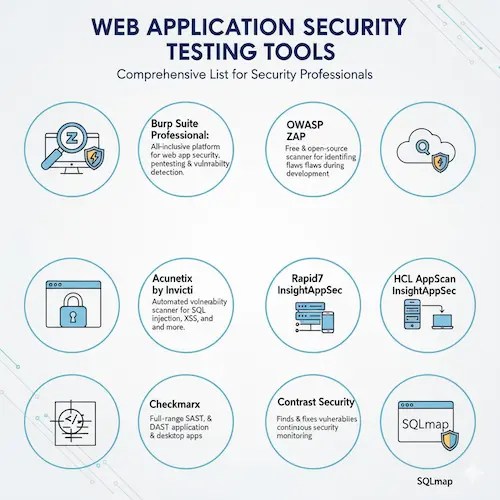
    Do you have a keen interest in learning web application security testing skills? If yes, then this article is just for you. Here, we will talk about the Top 10 Web Application Security Testing Tools that can offer you the best security environment.

    In the end, we have also mentioned one of the most renowned training providers offering a dedicated training & certification program for web application security skills. What are we waiting for? Let’s get straight to the topic!


    What Are Web Application Security Testing Tools?

    Software programs called web application security testing tools are made to find, examine, and fix security flaws in web applications. They aid in the detection of problems such as broken authentication, SQL injection, and cross-site scripting (XSS).

    Learn what are web application security testing tools at Craw Security

    Acunetix, Burp Suite, and OWASP ZAP are well-known products. Let’s talk about the Top 10 Web Application Security Testing Tools!


    Key Features for Web Application Security Testing Tools

    Following are some of the key features of web application security testing tools:

    1. Comprehensive Vulnerability Scanning: In addition to OWASP Top 10 vulnerabilities (such as SQL injection, XSS, and CSRF) and other basic security problems, the tool should be able to identify a broad variety of online application vulnerabilities.

    2. Dynamic Application Security Testing (DAST): To simulate real-world assaults and find weaknesses in the application’s runtime environment, DAST capabilities are crucial.

    3. Static Application Security Testing (SAST): Early in the development lifecycle, possible vulnerabilities can be found by analyzing source code using SAST.

    4. Integration with CI/ CD Pipelines: Automated security testing is made possible throughout the software development process through seamless integration with continuous integration and continuous delivery (CI/CD) pipelines.

    5. Accurate Reporting and Remediation Guidance: Along with concise and useful remedial instructions, the tool should include thorough and accurate reports of vulnerabilities found.

    6. API Testing Capabilities: Since APIs are becoming more and more common, the tool should be able to test API security, including data validation, authorization, and authentication.

    7. Support for Modern Web Technologies: The most recent web technologies and frameworks, such as web services, single-page applications (SPAs), and contemporary JavaScript frameworks, should be supported by the tool.

    8. Low False Positive Rate: The false positive rate of the tool must be extremely low. Security experts will save a great deal of time by doing this instead of wasting it looking into unrelated problems.


    Top 10 Web Application Security Testing Tools For 2025

    Learn about Top 10 Web Application Security Testing Tools For 2025h

    1. Burp Suite Professional:

    An all-inclusive platform for doing online application security. It has several capabilities and tools for penetration testing, vulnerability detection, and other tasks.

    2. OWASP ZAP (Zed Attack Proxy):

    A web application security scanner that is open-source and free. It works quite well at identifying flaws in web applications as they are being developed and tested.

    3. Acunetix by Invicti:

    SQL injection and cross-site scripting are only two of the many web application vulnerabilities that can be found with the aid of an automated web vulnerability scanner.

    4. Veracode:

    Offers a variety of options for application security assessment, such as software composition analysis, dynamic analysis, and static analysis.

    5. Checkmarx:

    This provides a full range of application security testing options, such as interactive application security testing (IAST), DAST, and SAST.

    6. Qualys TotalAppSec:

    Offers online application scanning as one of its cloud-based security and compliance solutions.

    7. Rapid7 InsightAppSec:

    A solution for dynamic application security testing (DAST) that finds weaknesses in web apps and APIs.

    8. HCL AppScan:

    Helps businesses find and fix vulnerabilities in their desktop, mobile, and web apps by offering application security testing solutions.

    9. Contrast Security:

    It provides solutions for IAST and runtime application self-protection (RASP), which offer ongoing security monitoring and defense.

    10. SQLmap:

    An open-source penetration testing tool that makes it easier to find and take advantage of SQL injection flaws.

    Why Web Application Security Testing Is Crucial in 2025?


    Details of Why Web Application Security Testing Is Crucial in 2025

    Web application security testing is crucial in 2025 for the following reasons:

    • Increased Sophistication of Cyberattacks: Traditional security measures are no longer adequate because cybercriminals are always creating more complex attack methods.
    • Expansion of the Attack Surface: The attack surface has grown dramatically due to the widespread use of online apps, APIs, and microservices, increasing the likelihood of exploitation.
    • Growing Reliance on Web Applications: Web apps are becoming more and more important to both individuals and businesses, which makes them easy targets for hackers.
    • Data Breaches and Compliance Requirements: Stricter data privacy laws (like GDPR) require strong security measures because data breaches can cause serious financial and reputational harm.
    • API Security Risks: To guarantee their protection, specific testing is necessary because the extensive usage of APIs creates new security flaws.
    • Rise of Cloud-Native Applications: Applications that are cloud-native provide particular security challenges that call for specific testing methods and tools.
    • Automation and CI/CD Integration: Security testing needs to be automated and incorporated into CI/CD pipelines to identify vulnerabilities early in order to keep up with rapid development cycles.
    • Evolving Threat Landscape: Continuous security testing is necessary to keep up with new threats because vulnerabilities are always being found.

    [wp_code id=”1″]


    Key Benefits of Using Web Application Security Testing Tools

    S.No. Benefits How?
    1. Prevention of Data Breaches Protects sensitive data by identifying and addressing vulnerabilities that can result in illegal access and data exfiltration.
    2. Protection of Customer Trust and Reputation Shows a dedication to security, building client trust, and avoiding reputational harm from security events.
    3. Reduced Financial Losses Prevents expensive downtime, legal costs, and fines from the government that come with security incidents and data breaches.
    4. Compliance with Regulatory Requirements Assists businesses in fulfilling regulatory requirements and industry standards like GDPR, HIPAA, and PCI DSS.
    5. Early Detection of Vulnerabilities Finds security problems early in the development process, enabling prompt rectification and lowering the expense of later vulnerability fixes.
    6. Improved Application Performance and Stability Performance snags and stability problems brought on by flaws or malicious code can be found via security testing.
    7. Enhanced Business Continuity Ensures that web apps continue to function and be available, reducing interruptions and preserving business continuity.
    8. Mitigation of Business Risk Proactively fixes security flaws that can jeopardize vital company resources and operations.

    How to Choose the Best Web Security Testing Tool?

    You can choose the right security testing tool by considering the following factors:

    1. Specific Testing Needs: Determine the necessary testing kinds (DAST, SAST, IAST, and API testing) and make sure the tool fully addresses them.
    2. Integration Capabilities: Check if the product works with the development and deployment processes you currently use, such as CI/CD pipelines and other security technologies.
    3. Accuracy and Reporting: Assess the tool’s precision in locating vulnerabilities and its capacity to deliver concise, useful results along with remedial instructions.
    4. Scalability and Performance: Examine the tool’s scalability to accommodate future requirements as well as its capacity to manage the volume and complexity of your web applications.
    5. Vendor Support and Expertise: Examine the vendor’s track record, level of support, and proficiency in web application security testing.


    Common Challenges in Web Application Security Testing

    S.No. Challenges Why?
    1. Rapidly Evolving Technologies Testers must constantly upgrade their knowledge and resources due to the rapid development of new web technologies and frameworks.
    2. Complexity of Modern Web Applications With their various microservices, APIs, and structures, modern online apps are difficult to test thoroughly.
    3. False Positives and Negatives Security testing technologies may produce false negatives, which overlook important vulnerabilities, or false positives, which waste effort.
    4. Integration with CI/ CD Pipelines It can be difficult to incorporate security testing into CI/CD pipelines that move quickly.
    5. API Security Testing It takes certain tools and knowledge to test the security of APIs, which are becoming more and more important to web applications.
    6. Maintaining Test Coverage It can be challenging to provide thorough test coverage across all program features and components.
    7. Resource Constraints Some organizations might not have the time, finances, or expertise to devote to security testing.
    8. Keeping Up with the Threat Landscape Because cyber dangers are constantly evolving, it is necessary to continuously study and adjust to new attack methods.

    Final Thoughts: Choosing the Best Tool for Your Needs

    Now that we have talked about the Top 10 Web Application Security Testing Tools, you might want to get the best testing experience from experts. For that, you can get in contact with Craw Security, one of the most reputable VAPT service providers in the IT Industry.

    Craw Security offers the best experience for Web Application Penetration Testing Services in India to several sectors working in the IT industry. They even use the latest web application security testing tools for testing the level of security measures. What are you waiting for? Contact, Now!


    Frequently Asked Questions

    About Top 10 Web Application Security Testing Tools

    1. What is web application security testing?

    The practice of assessing a web application to find security flaws and make sure it is safe from possible attacks is known as web application security testing.

    2. Why is security testing important for web applications?

    Security testing is important for web applications for the following reasons:

    1. Protection of Sensitive Data,
    2. Prevention of Financial Losses,
    3. Maintenance of User Trust,
    4. Compliance with Regulations, and
    5. Ensuring Business Continuity.

    3. Which security testing tool is best for beginners?

    Because of its user-friendly design and free, open-source nature, OWASP ZAP is frequently suggested as a fantastic place for newbies to start.

    4. Are free web security testing tools reliable?

    Although some free web security testing tools have useful capabilities, their dependability varies, and they might not have all the features and support of paid alternatives.

    5. How often should I perform web security testing?

    To handle new vulnerabilities, web security testing should be done often, ideally during the software development lifecycle and continually in production.

    6. Can automated security testing tools replace manual penetration testing?

    Because complicated vulnerability research and exploitation require human skill, automated security testing methods cannot completely replace manual penetration testing.

    7. What are the most common web application vulnerabilities?

    The following are some of the most common web application vulnerabilities:

    1. Broken Access Control,
    2. Cryptographic Failures,
    3. Injection,
    4. Cross-Site Scripting (XSS), and
    5. Security Misconfiguration.

    8. How do I choose the right security testing tool for my business?

    You can choose the right security testing tool for my business:

    1. Define Your Specific Needs,
    2. Assess Integration & Compatibility,
    3. Evaluate Accuracy & Reporting,
    4. Consider Scalability & Performance, and
    5. Evaluate Vendor Support & Expertise.

    9. Do web security testing tools affect application performance?

    Yes, by mimicking actual assaults, web security testing tools, particularly dynamic analysis tools, can impact application performance and could result in brief lags or interruptions.

    10. Which tool is used for web application security testing?

    Depending on the particular testing requirements, a variety of tools are employed, such as Acunetix, OWASP ZAP, and Burp Suite.

    11. What is the best DAST tool?

    Although the “best” DAST tool varies depending on the demands, Burp Suite Professional and Acunetix by Invicti are frequently praised for their accuracy and extensive feature set.

    12. What is the best SAST tool?

    The ultimate “best” SAST tool is a subjective decision that greatly depends on the needs of the particular company. Nonetheless, a few tools are regarded as industry leaders and frequently garner great reviews.

    13. What is the tool to check website security?

    Website security can be checked with a variety of tools that serve different purposes.

    Related Blogs

    Role of AI in Cybersecurity: Beneficial or Detrimental?
    Expert Training in Cyber Forensics Investigation 
    The 10 Essential Steps of Effective Penetration Testing
    Exploring the World of Ethical Hacking

  • What is the Role of AI in Cybersecurity? [2025]

    What is the Role of AI in Cybersecurity? [2025]

    What is the Role of AI in Cybersecurity?

    If you want to know about “What is the Role of AI in Cybersecurity?” you are at the right place. Here, we have mentioned how AI has covered most of the market right now and can be helpful & dangerous in its own way if used.

    Moreover, we have also mentioned one of the most trusted & reliable training institutes, offering a dedicated training program for IT Aspirants who want to make a career in the IT Industry with AI skills. What are we waiting for? Let’s get straight to the topic!

    What Is Artificial Intelligence?

    In cybersecurity, artificial intelligence (AI) refers to the application of sophisticated algorithms and machine learning to identify, stop, and address online threats. To find trends, irregularities, and possible weaknesses, it examines enormous volumes of data.

    AI increases overall security efficiency, automates responses, and improves threat detection. Not yet clear about “What is the Role of AI in Cybersecurity?” Let’s move forward!

    How does AI enhance threat Detection?

    In the following ways, AI enhances threat detection:

    1. Analysis Detection: AI systems can recognize anomalous trends and departures from typical behaviour in system logs, user activity, and network traffic.
    2. Pattern Recognition: AI is capable of spotting intricate relationships and patterns in large datasets, including phishing emails, malicious code, and other dangers.
    3. Real-time Analysis: Real-time security data analysis made possible by AI enables prompt threat identification and reaction.
    4. Continuous Learning: Over time, AI models’ detection capabilities will improve as they can continuously learn and adjust to new and changing threats.
    5. Reduced False Positives: Security teams can concentrate on the most important threats by using AI to help lower the number of false alarms.
    6. Improved Threat Intelligence: To better understand the threat landscape and spot new threats, AI can evaluate threat intelligence data from multiple sources.

    AI in Cybersecurity: Benefits for Businesses and Individuals

    S.No. Advantages How?
    1. Enhanced Threat Detection AI is excellent at finding minute patterns and irregularities in large datasets that humans might overlook, but that could point to a cyberattack.

    The likelihood of early detection is greatly increased by this proactive approach.

    2. Proactive Defense AI can forecast possible dangers by examining past data and present patterns. This makes it possible for both individuals and companies to proactively fortify their defenses by upgrading software, creating stronger passwords, and improving network security.
    3. Automated Response By automatically identifying and reacting to threats in real-time, AI-powered systems can lessen the impact of attacks. This covers things like alerting administrators, quarantining compromised files, and blocking malicious traffic.
    4. Improved Efficiency Repetitive tasks like patch management, vulnerability scanning, and log analysis are automated by AI. Security teams can now devote more of their valuable time to more strategic tasks like threat hunting and incident response planning.
    5. Increased Accuracy Because AI algorithms are more accurate than humans at analyzing data, there is a lower chance of false positives and negatives.

    This reduces interruptions and enhances overall security posture by guaranteeing that security resources are concentrated on real threats.

    6. Adaptability Artificial intelligence (AI) systems are constantly learning and adjusting to new and changing threats. This guarantees that defenses continue to be effective despite the constantly shifting threat landscape.
    7. Scalability Scaling AI solutions to meet the increasing complexity and volume of cyber threats is simple. This is essential since both individuals and enterprises are depending more and more on linked systems and producing vast volumes of data.
    8. Cost-Effectiveness AI can assist companies and individuals in lowering the overall cost of cybersecurity by automating processes and increasing productivity.

    This includes lower labor expenses, less downtime, and fewer expenses related to data breaches.

    AI and Real-Time Response to Cyber Attacks

    Following are the AI’s Real-Time Response to Cyber Attacks:

    • Real-time Threat Detection: Massive datasets can be analyzed in real-time by AI algorithms, which can spot possible dangers and questionable activity that humans might miss.
    • Automated Response Actions: Response actions, like severing compromised user accounts, blocking malicious IP addresses, or isolating compromised systems, can be automatically started by AI-powered systems.
    • Reduced Response Times: AI drastically cuts down on the time needed to contain and mitigate cyberattacks, reducing potential damage by automating threat detection and response.
    • Improved Incident Prioritization: Security teams can concentrate on the most important threats first thanks to AI’s ability to rank incidents according to their likelihood, impact, and severity.
    • Enhanced Incident Response Effectiveness: AI helps security teams create more focused and efficient response plans by offering insightful information about the type and extent of cyberattacks.
    • Continuous Learning and Adaptation: AI models are constantly learning from new threats and events, which enhances their capacity to identify and react to attacks in real-time.
    • Reduced Human Intervention: Numerous repetitive incident response tasks can be automated by AI, freeing up human analysts to concentrate on more complex and strategic problems.
    • Increased Visibility and Situational Awareness: Organizations can better comprehend and address new threats thanks to AI’s real-time visibility into the cyber threat landscape.

    Predictive Analytics: Preventing Threats Before They Happen

    S.No. Prevention How?
    1. Predictive Threat Modeling To anticipate possible attack vectors and targets, AI algorithms can examine vulnerability reports, historical threat data, and new trends.
    2. Vulnerability Prioritization Organizations can concentrate on the most important risks by using AI to rank vulnerabilities according to their seriousness, exploitability, and possible impact.
    3. Proactive Patch Management By automating the patching process and predicting which systems are most likely to be impacted by particular vulnerabilities, AI can reduce exposure.
    4. Phishing Attack Prediction AI can predict and stop phishing attacks before they happen by analyzing user behavior, sender information, and email content.
    5. Insider Threat Detection AI can recognize unusual patterns of behavior, such as unusual communication patterns, suspicious login attempts, and unusual data access, that could be signs of insider threats.
    6. Risk Assessment and Mitigation AI can continuously evaluate the overall risk profile of the company and suggest suitable mitigation techniques, like enforcing stricter access controls, improving network security, and regularly holding security awareness training sessions.
    7. Improved Incident Response Planning By anticipating the possible effects of various attack scenarios and determining the most important response actions, artificial intelligence (AI) can assist organizations in creating incident response plans that are more effective.
    8. Enhanced Situational Awareness Organizations can proactively modify their security posture and stay ahead of new threats by using predictive analytics, which offers insightful information about the changing threat landscape.

    Machine Learning in Cybersecurity: The Key to Continuous Improvement

    Due to the following factors, machine learning in cybersecurity is the key to continuous improvement:

    1. Continuous Learning and Adaptation: Machine learning models can continuously learn from fresh data, adjusting to changing threats and gradually increasing their accuracy.
    2. Improved Accuracy Over Time: ML models get better at identifying and thwarting cyberattacks as they process more data and come across new threats.
    3. Automated Refinement of Security Controls: Based on observed attack patterns and real-time threat intelligence, machine learning algorithms can automatically modify security controls.
    4. Proactive Identification of Emerging Threats: Massive datasets can be analyzed by ML to find minute patterns and irregularities that point to new dangers and enable preventative mitigation.
    5. Reduced Reliance on Human Intervention: Many repetitive security tasks are automated by ML, freeing up human analysts to concentrate on more intricate and strategic problems.

    AI-Powered Security Tools and Technologies

    Following are some of the AI-Powered Security Tools:

    1. Darktrace: By simulating the human immune system, this self-learning AI platform can identify and react to cyber threats instantly.
    2. Cylance: Machine learning is used by this AI-powered endpoint security platform to stop malware infections before they start.
    3. Vectra AI: Visibility into cyberattacks across hybrid environments is provided by this AI-powered threat detection and response platform.
    4. SentinelOne: Comprehensive threat detection and response capabilities are offered by this AI-powered endpoint protection platform.
    5. Cybereason: Detecting and preventing ransomware attacks is the area of expertise for this AI-powered endpoint detection and response platform.
    6. McAfee MVISION: A unified security platform for endpoint management and protection is offered by this AI-powered endpoint protection platform.
    7. Fortinet FortiAI: Threat intelligence and investigation capabilities are offered by this AI-powered security platform to assist organizations in comprehending and addressing cyber threats.
    8. CrowdStrike Falcon: Real-time threat detection and response capabilities are offered by this AI-powered endpoint security platform.
    9. Trellix: A unified security platform for managing and safeguarding networks, endpoints, and cloud environments is offered by this AI-powered security platform.
    10. Google Cloud Security Command Center: A unified view of security threats across the Google Cloud Platform is offered by this AI-powered security platform.

    Challenges of Implementing AI in Cybersecurity

    S.No. Challenges How?
    1. Data Quality and Quantity Large volumes of high-quality data are necessary for AI algorithms to be trained and function properly. It can be very difficult to gather and prepare such data.
    2. AI Integration with Legacy Systems It can be difficult and time-consuming to integrate AI-powered security tools with current legacy systems; it calls for a great deal of technical know-how and resources.
    3. Reliability and Trust Issues Concerns regarding the dependability and credibility of AI systems are raised by the fact that they occasionally yield unexpected or inaccurate results.
    4. Bias in Cybersecurity AI Algorithms Biases in the data that AI algorithms are trained on may be inherited by the algorithms, which could result in unfair or discriminatory results.
    5. Privacy and Data Security Concerns Because AI systems frequently need access to sensitive data, the use of AI in cybersecurity raises questions regarding data security and privacy.
    6. Skill Gap Professionals with the know-how to create, oversee, and protect AI-driven cybersecurity systems are in short supply.
    7. Explainability and Interpretability Many AI models are complex, making it hard to understand how they make decisions and difficult to debug and troubleshoot problems.
    8. The Arms Race An “arms race” between attackers and defenders is likely to result from cybercriminals adopting AI-based attack techniques as AI is used in cybersecurity more extensively.

    The Future of AI in Cyber Defense

    Following are some of the factors deciding the future of AI in Cyber Defense:

    1. Increased Automation: Anticipate increased automation of security tasks, ranging from incident investigation and remediation to threat detection and response.
    2. Proactive and Predictive Security: AI will be more important in anticipating and stopping cyberattacks than in responding to them after they happen.
    3. Enhanced Threat Intelligence: To provide a thorough and useful understanding of the threat landscape, artificial intelligence (AI) will be essential for evaluating and combining threat intelligence from multiple sources.
    4. AI-Driven Security Orchestration and Automation (SOAR): As SOAR platforms become more AI-powered, businesses will be able to automate intricate security processes and react to threats more quickly.
    5. AI-Powered Endpoint Security: AI will be used in increasingly complex endpoint security solutions to identify and address threats more quickly and accurately.
    6. AI-Driven Network Security: AI will be used by network security solutions to detect and stop sophisticated threats like targeted attacks and zero-day exploits.
    7. AI for Cybersecurity Workforce Augmentation: AI will enhance human security professionals’ skills by giving them useful information and resources to help them make better decisions.
    8. Focus on Ethical AI: The creation and application of ethical, open, and accountable AI systems will receive more attention.

    Conclusion

    Now that you have read about “What is the Role of AI in Cybersecurity?” you can go for a reliable training expert who can give you a better understanding of how AI works. For that, you can get in contact with Craw Security, one of the most reputed educational institutions offering a dedicated training program, “Artificial Intelligence Course in Delhi.”

    During the training sessions, students will be able to try their skills on AI-based devices under the supervision of professionals. With that, they will be facilitated with remote learning via the online sessions offered by Craw Security.

    After the completion of the Artificial Intelligence Course in Delhi offered by Craw Security, students will get a certificate validating their honed knowledge & skills during the sessions. What are you waiting for? Contact, Now!

    Frequently Asked Questions

    About What Is the Role of AI in Cybersecurity?

    1. What is the role of AI in cyber security?

    The following are the roles of AI in cybersecurity:

    1. Threat Detection,
    2. Real-time Response,
    3. Proactive Defense,
    4. Automation, and
    5. Improved Accuracy.

    2. How is artificial intelligence used in cybercrime?

    In the following ways, artificial intelligence is used in cybercrime:

    1. Automated Attacks,
    2. Enhanced Social Engineering,
    3. Vulnerability Exploitation,
    4. Evading Detection, and
    5. Developing New Attack Methods.

    3. What is responsible AI in cyber security?

    When developing and implementing AI-powered security solutions, responsible AI in cybersecurity places a high priority on equity, openness, accountability, and ethical considerations.

    4. What is the future use of AI in cyber security?

    Proactive threat prediction, automated incident response, and the application of AI to supplement human expertise will all be part of the future of AI in cybersecurity, resulting in more advanced and robust defenses.

    5. How will AI change cybersecurity?

    By facilitating proactive threat prediction, automated responses, and continuous learning, artificial intelligence (AI) will completely change cybersecurity from a reactive to a predictive and adaptive field.

    6. Is AI best for the future?

    Numerous facets of our lives could be completely transformed by AI, but its successful and advantageous integration will require ethical considerations, responsible development, and the resolution of any potential societal effects.

    7 Can AI predict cyber attacks?

    Yes, by examining past data, spotting trends, and projecting possible dangers, AI can anticipate cyberattacks and help businesses proactively fortify their defenses.

    8. Which jobs will AI replace?

    Jobs involving data entry, repetitive tasks, and predictable decision-making are likely to be automated by AI, which could affect positions in customer service, manufacturing, and transportation.

    9. What is the main challenge of using AI in cybersecurity?

    The following are the main challenges of using AI in cybersecurity:

    1. Data Quality and Quantity,
    2. Bias in AI Algorithms,
    3. Explainability and Interpretability,
    4. Integration with Existing Systems and
    5. The “Arms Race.”

    10. Is AI a risk for cyber security?

    Yes, artificial intelligence (AI) improves cybersecurity, but it also has drawbacks, such as the possibility that hackers could abuse it to create increasingly complex and evasive threats.

    11. Why is AI better than cyber security?

    Cybersecurity is not “better than” AI. They are two distinct ideas. While cybersecurity is the process of defending computer systems and networks against unwanted access or attack, artificial intelligence (AI) is the branch of computer science that seeks to build intelligent machines. While AI is a useful tool for improving cybersecurity, it cannot take the place of it.

    Related Blogs

    Unveiling the Power of Expert Training in Cyber Forensics Investigation 
    The 10 Essential Steps of Effective Penetration Testing
    Hackers with a Heart: Exploring the World of Ethical Hacking
    Unravelling Python Programming: Your Ultimate Training Course for Unmatched Coding Prowess

  • Expert Training in Cyber Forensics Investigation: A Complete Guide

    Expert Training in Cyber Forensics Investigation: A Complete Guide

    Expert Training in Cyber Forensics Investigation

    In today’s rapidly evolving digital landscape, cyber forensics investigation plays a crucial role in identifying and preventing cybercrimes. Cybercriminals are always finding new weaknesses. Because of this, organizations and governments around the world are spending a lot on cyber forensics training. This training helps protect digital systems and keeps digital evidence safe.

    What is Cyber Forensics?

    Cyber forensics, or computer forensics, is the process of gathering, studying, and keeping digital evidence. This helps to find out about cyber incidents and supports legal cases. It aims to:

    Learn about What is cyber forensics? Craw Security

    1. Identify how the cyberattack happened
    2. Recover deleted or hidden data
    3. Maintain a clear chain of custody
    4. Ensure admissibility of digital evidence in court

    Related Read: What is Cyber Forensics? Importance, Skills & Careers

    Common sources of digital evidence include:

    1. Log files
    2. Browser history
    3. Network traffic data
    4. Emails and attachments
    5. File timestamps and metadata

    Why Expert Training in Cyber Forensics is Critical?

    With the rise of cybercrimes such as identity theft, data breaches, and ransomware, skilled forensic professionals are in high demand. Expert training in cyber forensics prepares individuals to:

    1. Investigate complex security incidents
    2. Handle sensitive digital evidence securely
    3. Work with legal and law enforcement agencies
    4. Adapt to rapidly evolving threats

    This training goes far beyond basic IT knowledge. It equips professionals with hands-on expertise in tools, techniques, and legal protocols.

    Key Components of Cyber Forensics Training Programs

    A comprehensive cyber forensics training program covers a wide range of topics, including

    • Digital evidence collection and preservation
    • Data recovery methodologies
    • Legal and ethical considerations in cyber forensics
    • Hands-on exercises and real-world simulations

    These programs train trainees to manage the challenges of cyber investigations. They ensure that trainees are ready for real-world problems.

    Benefits of Expert Training in Cyber Forensics

    Investing in cyber forensics training offers numerous advantages:

    1. Enhanced Accuracy in Digital Evidence Analysis: Rigorous training minimizes the risk of evidence tampering and mishandling.
    2. Improved Threat Identification: Professionals learn to trace even the most sophisticated cyber threats.
    3. Increased Credibility: Properly trained experts can present findings confidently in legal settings.

    Industry Demand for Cyber Forensics Professionals

    The demand for cyber forensics experts has skyrocketed due to the alarming increase in cybercrimes. From ransomware attacks to data theft, organizations across sectors are seeking skilled professionals to protect their digital assets. Career opportunities include roles such as:

    • Digital investigators
    • Forensic analysts
    • Cybersecurity consultants

    Certified experts play a critical role in high-profile cybercrime cases, ensuring cybercriminals are brought to justice.

    Conclusion: The Future of Cyber Forensics

    In a world driven by digital data, expert training in cyber forensics is no longer optional—it’s essential. Whether you’re starting your career in cybersecurity or upskilling for advanced roles, investing in a reputable cyber forensics training program will help you stay ahead of evolving cyber threats and build a future-proof career.

    FAQs

    1. What is a cyber forensics investigation?

    cyber forensics investigation involves collecting and analyzing digital evidence to solve cybercrimes and support legal proceedings.

    2. Why is expert training essential in cyber forensics?

    Expert training ensures professionals can handle digital evidence accurately, minimize tampering risks, and identify sophisticated cyber threats.

    3. What types of digital evidence are collected in cyber forensics?

    Common types include log files, metadata, network traffic, and files.

    4. What challenges do evolving cyber threats pose?

    Cyber threats constantly evolve, requiring professionals to adapt quickly to new methods and tools used by criminals.

    5. What career opportunities exist in cyber forensics?

    Professionals can work in law enforcement, corporate sectors, cybersecurity firms, and high-profile cybercrime cases.

    6. How do training programs cater to different skill levels?

    Programs range from beginner courses to advanced specializations, accommodating diverse skill levels.

    7. What strategies help professionals stay updated?

    Continuous learning, attending workshops, and staying informed about industry developments are key.

  • Top 10 Essential Steps of Effective Penetration Testing 2025

    Top 10 Essential Steps of Effective Penetration Testing 2025

    Top 10 Essential Steps of Effective Penetration Testing

    In today’s evolving cyber threat landscape, penetration testing (pentesting) is no longer optional—it’s a necessity. This guide breaks down the 10 essential steps of effective penetration testing, helping organizations identify vulnerabilities before hackers exploit them.

    What is Penetration Testing? (Definition & Importance)

    Penetration testing (pentesting) is a simulated cyberattack conducted by ethical hackers to identify security weaknesses in networks, applications, and systems.

    Why It Matters in 2025:

    ✔ Prevents costly data breaches
    ✔ Ensures compliance (GDPR, HIPAA, PCI DSS)
    ✔ Strengthens cybersecurity posture

    Understanding the Penetration Testing Process

    The penetration testing process is divided into several distinct stages, each with its specific objectives and methodologies. These stages ensure a structured and thorough approach to identifying weaknesses in a system.

    1. Planning and Reconnaissance
      Before any testing takes place, meticulous planning is essential. This involves defining the scope of the test, setting objectives, and determining the rules of engagement. The reconnaissance phase involves gathering information about the target, such as its architecture, technology stack, and potential vulnerabilities.
    1. Scanning
      In this phase, the penetration tester scans the target network to identify open ports, services, and potential entry points. This is a crucial step in understanding the network’s architecture and potential attack vectors.
    1. Gaining Access
      Once vulnerabilities are identified, the penetration tester attempts to exploit them to gain unauthorized access to the system. This phase involves various techniques, including exploiting known vulnerabilities, using password attacks, and leveraging social engineering tactics.
    1. Maintaining Access
      Gaining initial access is only the beginning. Skilled attackers aim to maintain persistence within the system to continue their malicious activities. The penetration tester replicates this behavior to identify weak points in the organization’s defense strategies.
    1. Analysis and Reporting
      After the penetration testing is complete, a thorough analysis of the findings is conducted. This analysis involves assessing the impact of compromised systems, identifying sensitive data at risk, and mapping the network. A comprehensive report is then generated to communicate the findings to stakeholders.

    Setting the Stage for a Successful Test

    For a successful penetration test, several foundational elements must be established.

    1. Establishing Clear Objectives
      Defining clear and measurable objectives ensures that the testing process aligns with the organization’s goals and priorities. These objectives provide a roadmap for the entire testing process.
    1. Identifying Scope and Limitations
      Clearly defining the scope of the test helps focus efforts on specific areas of concern. This prevents unnecessary disruptions and ensures that the test remains relevant to the organization’s needs.
    1. Defining Rules of Engagement
      Rules of engagement outline the boundaries of the penetration test. This includes specifying which systems can be tested, which techniques can be used, and the extent to which the system can be exploited.

    Gathering Intelligence: Planning and Reconnaissance

    The planning and reconnaissance phase sets the stage for a successful penetration test.

    Researching the Target
    Thoroughly researching the target is essential. This involves collecting information about the organization’s infrastructure, technology stack, and potential vulnerabilities.

    Identifying Potential Vulnerabilities
    Understanding the potential vulnerabilities in the target’s systems and applications is a critical step. This can involve analyzing software versions, configurations, and historical vulnerabilities.

    Analyzing Attack Surfaces
    Mapping out the organization’s attack surfaces helps identify potential points of entry for attackers. This includes identifying exposed services, open ports, and potential weak spots in the network.

    Scanning the Terrain: Network and Vulnerability Scanning

    Network and vulnerability scanning provide insights into the organization’s security posture.

    Conducting Network Reconnaissance
    Network reconnaissance involves gathering information about the organization’s network architecture, IP addresses, and domain structure. This information is crucial for identifying potential entry points.

    Identifying Open Ports and Services
    Scanning tools are used to identify open ports and services on the target network. This information helps penetration testers understand the attack surface and potential avenues for exploitation.

    Utilizing Vulnerability Scanning Tools
    Vulnerability scanning tools automate the process of identifying known vulnerabilities in the target’s systems. These tools provide a comprehensive view of potential weaknesses that could be exploited by attackers.

    Maintaining Access for Deeper Exploration

    Maintaining access is crucial for understanding the potential impact of a successful attack.

    Evading Detection

    Skilled attackers often aim to remain undetected within a compromised system. Penetration testers replicate this behavior to identify potential blind spots in the organization’s monitoring and detection mechanisms.

    Establishing Persistence

    Maintaining persistence involves ensuring that unauthorized access to the system persists even after security measures are applied. This mimics the behavior of advanced attackers who seek to maintain control over compromised systems.

    Privilege Escalation

    Privilege escalation is the process of gaining higher levels of access within a system. Penetration testers assess the organization’s ability to detect and mitigate privilege escalation attempts.

    Analyzing the Battlefield: Post-Exploitation Analysis

    Post-exploitation analysis provides insights into the potential impact of a successful attack.

    Assessing the Value of Compromised Systems

    Understanding the value of compromised systems helps organizations prioritize their response efforts. Penetration testers assess the potential consequences of a successful attack on different systems.

    Identifying Sensitive Data at Risk

    Sensitive data is a prime target for attackers. Penetration testers identify where sensitive data is stored, assess its security measures, and determine the ease of access for attackers.

    Mapping the Network

    Mapping the network provides a visual representation of the organization’s infrastructure. This includes identifying interconnected systems, communication pathways, and potential points of lateral movement for attackers.

    Choosing the Right Penetration Testing Tools

    The choice of tools significantly impacts the effectiveness of a penetration test.

    1. Overview of Popular Penetration Testing Tools
      Penetration testers have a wide array of tools at their disposal. These tools include network scanners, vulnerability assessment tools, and exploitation frameworks.
    2. Selecting Tools Based on Test Objectives
      The choice of tools depends on the objectives of the penetration test. Different tools are suited for specific types of testing, such as web application testing or network infrastructure assessment.
    3. Ensuring Tool Proficiency and Accuracy
      Proficiency in using penetration testing tools is essential for accurate results. Misconfigurations or errors in tool usage can lead to false positives or false negatives.

    Penetration Testing vs. Vulnerability Assessment

    Penetration testing and vulnerability assessment serve different purposes within a cybersecurity strategy.

    Distinguishing Between the Two

    While penetration testing involves simulating real-world attacks to identify vulnerabilities, vulnerability assessment focuses on identifying and categorizing vulnerabilities.

    Understanding Their Complementary Roles

    Penetration testing and vulnerability assessment complement each other. Vulnerability assessment provides a snapshot of the organization’s security posture, while penetration testing assesses its resilience to active attacks.

    When to Use Each Approach

    Penetration testing is typically conducted less frequently than vulnerability assessments. Organizations may use penetration testing to validate the effectiveness of security measures after major changes to their systems.

    Benefits of Regular Penetration Testing

    Regular penetration testing offers numerous benefits for organizations seeking to bolster their cybersecurity defenses.

    Continuous Security Improvement

    Regular testing helps organizations identify vulnerabilities and weaknesses over time, leading to continuous security improvement.

    Cost-Effectiveness in the Long Run

    Investment in regular penetration testing can prevent costly data breaches and security incidents. The upfront costs of testing are often significantly lower than the financial and reputational costs of a successful cyberattack.

    Meeting Compliance Requirements

    Many regulatory frameworks require organizations to conduct penetration testing as part of their cybersecurity measures. Regular testing helps organizations remain compliant with industry regulations.

    Frequently Asked Questions (FAQs)

    Q1: What is penetration testing?

    Penetration testing, or pen testing, is a proactive cybersecurity practice. It simulates real-world attacks on systems, networks, or applications. The goal is to find vulnerabilities and weaknesses. The goal is to uncover potential entry points that malicious actors could exploit and provide recommendations for strengthening security.

    Q2: How often should penetration tests be conducted?

    The frequency of penetration testing depends on several factors. These include the organization’s risk profile, industry rules, and changes in the IT environment. Generally, annual testing is recommended, but high-risk environments or those undergoing frequent changes may require more frequent assessments.

    Q3: Can penetration testing guarantee 100% security?

    No security measure can guarantee absolute security. Penetration testing significantly reduces the risk of breaches by identifying vulnerabilities, but it cannot eliminate all potential threats. It provides valuable insights to enhance security measures and minimize the attack surface.

    Q4: Is penetration testing suitable for small businesses?

    Absolutely. Penetration testing is relevant for businesses of all sizes. Small businesses may have limited resources, but identifying vulnerabilities and addressing them can prevent significant financial losses and reputational damage. Tailored testing can align with their specific needs and risk levels.

    Q5: What qualifications should a penetration tester have?

    Penetration testers should possess a combination of technical skills, cybersecurity knowledge, and ethical hacking expertise. Certifications like Certified Ethical Hacker (CEH) and Offensive Security Certified Professional (OSCP) are widely recognized in the industry and demonstrate the tester’s competence.

    Q6: What is the role of ethical considerations in penetration testing?

    Ethical considerations are fundamental in penetration testing. Ethical hackers follow a strict code of ethics that govern their behavior. This includes obtaining proper authorization before testing, respecting privacy, disclosing vulnerabilities responsibly, and acting in the best interests of the organization.

    Q7: How do penetration testers choose their tools?

    Penetration testers select tools based on the objectives of the test. Different tools cater to specific types of testing, such as network scanning or web application assessment. The choice depends on the target’s technology stack and the desired outcomes.

    Q8: What’s the difference between penetration testing and vulnerability assessment?

    Penetration testing involves actively exploiting vulnerabilities to assess the organization’s response to attacks. A vulnerability assessment, on the other hand, focuses on identifying and categorizing vulnerabilities without exploiting them. The two practices complement each other in providing a comprehensive security assessment.

    Q9: How can organizations benefit from regular penetration testing?

    Regular penetration testing offers continuous security improvement by identifying vulnerabilities, assessing their impact, and recommending remediation measures. It is cost-effective in the long run as it prevents potential financial losses from successful cyberattacks and helps organizations meet compliance requirements.

    Q10: What are some future trends in penetration testing?

    The penetration testing field is evolving with technology. Trends include the integration of artificial intelligence and machine learning to automate tasks, address advanced threats, and enhance accuracy. As new technologies emerge, penetration testers must adapt to anticipate and mitigate novel threat vectors.

    Conclusion: Secure Your Systems in 2025

    Penetration testing is not a one-time task—it’s an ongoing security practice. By following these 10 essential steps, organizations can stay ahead of cybercriminals.

    Need a pentest? Get a free consultation with our certified ethical hackers today!

  • Java Course Journey in India 2024

    Java Course Journey in India 2024

    Level Up Your Tech Skills: Your Guide to Java Course Journey in India

    Java’s the king of coding in India, and for good reason! It lets you build awesome apps and lands you great jobs. Thinking about learning Java? This guide will help you navigate your journey from a newbie to a Java jitsu master (okay, maybe just a skilled developer).

    Why Java? It Rocks!

    • Works Everywhere: Write code once, and use it anywhere! Perfect for India’s diverse tech scene.
    • Tons of Resources: Java has a ton of helpful tools and a friendly online community to guide you.
    • Great Career Choice: Java developers are high in demand, opening doors to exciting careers.

    Your Java Course Path: Beginner to Boss

    • Newbie Ninja: Start with the basics: data types, coding rules, and those cool object-oriented things (classes and objects). Find a course with a mix of learning and doing.
    • Java Warrior: Conquer advanced topics like fancy program tricks (inheritance, polymorphism) and working with databases. Build your mini-apps to show off your skills.
    • Java Master: Ready for the big leagues? Master multithreading and web development, and score certifications to prove you’re the real deal.

    Learning Your Way: Finding the Perfect Fit

    • Classroom Champion: Structured learning with teachers is great for group learners.
    • Online Hero: E-learning platforms offer flexibility to learn at your own pace.
    • Bootcamp Blitz: Fast-paced programs focus on practical skills and projects.
    • DIY Dojo: For the self-motivated, there are tons of online resources to teach yourself.

    Tips to Become a Java Master

    • Learn How You Learn: Find a teaching style that works for you—videos, books, or lectures.
    • Practice Makes Perfect: Coding is like a sport; the more you do it, the better you get.
    • Find Your Tribe: Online communities and forums are great for connecting with fellow learners and getting help.
    • Build Stuff!: Don’t just learn; put your skills to the test by creating mini-programs.
    • Embrace the Challenge: Getting stuck is part of learning. Keep at it, and you’ll solve those coding puzzles!

    Java Course Journey in India: Frequently Asked Questions

    Why is Java such a popular programming language in India?

    Java’s popularity in India stems from several factors:

    • Platform Independence: “Write Once, Run Anywhere” (WORA) allows code to run on various platforms, making it ideal for India’s diverse tech landscape.
    • Vast Ecosystem: Java boasts a wealth of libraries, frameworks, and a supportive online community, easing the learning curve.
    • Lucrative Career Path: Java developers are in high demand, offering graduates promising job opportunities.

    What are the different learning paths available for Java courses in India?

    There’s a learning path for everyone! Here are some popular options:

    • Classroom Learning: Structured courses with instructors are perfect for those who thrive in a group environment.
    • Online Learning Platforms: Flexible and self-paced, online platforms offer video lectures, interactive exercises, and quizzes.
    • Coding Bootcamps: Intensive programs provide a fast-paced, deep dive into practical Java skills and project building.
    • Self-Learning: Highly motivated individuals can leverage online tutorials, documentation, and open-source projects.

    What are some helpful tips for succeeding in my Java learning journey?

    Here are some pointers to becoming a Java master:

    • Know Your Learning Style: Identify what works best for you—video tutorials, interactive platforms, textbooks, or in-person lectures.
    • Practice Makes Perfect: Regular coding practice is crucial. Work on personal projects, coding challenges, or contribute to open-source initiatives.
    • Join the Community: Connect with fellow learners and experienced Java developers through online forums and communities. They can offer valuable insights and support.
    • Build Your Portfolio: Showcase your skills by creating mini-applications or projects that demonstrate your Java proficiency.
    • Embrace Challenges: Getting stuck is inevitable. Don’t give up! Use online resources and forums, or reach out to mentors for help.

    How long does it take to learn Java?

    The timeframe depends on your learning style, dedication, and prior programming experience.

    • Beginners can grasp the foundational concepts in a few months with consistent effort.
    • Building mastery of advanced topics and frameworks might take up to a year or more.
    • Remember, learning is a continuous process. Even experienced developers keep learning new things!

    Are there any certifications I should consider pursuing?

    While not mandatory, Java certifications can validate your skills and enhance your resume. Popular options include:

    • Oracle Certified Java Programmer (OCJP)
    • Java SE 11 Programmer I Exam

    These certifications demonstrate your proficiency in core Java concepts and can be valuable assets in your job search.

    Related Blogs

    Hackers with a Heart: Exploring the World of Ethical Hacking
    Python Programming: Your Ultimate Training Course
    Mastering AWS Cloud Security Course in Laxmi Nagar
    The Ultimate AWS Associate Training Course in Laxmi Nagar